AQA · A-Level · Psychology
Course version: 7182-2025 · Exams from 2027
Offender profiling: the typology approach, including organised and…
Full specification wording
Forensic Psychology: Offender profiling: the typology approach, including organised and disorganised types; the data-driven approach, including investigative Psychology; geographical profiling.
Offender profiling aims to narrow down suspect lists by predicting offender characteristics from crime scene evidence.
Checked against the AQA 7182-2025 specification (opens in a new tab) on .
- Point 1 of 4
- 4 key terms
Study notes
From the checked teaching notes for this specification point.
The idea
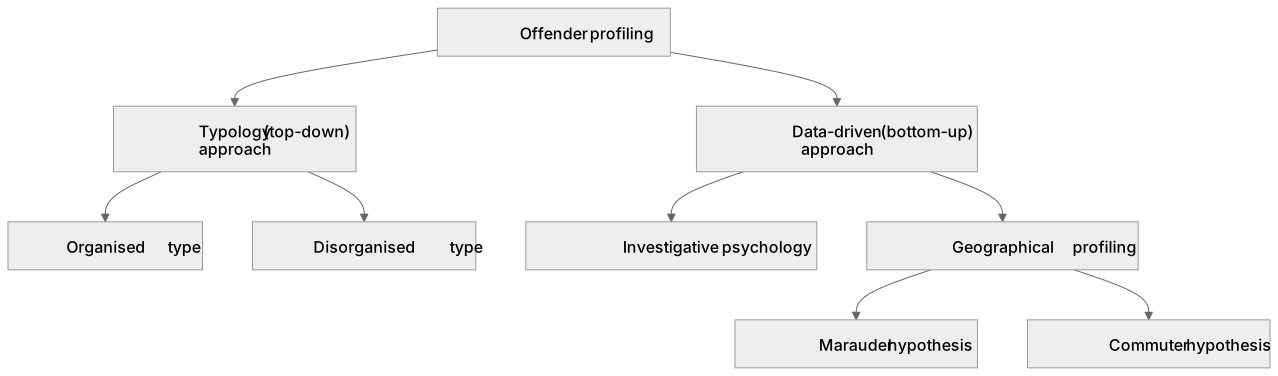
Offender profiling aims to narrow down suspect lists by predicting offender characteristics from crime scene evidence. The American typology (top-down) approach classifies offenders as organised (socially competent, planning crimes, targeting victims) or disorganised (spontaneous, leaving evidence, socially inadequate) based on FBI interviews with serial killers. Conversely, the British data-driven (bottom-up) approach uses statistical analysis of crime data. This includes investigative psychology, which establishes patterns like interpersonal coherence (how offenders treat victims reflects their everyday behaviour), and geographical profiling, which analyses spatial patterns of crime locations to predict the offender's base (the marauder or commuter hypotheses).
What earns the marks
- Distinguish between the top-down (typology) approach based on FBI templates and the bottom-up (data-driven) approach based on statistical databases.
- Describe characteristics of organised offenders (e.g., high intelligence, skilled occupation) versus disorganised offenders (e.g., low intelligence, socially isolated).
- Explain investigative psychology concepts such as interpersonal coherence, forensic awareness, and smallest space analysis.
- Outline geographical profiling principles, specifically spatial consistency, circle theory, and the distinction between marauders and commuters.
Common mistakes and how to put them right
Confusing the origins of the approaches.
Put it right: The typology approach is American (FBI), whereas the data-driven approach is British (Canter).
Assuming offenders strictly fit one typology.
Put it right: Acknowledge that offenders can exhibit both organised and disorganised traits, making the dichotomy overly simplistic.
Misunderstanding interpersonal coherence; correction: it does not mean the offender is coherent or logical, but rather that their behaviour at the crime scene mirrors their everyday social interactions.
Exam tips
- Use specific terminology like 'interpersonal coherence' and 'spatial consistency' when evaluating the bottom-up approach to access higher mark bands.
- When evaluating the top-down approach, reference the methodological flaws of the original FBI sample (small, unrepresentative group of 36 serial killers).
- Compare the two approaches directly in essay questions, highlighting how the bottom-up approach is considered more scientific and objective than the top-down approach.
Try the lesson
The start of the Forensic Psychology: Offender profiling: the typology approach, including organised and disorganised types; the data-driven approach, including investigative Psychology; geographical profiling. lesson, made from checked teaching notes for this specification point.
Have a go first
According to the FBI's typology approach to offender profiling, which of the following is a characteristic typically associated with a disorganised offender?
Listen
Offender profiling aims to narrow down suspect lists by predicting offender characteristics from crime scene evidence. The American typology (top-down) approach classifies offenders as organised (socially competent, planning crimes, targeting victims) or disorganised (spontaneous, leaving evidence, socially inadequate) based on FBI interviews with serial killers. Conversely, the British data-driven (bottom-up) approach uses statistical analysis of crime data. This includes investigative psychology, which establishes patterns like interpersonal coherence (how offenders treat victims reflects their everyday behaviour), and geographical profiling, which analyses spatial patterns of crime locations to predict the offender's base (the marauder or commuter hypotheses). A strong answer earns marks for these points. Distinguish between the top-down (typology) approach based on FBI templates and the bottom-up (data-driven) approach based on statistical databases. Describe characteristics of organised offenders (e.g., high intelligence, skilled occupation) versus disorganised offenders (e.g., low intelligence, socially isolated). Explain investigative psychology concepts such as interpersonal coherence, forensic awareness, and smallest space analysis. Outline geographical profiling principles, specifically spatial consistency, circle theory, and the distinction between marauders and commuters. A common slip: Confusing the origins of the approaches. Instead, the typology approach is American (FBI), whereas the data-driven approach is British (Canter). Exam tip: Use specific terminology like 'interpersonal coherence' and 'spatial consistency' when evaluating the bottom-up approach to access higher mark bands.
See it
Key words
Say what each word means before you turn the card.
Typology approach
Try answering aloud or in your head before turning the card.
Data-driven approach
Try answering aloud or in your head before turning the card.
Investigative psychology
Try answering aloud or in your head before turning the card.
Geographical profiling
Try answering aloud or in your head before turning the card.
See every definition
- Typology approach
- Classifies offenders as organised or disorganised types based on FBI interviews with serial killers.
- Data-driven approach
- Uses statistical analysis of crime data, including investigative psychology and geographical profiling.
- Investigative psychology
- Establishes patterns such as interpersonal coherence, where how offenders treat victims reflects their everyday behaviour.
- Geographical profiling
- Analyses spatial patterns of crime locations to predict the offender's base, using the marauder or commuter hypotheses.
Label the diagram
Some boxes have lost their names. Pick the right name for each number.
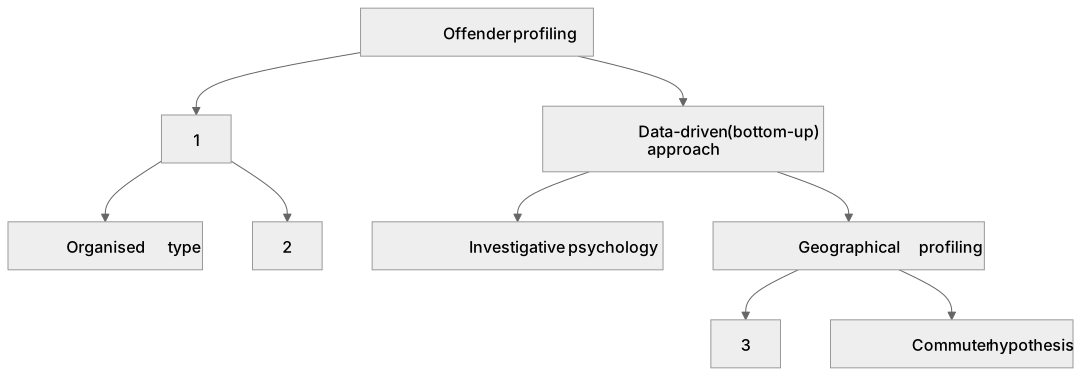
1Box 1
2Box 2
3Box 3
There is more to this lesson
The full lesson goes on to check your understanding and help you earn the marks. Create a free account to carry on, with your progress saved.
A week of Premium from your first lesson · Then the free plan continues · No card, no charge
Test your understanding of Forensic Psychology: Offender profiling: the typology approach, including organised and disorganised types; the data-driven approach, including investigative Psychology; geographical profiling.
Active recall beats re-reading. Take an instant quiz now to test what you’ve learned and lock it into long-term memory.
A week of Premium from your first lesson · Then the free plan continues · No card, no charge