AQA · A-Level · Psychology
Course version: 7182-2025 · Exams from 2027
Make order of magnitude calculations (to include: estimating the mean test…
Full specification wording
Handling data: Make order of magnitude calculations (to include: estimating the mean test score for a large number of participants on the basis of the total overall score)
An order-of-magnitude calculation estimates the scale of a value using powers of ten and provides a quick plausibility check.
Checked against the AQA 7182-2025 specification (opens in a new tab) on .
- Point 10 of 17
- 4 key terms
Study notes
From the checked teaching notes for this specification point.
The idea
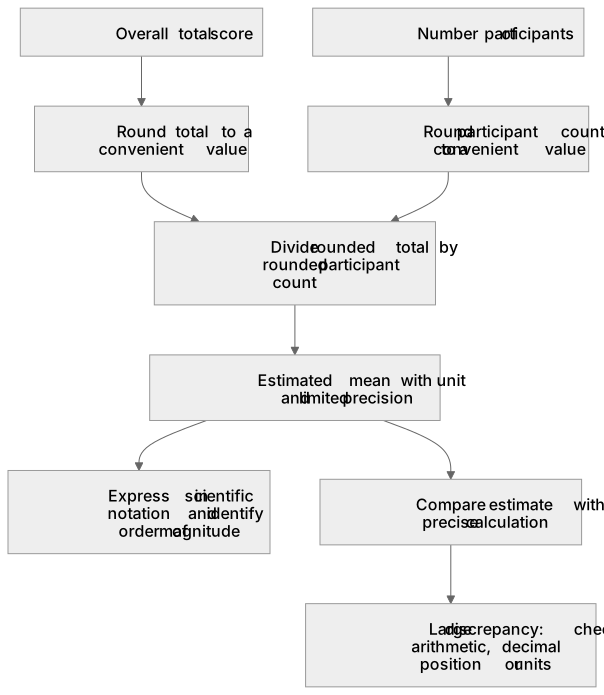
An order-of-magnitude calculation estimates the scale of a value using powers of ten and provides a quick plausibility check. To estimate a mean, divide the overall total by the number of participants after rounding both to convenient values. For example, 4,850 words recalled by 97 participants is approximately 5,000 divided by 100, or 50 words per participant. In scientific notation this is $5 × 10^1$, so its order of magnitude is $10^1$. Compare the estimate with the precise calculation: a large discrepancy signals that the arithmetic, decimal position or units should be checked. An estimate is deliberately approximate, so report it with an appropriate unit and limited precision.
What earns the marks
- State the method: the estimated mean is the rounded overall total divided by the rounded number of participants.
- Round sensibly to make the division easy, for example treating 4,850 as about 5,000 and 97 as about 100 to obtain about 50 per participant.
- Giving the answer with its unit and to a sensible accuracy, such as about 50 words recalled per participant, rather than an unlabelled figure.
- Use scientific notation to identify scale: 50 is $5 × 10^1$, so its order of magnitude is $10^1$.
- Use the estimate to check a calculated result and investigate discrepancies in arithmetic, decimal position or units rather than assuming one cause.
Common mistakes and how to put them right
Dividing the number of participants by the total score instead of the other way round, which gives a fraction of a word per person and is never a sensible mean.
Rounding so hard that the estimate stops being informative, such as calling 97 participants one hundred and a total of 4,850 ten thousand, then reporting a mean of one hundred.
Writing the estimate with no working, which hides whether the total was divided by the participant count in the correct direction.
Dropping the unit, so a mean reported as 50 could be seconds, words recalled or percent and means nothing on its own.
Exam tips
- Read the table heading carefully to decide whether the total belongs to one participant or to the full sample before estimating the mean.
- Show the rounded values and the division so the method can be followed and checked.
- If the command says estimate, use sensible rounding and avoid reporting a long string of calculator decimals.
- Use the estimate to check the precise result, then reconsider the operation, decimal position and units if their scales differ substantially.
Try the lesson
The start of the Handling data: Make order of magnitude calculations (to include: estimating the mean test score for a large number of participants on the basis of the total overall score) lesson, made from checked teaching notes for this specification point.
Have a go first
A national survey of 4123 students yields a total combined well-being score of 79,850. By rounding the total score and the number of participants to one significant figure, what is the estimated mean well-being score?
Listen
An order-of-magnitude calculation estimates the scale of a value using powers of ten and provides a quick plausibility check. To estimate a mean, divide the overall total by the number of participants after rounding both to convenient values. For example, 4,850 words recalled by 97 participants is approximately 5,000 divided by 100, or 50 words per participant. In scientific notation this is 5 × 10^1, so its order of magnitude is 10^1. Compare the estimate with the precise calculation: a large discrepancy signals that the arithmetic, decimal position or units should be checked. An estimate is deliberately approximate, so report it with an appropriate unit and limited precision. A strong answer earns marks for these points. State the method: the estimated mean is the rounded overall total divided by the rounded number of participants. Round sensibly to make the division easy, for example treating 4,850 as about 5,000 and 97 as about 100 to obtain about 50 per participant. Giving the answer with its unit and to a sensible accuracy, such as about 50 words recalled per participant, rather than an unlabelled figure. Use scientific notation to identify scale: 50 is 5 × 10^1, so its order of magnitude is 10^1. Exam tip: Read the table heading carefully to decide whether the total belongs to one participant or to the full sample before estimating the mean.
See it
Key words
Say what each word means before you turn the card.
order of magnitude estimation
Try answering aloud or in your head before turning the card.
mean from a total score
Try answering aloud or in your head before turning the card.
powers of ten
Try answering aloud or in your head before turning the card.
plausibility checking of results
Try answering aloud or in your head before turning the card.
See every definition
- order of magnitude estimation
- An order-of-magnitude calculation estimates the scale of a value using powers of ten and provides a quick plausibility check.
- mean from a total score
- To estimate a mean, divide the overall total by the number of participants after rounding both to convenient values.
- powers of ten
- Scientific notation expresses a value such as 50 as 5 × 10^1, so its order of magnitude is 10^1.
- plausibility checking of results
- Compare the estimate with the precise calculation: a large discrepancy signals that the arithmetic, decimal position or units should be checked.
Label the diagram
Some boxes have lost their names. Pick the right name for each number.
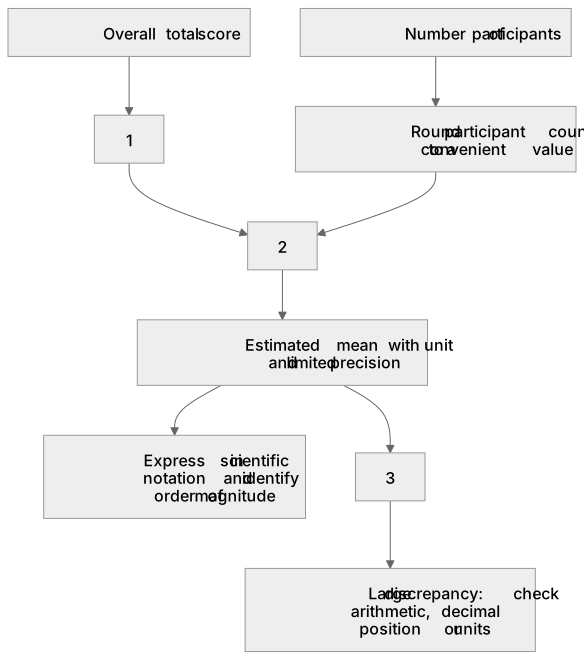
1Box 1
2Box 2
3Box 3
There is more to this lesson
The full lesson goes on to check your understanding and help you earn the marks. Create a free account to carry on, with your progress saved.
A week of Premium from your first lesson · Then the free plan continues · No card, no charge
Test your understanding of Handling data: Make order of magnitude calculations (to include: estimating the mean test score for a large number of participants on the basis of the total overall score)
Active recall beats re-reading. Take an instant quiz now to test what you’ve learned and lock it into long-term memory.
A week of Premium from your first lesson · Then the free plan continues · No card, no charge