AQA · A-Level · Psychology
Course version: 7182-2025 · Exams from 2027
Use an appropriate number of significant figures (to include: expressing a…
Full specification wording
Handling data: Use an appropriate number of significant figures (to include: expressing a correlation coefficient to two or three significant figures)
Significant figures are counted from the first non-zero digit.
Checked against the AQA 7182-2025 specification (opens in a new tab) on .
- Point 1 of 17
- 3 key terms
Study notes
From the checked teaching notes for this specification point.
The idea
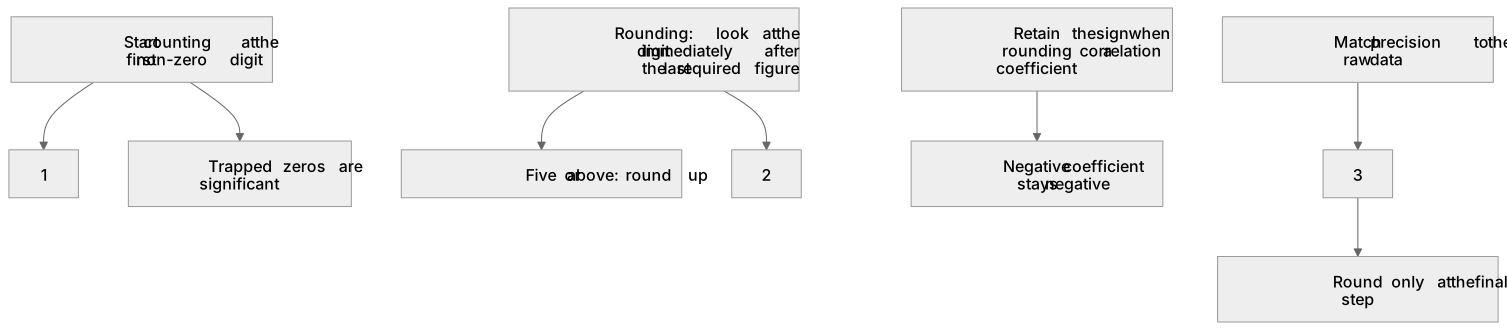
Significant figures are counted from the first non-zero digit. In 0.0468, the leading zeros are placeholders, so the significant digits are four, six, and eight. Rounding depends on the digit following the last required figure: five or above rounds up, while four or below remains unchanged. A correlation coefficient of 0.74613 is expressed as 0.75 to two significant figures or 0.746 to three significant figures. The sign is retained, so a negative coefficient remains negative (e.g. -0.74613 becomes -0.75). Precision should reflect the raw data; for example, whole-word recall scores justify a mean of 9.3, not 9.3125. Always use an appropriate number of significant figures for the context, leaving unrounded values in your working.
What earns the marks
- Counting significant figures: Start counting from the first non-zero digit. For example, 0.0724 has three significant figures, while 1.05 also has three because trapped zeros are significant.
- Rounding a correlation coefficient: To express a coefficient to two significant figures, look at the third figure. For instance, 0.6349 becomes 0.63 to two significant figures and 0.635 to three significant figures.
- Retaining the sign: A negative correlation coefficient must keep its minus sign when rounded, as it indicates the direction of the relationship (e.g., -0.6349 becomes -0.63 to two significant figures).
Common mistakes and how to put them right
Counting leading zeros as significant figures.
Put it right: Start counting from the first non-zero digit, so 0.045 has two significant figures, not four.
Rounding in multiple stages (e.g., rounding 0.7449 to 0.745, then to 0.75).
Put it right: Look only at the digit immediately following the required number of significant figures; 0.7449 rounds directly to 0.74 to two significant figures.
Confusing significant figures with decimal places.
Put it right: Recognise that these are different rules; for example, 0.0083 is given to two significant figures, but it is given to four decimal places.
Exam tips
- Always read the question carefully to check if it specifies expressing your calculated correlation coefficient to two or three significant figures, and format your final answer exactly as requested.
- When calculating statistical values, keep unrounded numbers in your calculator or working out, and only round to the appropriate number of significant figures at the very final step to avoid compounding rounding errors.
Try the lesson
The start of the Handling data: Use an appropriate number of significant figures (to include: expressing a correlation coefficient to two or three significant figures) lesson, made from checked teaching notes for this specification point.
Have a go first
A psychologist conducts a correlational study and calculates a correlation coefficient of r = 0.846. What is this value expressed to two significant figures?
Listen
Significant figures are counted from the first non-zero digit. In 0.0468, the leading zeros are placeholders, so the significant digits are four, six, and eight. Rounding depends on the digit following the last required figure: five or above rounds up, while four or below remains unchanged. A correlation coefficient of 0.74613 is expressed as 0.75 to two significant figures or 0.746 to three significant figures. The sign is retained, so a negative coefficient remains negative (e.g. -0.74613 becomes -0.75). Precision should reflect the raw data; for example, whole-word recall scores justify a mean of 9.3, not 9.3125. Always use an appropriate number of significant figures for the context, leaving unrounded values in your working. A strong answer earns marks for these points. Counting significant figures: Start counting from the first non-zero digit. For example, 0.0724 has three significant figures, while 1.05 also has three because trapped zeros are significant. Rounding a correlation coefficient: To express a coefficient to two significant figures, look at the third figure. For instance, 0.6349 becomes 0.63 to two significant figures and 0.635 to three significant figures. Retaining the sign: A negative correlation coefficient must keep its minus sign when rounded, as it indicates the direction of the relationship (e.g., -0.6349 becomes -0.63 to two significant figures). Using an appropriate number of significant figures: Match the precision of calculated answers to the raw data. Reporting a mean as 12.40625 seconds when raw data is in whole seconds represents false precision; 12.4 seconds is appropriate. A common slip: Counting leading zeros as significant figures. Instead, Start counting from the first non-zero digit, so 0.045 has two significant figures, not four. Exam tip: Always read the question carefully to check if it specifies expressing your calculated correlation coefficient to two or three significant figures, and format your final answer exactly as requested.
See it

Key words
Say what each word means before you turn the card.
significant figures
Try answering aloud or in your head before turning the card.
correlation coefficients
Try answering aloud or in your head before turning the card.
data precision
Try answering aloud or in your head before turning the card.
See every definition
- significant figures
- Counted from the first non-zero digit, with leading zeros acting as placeholders rather than significant digits.
- correlation coefficients
- Expressed to two or three significant figures, with the sign retained so a negative coefficient remains negative.
- data precision
- Should reflect the raw data, so whole-word recall scores justify a mean of 9.3 rather than 9.3125.
Label the diagram
Some boxes have lost their names. Pick the right name for each number.
1Box 1
2Box 2
3Box 3
There is more to this lesson
The full lesson goes on to check your understanding and help you earn the marks. Create a free account to carry on, with your progress saved.
A week of Premium from your first lesson · Then the free plan continues · No card, no charge
Test your understanding of Handling data: Use an appropriate number of significant figures (to include: expressing a correlation coefficient to two or three significant figures)
Active recall beats re-reading. Take an instant quiz now to test what you’ve learned and lock it into long-term memory.
A week of Premium from your first lesson · Then the free plan continues · No card, no charge