AQA · A-Level · Psychology
Idiographic and Nomothetic Approaches
This guide dissects the fundamental AQA A-Level Psychology debate between Idiographic and Nomothetic approaches. Understanding this is crucial for Paper 2, as it tests your ability to evaluate the scientific nature of psychology and appreciate the trade-off between in-depth individual insight and broad, generalisable laws."
- 5 min read
- 3 worked examples
- 5 practice questions
Study Notes
Overview
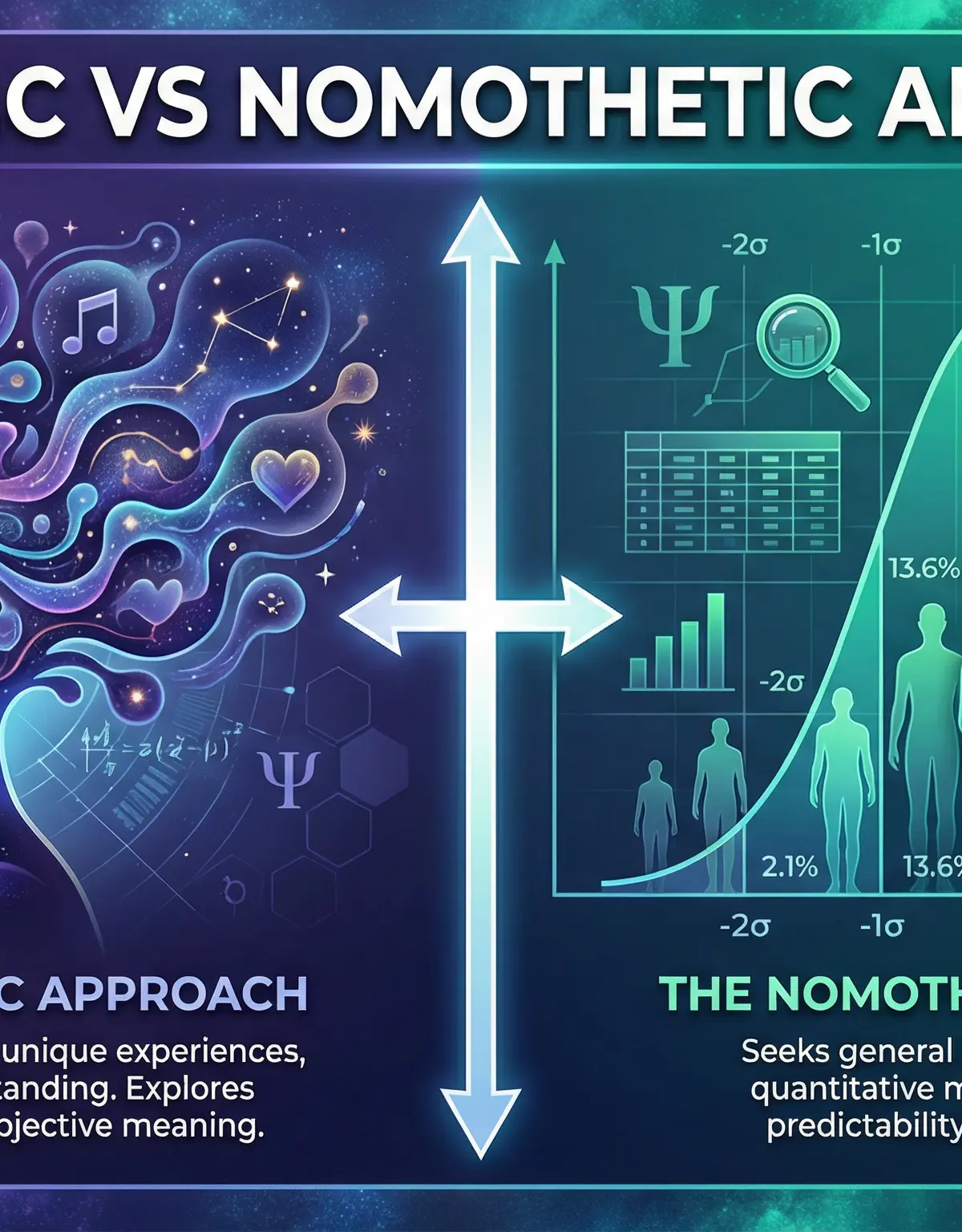
The debate between the idiographic and nomothetic approaches represents a core tension in psychology: should we focus on the unique individual, or should we aim to establish universal laws of human behaviour? This is not just a philosophical argument; it defines the very methods and goals of psychological inquiry. For AQA A-Level Psychology, examiners expect candidates to demonstrate a clear understanding of both approaches, the methodologies they employ, the psychological perspectives that favour them, and, most importantly, to evaluate their respective strengths and limitations. A sophisticated response will move beyond a simple either/or dichotomy and argue for a complementary, interactionist perspective. This guide will equip you with the specific knowledge and evaluative points needed to achieve top-band marks on this topic.

The Two Approaches: A Head-to-Head Comparison
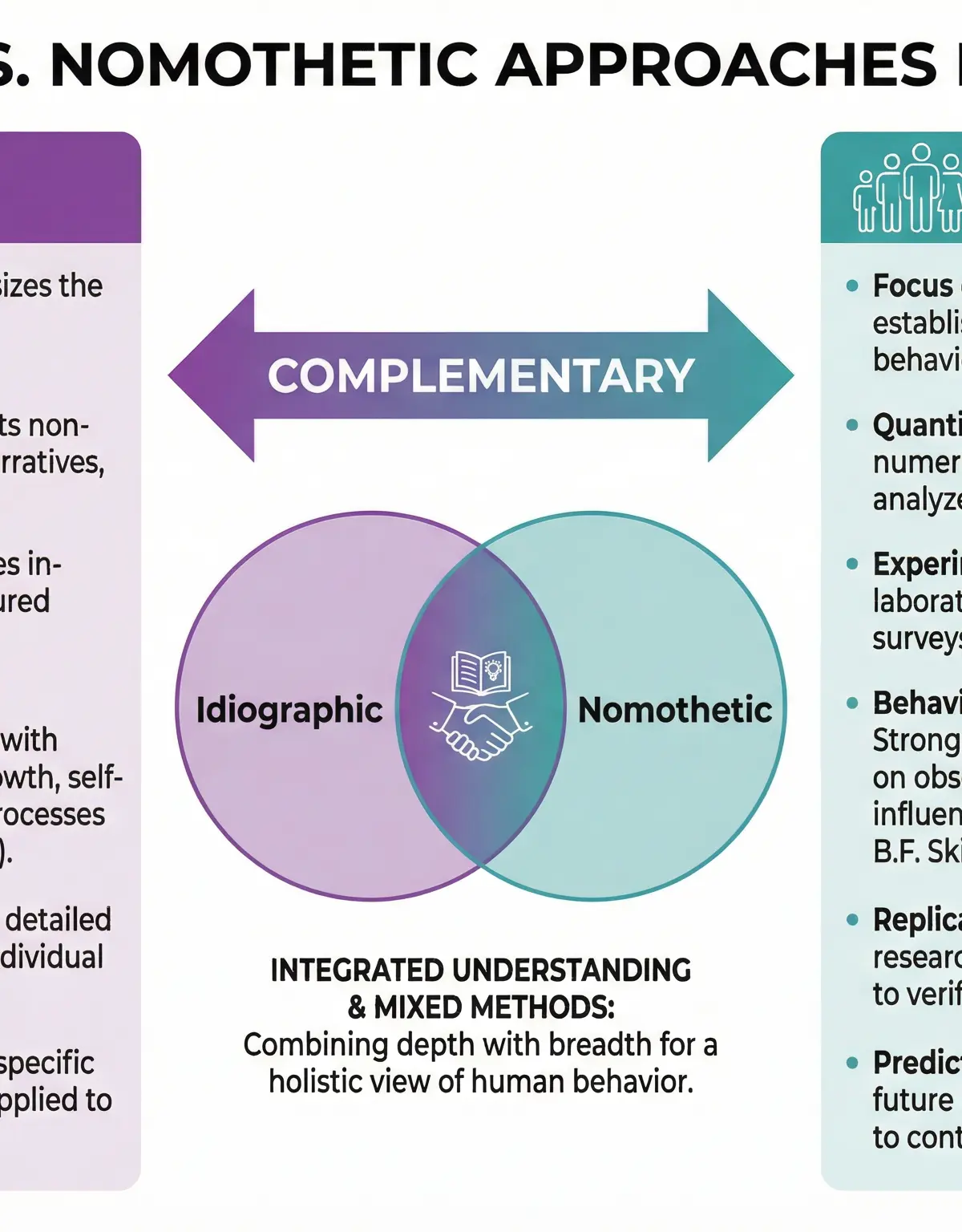
The Idiographic Approach
What it is: The term "idiographic" derives from the Greek "idios," meaning "own" or "private." This approach focuses on understanding the individual as a unique entity, with a rich personal history and subjective experience. It does not seek to create general laws but to explore the depth and complexity of a single case.
Methodology: It relies on qualitative methods to gather rich, detailed data. Key methods include:
- Case Studies: In-depth investigations of a single individual, group, or event. The case of Patient HM is a classic example, revealing the role of the hippocampus in memory.
- Unstructured Interviews: Open-ended interviews that allow the respondent to lead the conversation, providing deep insights into their personal world.
- Personal Documents: Analysis of diaries, letters, and other personal effects to understand an individual's subjective experience.
Associated Perspectives:
- Humanistic Psychology: Carl Rogers and Abraham Maslow focused on the unique, subjective experience of the self, making their work inherently idiographic.
- Psychodynamic Approach: While Freud aimed for universal (nomothetic) laws, his primary method was the case study (e.g., Little Hans, Anna O), which is an idiographic technique. This is a crucial point of nuance for evaluation.
The Nomothetic Approach
What it is: The term "nomothetic" comes from the Greek "nomos," meaning "law." This approach is the mainstream scientific model in psychology. It aims to establish general principles and universal laws of behaviour that can be applied across populations.
Methodology: It relies on quantitative methods that produce numerical data suitable for statistical analysis. Key methods include:
- Experiments: Controlled studies that manipulate an independent variable to measure its effect on a dependent variable, allowing for cause-and-effect conclusions.
- Correlational Research: Large-scale studies using questionnaires and psychometric tests to identify patterns and relationships in behaviour.
- Structured Observations: Observing behaviour in a controlled manner using pre-defined categories.
Associated Perspectives:
- Behaviourist Approach: Skinner's work on operant conditioning aimed to establish universal laws of learning that apply to all species.
- Biological Approach: This perspective seeks to identify universal biological mechanisms (e.g., neurotransmitters, brain structures) that underpin behaviour.
- Cognitive Approach: While it sometimes uses case studies, the cognitive approach primarily uses experimental methods to infer universal mental processes.
The Three Types of Nomothetic Law
Examiners award credit for specifying the different kinds of general laws the nomothetic approach seeks to establish.
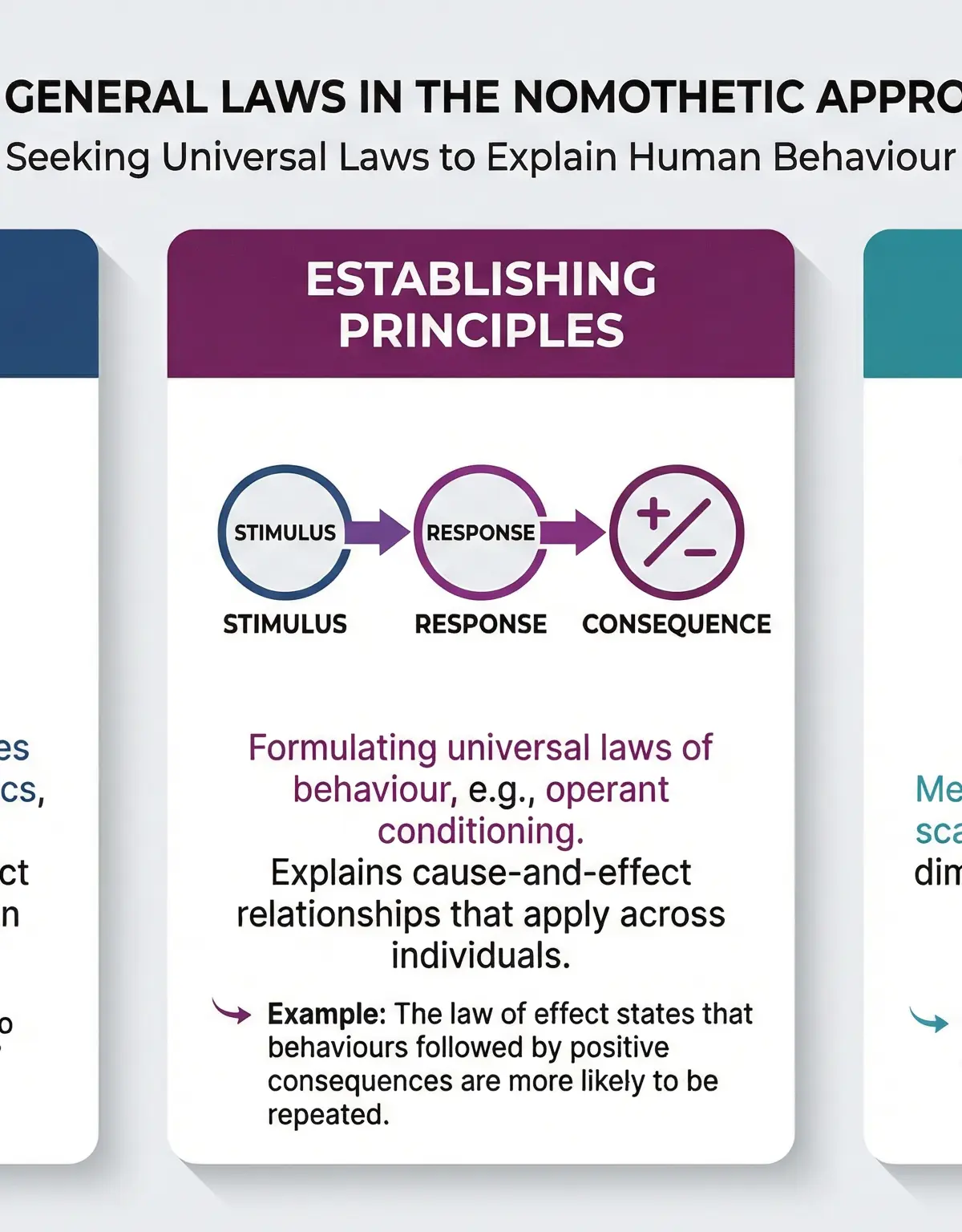
- Classification: Placing people into distinct groups or categories. A key example is the Diagnostic and Statistical Manual of Mental Disorders (DSM), which classifies individuals with mental health issues into diagnostic categories like schizophrenia or major depressive disorder.
- Establishing Principles: Formulating laws and principles that apply to all human behaviour. For example, the Law of Effect in operant conditioning states that behaviour followed by a reward is likely to be repeated.
- Establishing Dimensions: Placing people on a continuum to compare them with others. For instance, Eysenck's Personality Inventory measures individuals on dimensions like introversion-extraversion and neuroticism-stability, allowing for quantitative comparison.
"
Worked Examples
3 worked examples — open one to explore the question and available guidance.
Practice Questions
Test your understanding — click to reveal model answers
Outline the nomothetic approach in psychology. (4 marks)
Hint: Think about the aim, the methods, and the type of data.
Explain the difference between the idiographic and nomothetic approaches. (4 marks)",
"marks": 4
Evaluate the use of the case study method in psychological research. Refer to the idiographic-nomothetic debate in your answer. (8 marks)",
"marks": 8
Outline what is meant by the term 'classification' as a type of nomothetic law. (2 marks)
Hint: Think about the DSM.
To what extent is the psychodynamic approach idiographic? (8 marks)
Hint: Consider both the methods used and the ultimate aims of the approach.