OCR · A-Level · Psychology
Environmental Psychology
Environmental Psychology explores the critical two-way relationship between our surroundings and our behaviour. This guide provides the essential OCR A-Level knowledge on how stressors like noise, the design of spaces, and even the view from a window can profoundly affect our minds and actions, equipping you with the specific studies and evaluation points needed to secure top marks.
- 6 min read
- 3 worked examples
- 5 practice questions
- 7 key terms
Study Notes
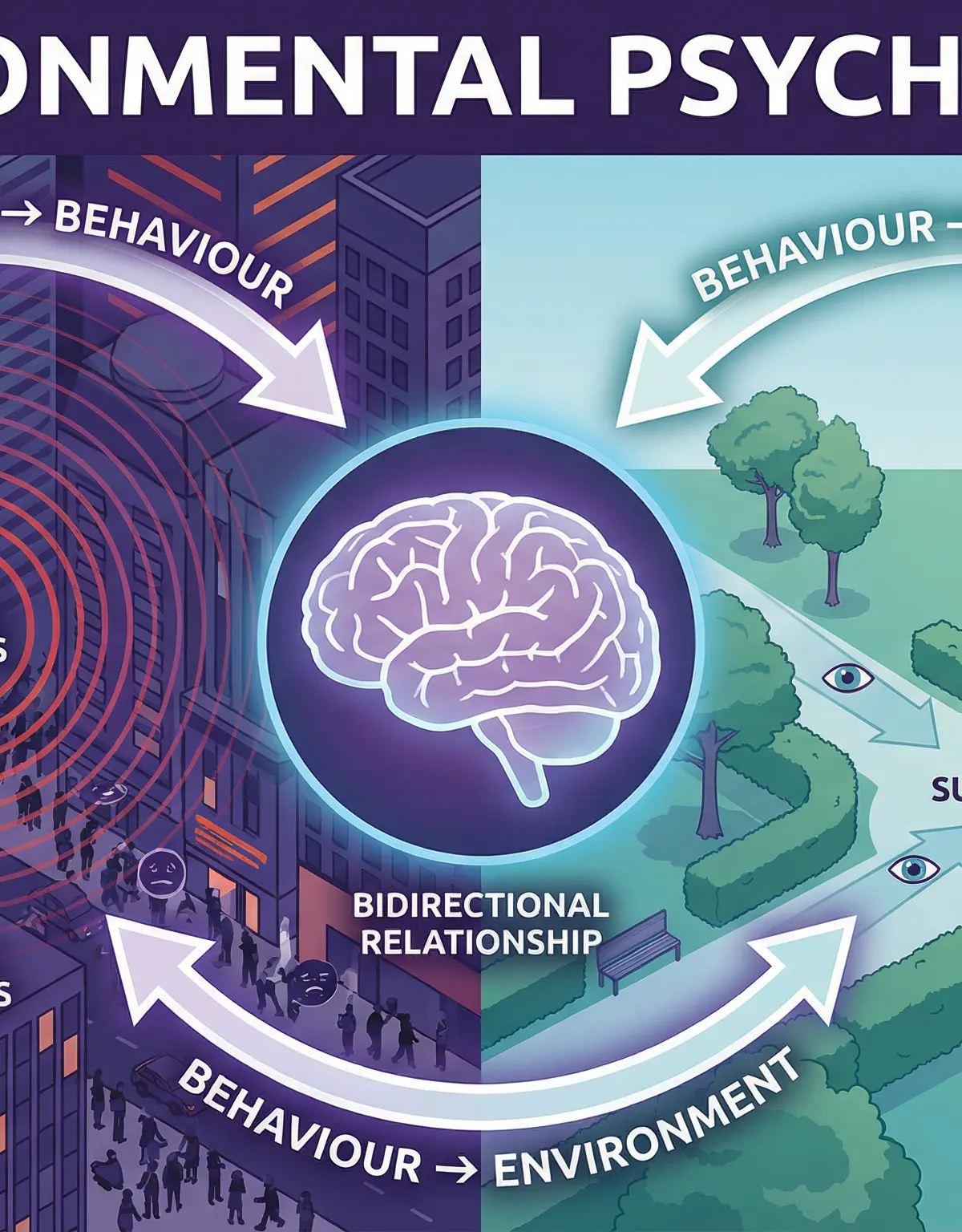
Overview
Environmental Psychology is a core component of the OCR A-Level Psychology (H567) specification, falling under Component 03: Applied Psychology. This topic investigates the bidirectional relationship between human behaviour and the physical environment. Examiners expect candidates to demonstrate detailed knowledge of key research into environmental stressors (noise, temperature, crowding), territory and personal space, and the design of environments (ergonomics, defensible space). A key skill is the ability to apply theoretical principles to practical scenarios, such as suggesting design improvements for a public space or evaluating the psychological impact of an office layout. High-level responses will move beyond simple description (AO1) to offer well-structured evaluation (AO3) using the specific 'Issues and Debates' mandated by OCR, such as reductionism, determinism, and usefulness. Understanding this topic not only prepares you for the exam but also provides a new lens through which to view the everyday spaces you inhabit.

Key Research & Concepts
Environmental Stressors
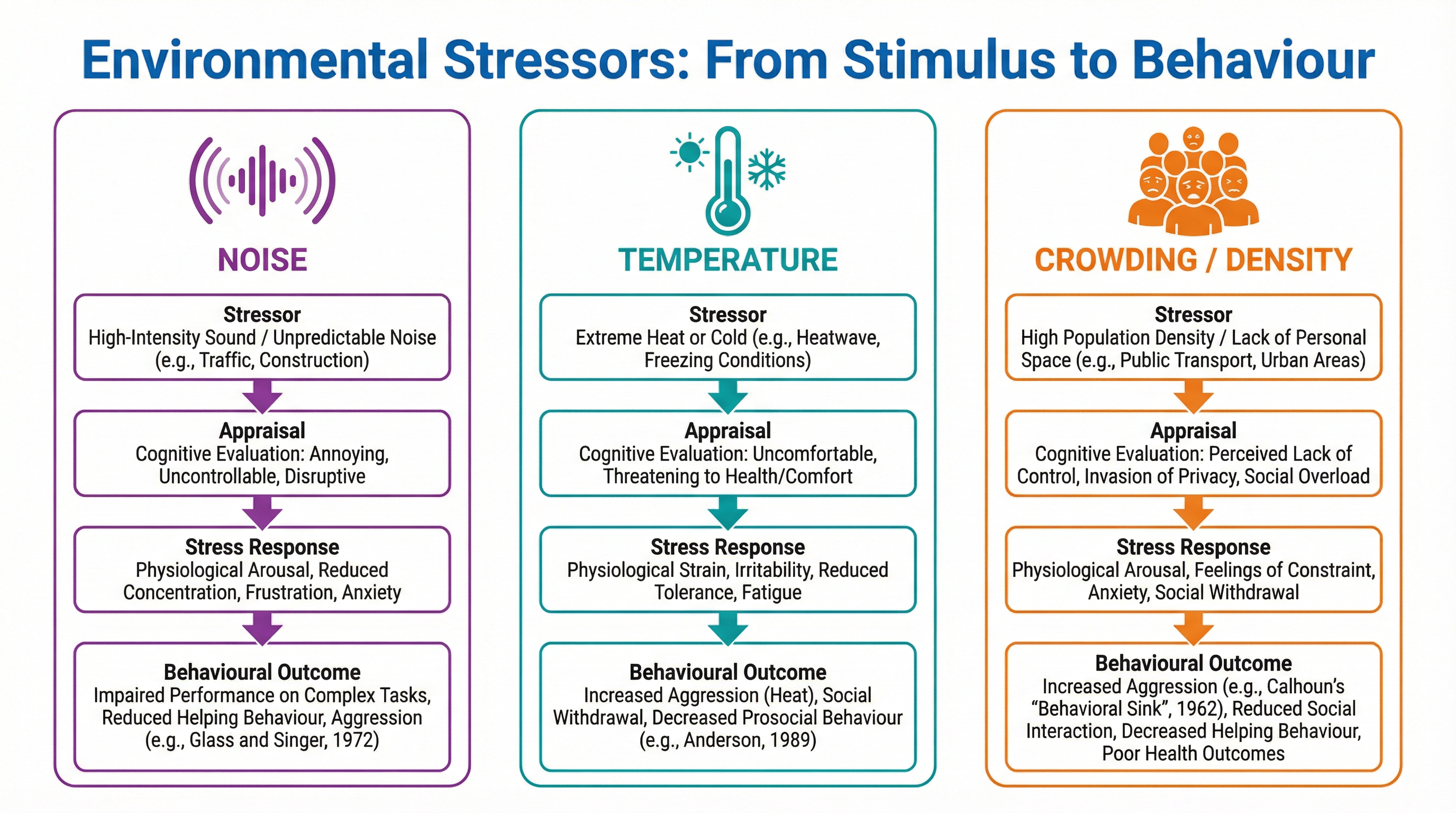
What it is: Environmental stressors are aspects of the physical world that cause a negative psychological and physiological reaction. The specification focuses on three key stressors: noise, temperature, and crowding/density.
Why it matters: Questions on stressors are common. Candidates must be able to describe the research and evaluate its implications. For example, understanding that perceived control mitigates stress (Glass & Singer) is a high-level point that distinguishes top candidates.
Specific Knowledge: You must know the aim, procedure, findings, and conclusions of Glass & Singer (1972) on noise and control, Anderson (1989) on temperature and aggression, and Calhoun (1962) on density and social pathology (the 'behavioural sink').
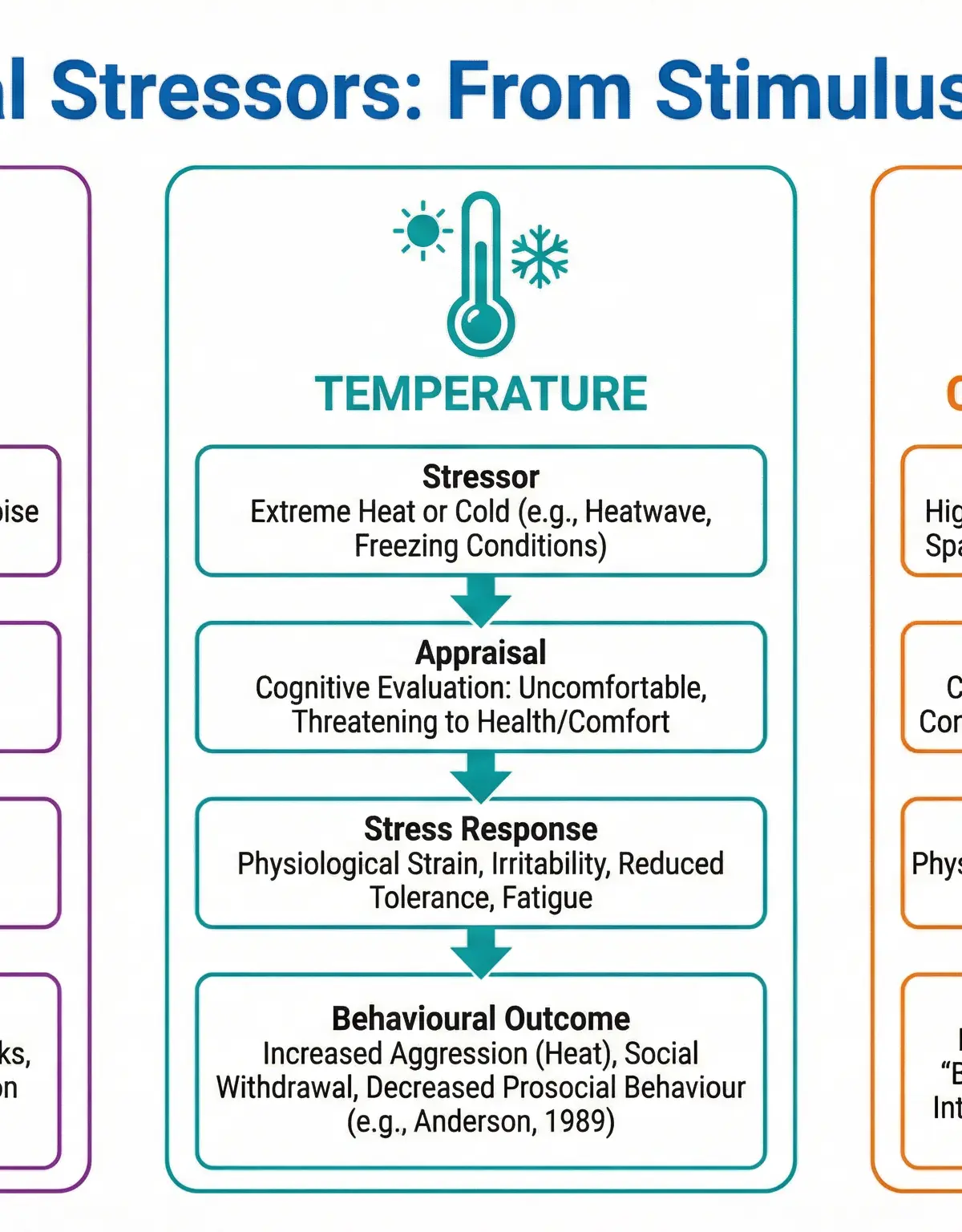
Territory & Personal Space
What it is: This area covers how humans use and define space. It includes Altman's (1975) model of primary, secondary, and tertiary territories, and the concept of personal space.
Why it matters: This links directly to questions about social behaviour in different settings. A common mistake is to confuse personal space with territory. Examiners look for a clear distinction and the use of specific terminology from Altman's model.
Specific Knowledge: Be able to define and give examples of Primary Territory (e.g., your bedroom), Secondary Territory (e.g., your regular seat in the library), and Tertiary Territory (e.g., a park bench). Understand that invasions of primary territory provoke the strongest reactions.
Designing for People
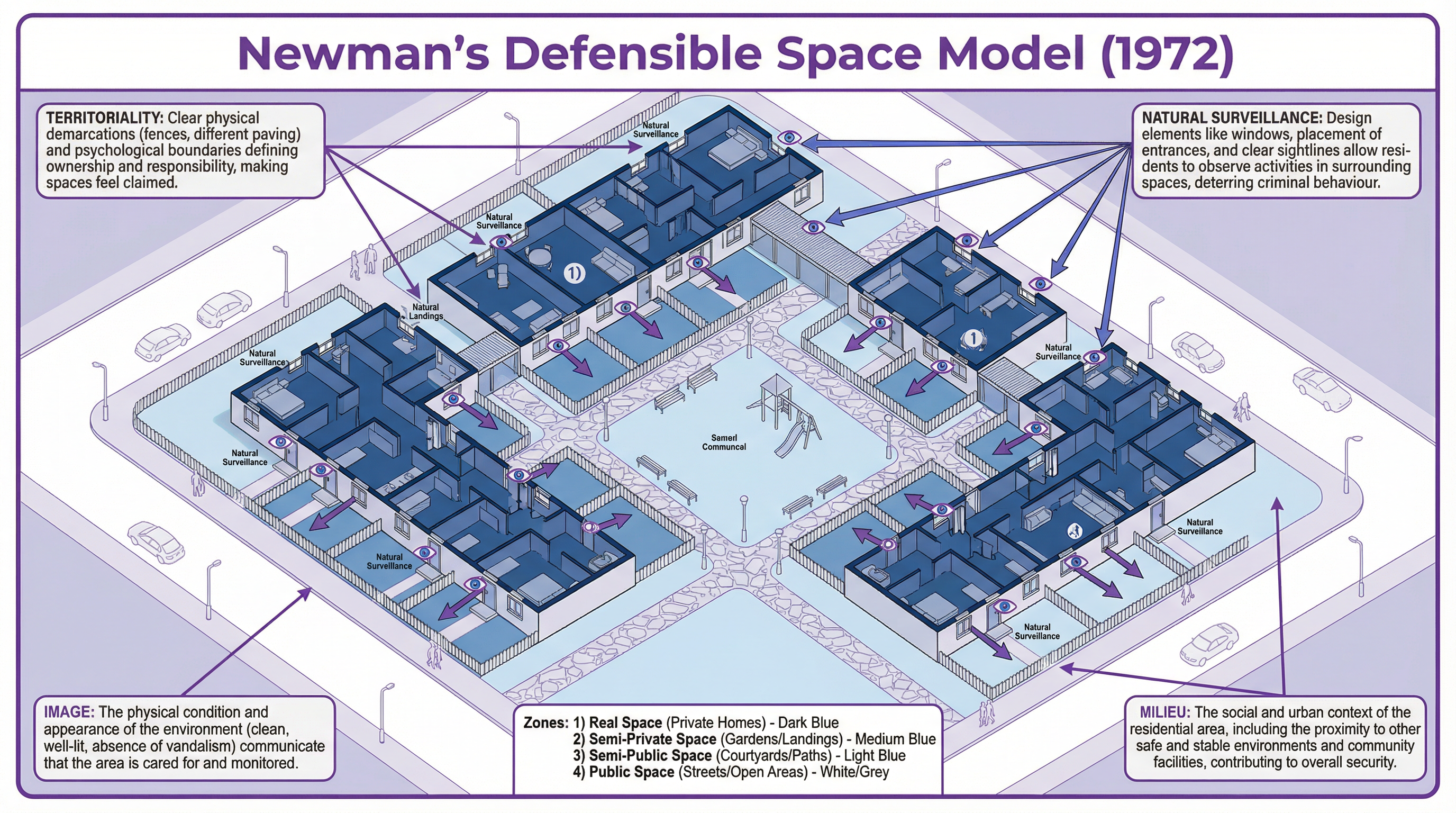
What it is: This section focuses on applying psychological principles to design. Key concepts include Newman's (1972) Defensible Space theory and Ulrich's (1984) research on the restorative effects of nature.
Why it matters: This is the 'applied' part of Applied Psychology. 'Suggest' questions often draw from this area, requiring candidates to propose design solutions to problems like crime or stress, and justify them with psychological theory.
Specific Knowledge: Memorise the four key features of Defensible Space: territoriality, natural surveillance, image, and milieu. For Ulrich (1984), you must know the specific findings: patients with a view of nature had shorter hospital stays (7.96 vs 8.70 days) and required fewer strong analgesics.

Second-Order Concepts
Causation
Environmental psychology often deals with complex causal relationships. For example, does high temperature cause aggression (Anderson, 1989), or is it merely correlated, with other factors like increased social interaction in summer acting as confounding variables? Top-tier analysis involves questioning these causal links and considering alternative explanations, a key skill for AO3.
Consequence
The consequences of environmental design are a central theme. Newman's work shows the consequence of poor design (high crime in the Van Dyke Houses) versus good design (lower crime in Brownsville). Ulrich's study demonstrates the positive health consequences of biophilic design (incorporating nature). Candidates should be able to trace the line from an environmental feature to a behavioural or psychological outcome.
Change & Continuity
This topic reflects changes in architectural and social thinking. The move away from high-rise, anonymous housing projects in the 1970s and 80s was partly influenced by the ideas of Newman and others. However, the fundamental human need for territory and personal space, as described by Altman, remains a constant. Continuity is seen in our persistent negative reactions to uncontrollable stressors like traffic noise.
Significance
The significance of this field lies in its real-world applicability. The findings of environmental psychologists have directly influenced hospital design, urban planning, office layouts, and crime prevention strategies. Its significance for examiners is that it provides a perfect test of a candidate's ability to apply psychological knowledge to solve practical problems.
Visual Resources
2 diagrams and illustrations
Interactive Diagrams
1 interactive diagram to visualise key concepts
Conceptual Flow Outline
Flowchart showing the cognitive appraisal model of stress, based on Glass & Singer (1972). This illustrates that the perception of control is the critical factor that determines the behavioural outcome.
Worked Examples
3 worked examples — open one to explore the question and available guidance.
Practice Questions
Test your understanding — click to reveal model answers
Outline the difference between density and crowding. (4 marks)
Hint: Think about objective vs. subjective. Use an example to illustrate the difference.
Describe one study of territory or personal space. (10 marks)
Hint: Focus on Altman's (1975) model of territory. Describe the three types and give examples.
To what extent is the effect of the physical environment on behaviour deterministic? (15 marks)
Hint: This is an AO3 question about the determinism debate. Argue both for and against a deterministic view, using evidence from studies.
Describe the findings of Ulrich's (1984) study on hospital recovery. (6 marks)
Hint: Be specific with the results. Examiners reward precise knowledge of the numbers.
Evaluate the usefulness of research into environmental psychology. (15 marks)
Hint: Think about the real-world applications of the research. Use studies like Newman (1972) and Ulrich (1984) as your primary examples.