AQA · A-Level · Psychology
Course version: 7182-2025 · Exams from 2027
Gender and culture in Psychology – universality and bias. Gender bias…
Full specification wording
Issues and debates in Psychology: Gender and culture in Psychology – universality and bias. Gender bias including androcentrism and alpha and beta bias; cultural bias, including ethnocentrism and cultural relativism.
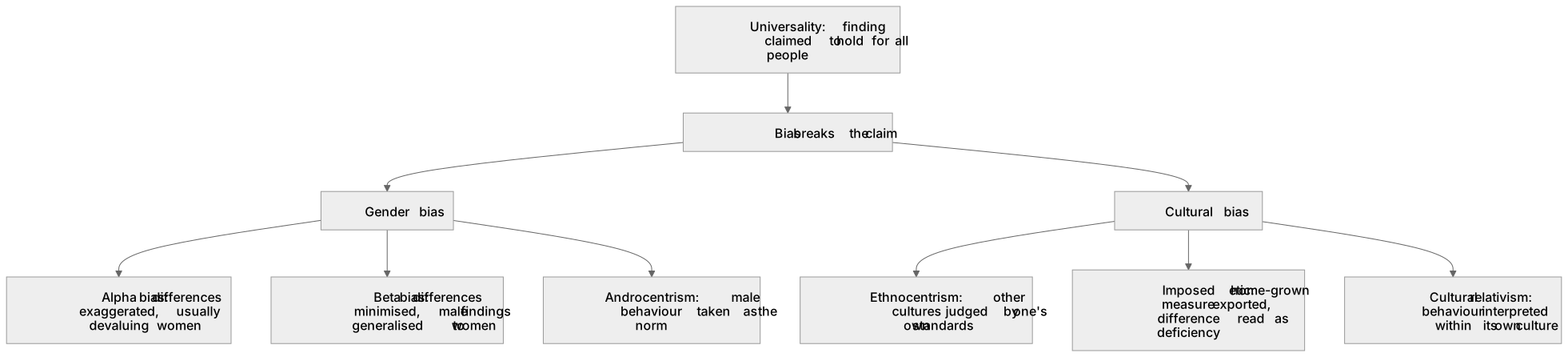
Universality is the claim that a finding holds for everyone, everywhere; bias is what breaks it.
Checked against the AQA 7182-2025 specification (opens in a new tab) on .
- Point 1 of 6
- 4 key terms
Study notes
From the checked teaching notes for this specification point.
The idea
Universality is the claim that a finding holds for everyone, everywhere; bias is what breaks it. Alpha bias exaggerates the difference between the sexes, usually to women's cost, as in Freud's weaker female superego. Beta bias minimises it: fight-or-flight was mapped on male animals and assumed to fit women, until Taylor's tend-and-befriend work found an oxytocin-driven pattern instead. Androcentrism makes male behaviour the yardstick, so female behaviour reads as deviant. Ethnocentrism does the same across cultures, and Ainsworth's Strange Situation is the standard case of an imposed etic: Van IJzendoorn and Kroonenberg's meta-analysis of 32 studies found 35% avoidant infants in Germany, yet more variation within countries than between them. Cultural relativism answers that behaviour only means something in its own context.
What earns the marks
- Universality: the claim that a psychological finding applies to all people, in all cultures and at all times, regardless of gender.
- Alpha bias: differences between men and women exaggerated, usually devaluing women (Freud's account of the female superego; sociobiological accounts of male promiscuity).
- Beta bias: real differences ignored or minimised, so findings from male samples are generalised to women (the fight-or-flight research programme).
- Androcentrism: male behaviour taken as the norm, so female behaviour is judged abnormal or deficient, as in the medicalising of premenstrual syndrome.
- Ethnocentrism: judging other cultures by the standards of one's own; an imposed etic exports a home-grown measure and reads the difference as a deficiency.
- Cultural relativism and the emic-etic distinction: behaviour can only be interpreted within the culture that produced it.
- AO3: Van IJzendoorn and Kroonenberg found greater variation within countries than between them, so 'culture' is too blunt a unit to carry the explanation.
- AO3: bias is a property of the researcher as well as the sample, which is why reflexivity and the use of indigenous researchers are offered as remedies.
Common mistakes and how to put them right
Swapping alpha and beta bias round.
Put it right: Alpha exaggerates the difference, beta erases it; the quick check is whether the theory says the sexes are very different or says the difference is not there.
Treating beta bias as harmless because it 'treats everyone the same'.
Put it right: It does damage precisely because identical treatment of different needs hides female experience.
Calling a study 'culturally biased' with no mechanism named.
Put it right: Say which it is: ethnocentrism, an imposed etic, or simply an unrepresentative sample.
Confusing cultural relativism with the claim that nothing is universal.
Put it right: Relativism is about interpreting behaviour in context, not denying that anything is shared.
Exam tips
- A sixteen-mark essay here requires a balance of skills. Avoid assuming a blanket split of six description and ten evaluation marks; if there is a stem, marks are allocated to application (AO2), so do not neglect applying your knowledge to the scenario alongside your AO3 evaluation.
- Give a worked example for every term. 'Androcentrism' on its own is worth nothing without the premenstrual syndrome or fight-or-flight illustration.
- When there is a stem, quote the researcher's own words back and label the bias those words demonstrate before you evaluate.
Try the lesson
The start of the Issues and debates in Psychology: Gender and culture in Psychology – universality and bias. Gender bias including androcentrism and alpha and beta bias; cultural bias, including ethnocentrism and cultural relativism. lesson, made from checked teaching notes for this specification point.
Have a go first
Which of the following best describes beta bias in psychological research?
Listen
Universality is the claim that a finding holds for everyone, everywhere; bias is what breaks it. Alpha bias exaggerates the difference between the sexes, usually to women's cost, as in Freud's weaker female superego. Beta bias minimises it: fight-or-flight was mapped on male animals and assumed to fit women, until Taylor's tend-and-befriend work found an oxytocin-driven pattern instead. Androcentrism makes male behaviour the yardstick, so female behaviour reads as deviant. Ethnocentrism does the same across cultures, and Ainsworth's Strange Situation is the standard case of an imposed etic: Van IJzendoorn and Kroonenberg's meta-analysis of 32 studies found 35% avoidant infants in Germany, yet more variation within countries than between them. Cultural relativism answers that behaviour only means something in its own context. A strong answer earns marks for these points. Universality: the claim that a psychological finding applies to all people, in all cultures and at all times, regardless of gender. Alpha bias: differences between men and women exaggerated, usually devaluing women (Freud's account of the female superego; sociobiological accounts of male promiscuity). Beta bias: real differences ignored or minimised, so findings from male samples are generalised to women (the fight-or-flight research programme). Androcentrism: male behaviour taken as the norm, so female behaviour is judged abnormal or deficient, as in the medicalising of premenstrual syndrome. Exam tip: A sixteen-mark essay here requires a balance of skills. Avoid assuming a blanket split of six description and ten evaluation marks; if there is a stem, marks are allocated to application (AO2), so do not neglect applying your knowledge to the scenario alongside your AO3 evaluation.
See it
Key words
Say what each word means before you turn the card.
universality
Try answering aloud or in your head before turning the card.
alpha bias
Try answering aloud or in your head before turning the card.
beta bias
Try answering aloud or in your head before turning the card.
androcentrism
Try answering aloud or in your head before turning the card.
See every definition
- universality
- The claim that a psychological finding applies to all people, in all cultures and at all times, regardless of gender.
- alpha bias
- Differences between men and women exaggerated, usually devaluing women, as in Freud's account of the female superego.
- beta bias
- Real differences ignored or minimised, so findings from male samples are generalised to women, as in the fight-or-flight research programme.
- androcentrism
- Male behaviour taken as the norm, so female behaviour is judged abnormal or deficient, as in the medicalising of premenstrual syndrome.
Label the diagram
Some boxes have lost their names. Pick the right name for each number.
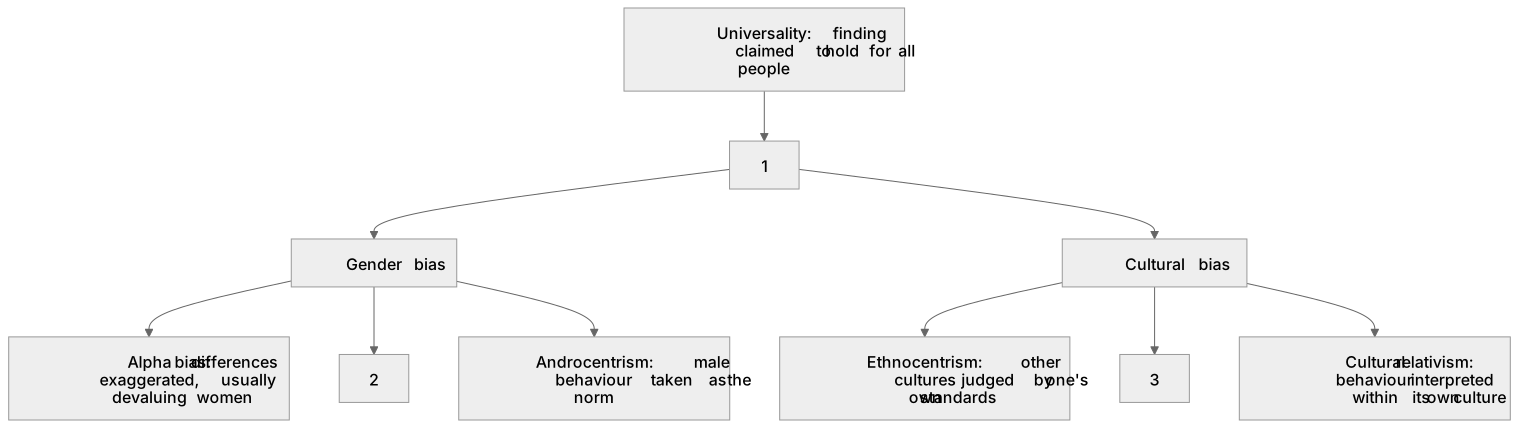
1Box 1
2Box 2
3Box 3
There is more to this lesson
The full lesson goes on to check your understanding and help you earn the marks. Create a free account to carry on, with your progress saved.
A week of Premium from your first lesson · Then the free plan continues · No card, no charge
Test your understanding of Issues and debates in Psychology: Gender and culture in Psychology – universality and bias. Gender bias including androcentrism and alpha and beta bias; cultural bias, including ethnocentrism and cultural relativism.
Active recall beats re-reading. Take an instant quiz now to test what you’ve learned and lock it into long-term memory.
A week of Premium from your first lesson · Then the free plan continues · No card, no charge