AQA · A-Level · Psychology
Course version: 7182-2025 · Exams from 2027
Free will and determinism: hard determinism and soft determinism;…
Full specification wording
Issues and debates in Psychology: Free will and determinism: hard determinism and soft determinism; biological, environmental and psychic determinism. The scientific emphasis on causal explanations.
Free will says you author your own choices; determinism says every action is caused by something you did not choose.
Checked against the AQA 7182-2025 specification (opens in a new tab) on .
- Point 2 of 6
- 4 key terms
Study notes
From the checked teaching notes for this specification point.
The idea
Free will says you author your own choices; determinism says every action is caused by something you did not choose. Hard determinism treats free will as an illusion and leaves no room for choice at all. Soft determinism, from William James, keeps conscious choice inside limits the situation sets. The three varieties simply name the cause: biological (genes such as MAOA, neurotransmitters, hormones), environmental (Skinner argued behaviour is nothing but an accumulated history of reinforcement) and psychic (Freud's unconscious childhood conflicts, where even a slip of the tongue has a cause). Science leans determinist because a controlled experiment is built to isolate a cause. The sharpest challenge is Libet's, whose readiness potential appeared in motor cortex before participants reported deciding to move.
What earns the marks
- Free will: the individual is self-determining and can reject internal and external pressures, the position the humanistic approach takes.
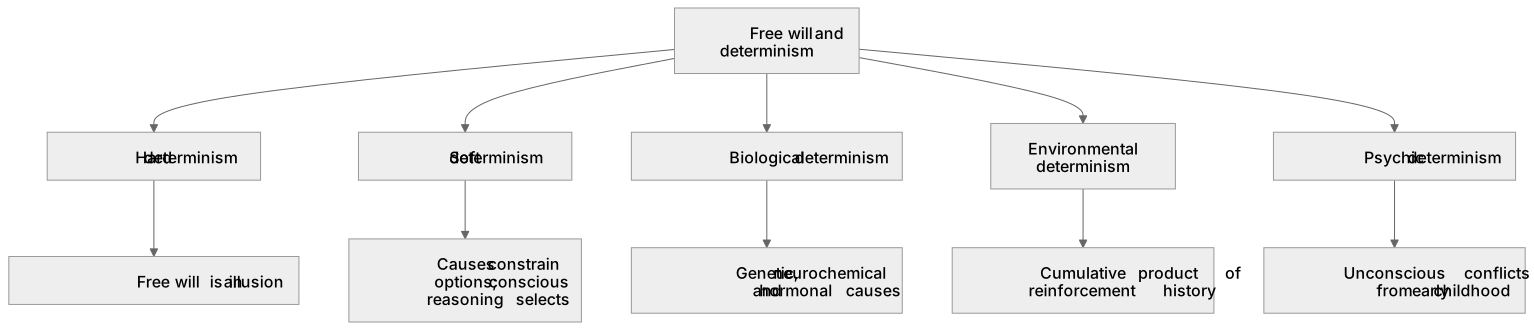
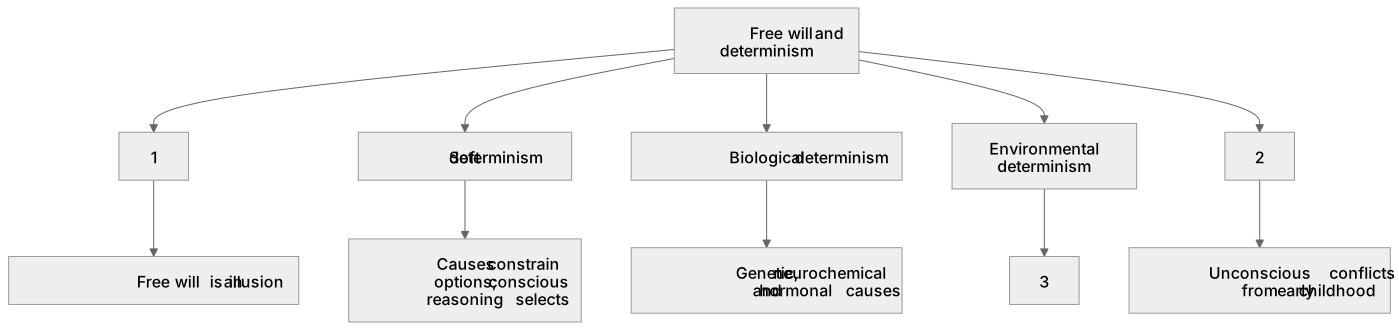
- Hard determinism: every behaviour has a cause that could in principle be identified, so free will is an illusion.
- Soft determinism: causes constrain the options but conscious reasoning still selects among them (James; the cognitive approach).
- Biological determinism: genetic, neurochemical and hormonal causes, such as dopamine in schizophrenia or the MAOA gene in aggression.
- Environmental determinism: Skinner's claim that behaviour is the cumulative product of reinforcement history rather than choice.
- Psychic determinism: Freud's unconscious conflicts formed in early childhood, with parapraxes treated as caused rather than accidental.
- The scientific emphasis on causal explanation: the controlled experiment manipulates one variable to establish cause and effect, which assumes determinism.
- AO3: Libet's readiness potential precedes the reported decision, but the counter is that it may signal readiness to act rather than the decision itself.
- AO3: hard determinism is close to unfalsifiable, and both the legal system and locus-of-control research assume people are responsible agents.
Common mistakes and how to put them right
Writing that determinism means behaviour can be predicted with certainty.
Put it right: Hard determinism claims causes exist, not that psychologists have found them.
Leaving soft determinism as 'a bit of both'.
Put it right: State the claim: causes fix the range of options, conscious thought picks within that range.
Using Libet as proof that free will does not exist and stopping there.
Put it right: Evidence with no counter-argument attached is description, not evaluation.
Naming Freud for psychic determinism and then describing genes.
Put it right: Psychic determinism is unconscious conflict, not biology.
Exam tips
- Scenario questions plant one kind of cause per character, so identify which determinism each detail points to before writing a word.
- Keep the implications paragraph concrete: responsibility in law, and the raised depression risk found in people with an external locus of control.
- Do not spend half the essay on free will. The specification names five determinist positions (hard, soft, biological, environmental and psychic) and a marker is looking for you to distinguish them.
Try the lesson
The start of the Issues and debates in Psychology: Free will and determinism: hard determinism and soft determinism; biological, environmental and psychic determinism. The scientific emphasis on causal explanations. lesson, made from checked teaching notes for this specification point.
Have a go first
Which statement best describes the concept of soft determinism in psychology?
Listen
Free will says you author your own choices; determinism says every action is caused by something you did not choose. Hard determinism treats free will as an illusion and leaves no room for choice at all. Soft determinism, from William James, keeps conscious choice inside limits the situation sets. The three varieties simply name the cause: biological (genes such as MAOA, neurotransmitters, hormones), environmental (Skinner argued behaviour is nothing but an accumulated history of reinforcement) and psychic (Freud's unconscious childhood conflicts, where even a slip of the tongue has a cause). Science leans determinist because a controlled experiment is built to isolate a cause. The sharpest challenge is Libet's, whose readiness potential appeared in motor cortex before participants reported deciding to move. A strong answer earns marks for these points. Free will: the individual is self-determining and can reject internal and external pressures, the position the humanistic approach takes. Hard determinism: every behaviour has a cause that could in principle be identified, so free will is an illusion. Soft determinism: causes constrain the options but conscious reasoning still selects among them (James; the cognitive approach). Biological determinism: genetic, neurochemical and hormonal causes, such as dopamine in schizophrenia or the MAOA gene in aggression. Exam tip: Scenario questions plant one kind of cause per character, so identify which determinism each detail points to before writing a word.
See it
Key words
Say what each word means before you turn the card.
free will
Try answering aloud or in your head before turning the card.
hard determinism
Try answering aloud or in your head before turning the card.
soft determinism
Try answering aloud or in your head before turning the card.
psychic determinism
Try answering aloud or in your head before turning the card.
See every definition
- free will
- The individual is self-determining and can reject internal and external pressures, the position the humanistic approach takes.
- hard determinism
- Every behaviour has a cause that could in principle be identified, so free will is an illusion.
- soft determinism
- Causes constrain the options but conscious reasoning still selects among them.
- psychic determinism
- Unconscious conflicts formed in early childhood, with parapraxes treated as caused rather than accidental.
Label the diagram
Some boxes have lost their names. Pick the right name for each number.
1Box 1
2Box 2
3Box 3
There is more to this lesson
The full lesson goes on to check your understanding and help you earn the marks. Create a free account to carry on, with your progress saved.
A week of Premium from your first lesson · Then the free plan continues · No card, no charge
Test your understanding of Issues and debates in Psychology: Free will and determinism: hard determinism and soft determinism; biological, environmental and psychic determinism. The scientific emphasis on causal explanations.
Active recall beats re-reading. Take an instant quiz now to test what you’ve learned and lock it into long-term memory.
A week of Premium from your first lesson · Then the free plan continues · No card, no charge