AQA · A-Level · Psychology
Course version: 7182-2025 · Exams from 2027
Holism and reductionism: levels of explanation in Psychology. Biological…
Full specification wording
Issues and debates in Psychology: Holism and reductionism: levels of explanation in Psychology. Biological reductionism and environmental (stimulus-response) reductionism.
Reductionism explains behaviour by breaking it into its simplest parts, justified by parsimony; holism insists some things exist only in the whole, which is what Gestalt psychologists meant by the…
Checked against the AQA 7182-2025 specification (opens in a new tab) on .
- Point 4 of 6
- 4 key terms
Study notes
From the checked teaching notes for this specification point.
The idea
Reductionism explains behaviour by breaking it into its simplest parts, justified by parsimony; holism insists some things exist only in the whole, which is what Gestalt psychologists meant by the whole being more than the sum of its parts. Between the two sit levels of explanation. Obsessive-compulsive disorder can be described socio-culturally as deviating from cleanliness norms, physically as repetitive hand-washing, psychologically as an intrusive thought, physiologically as an overactive worry circuit and neurochemically as low serotonin. Biological reductionism works at the lowest level, which is why drug treatment targets serotonin. Environmental reductionism, the behaviourists' version, breaks learning down into stimulus-response links built by conditioning, as Skinner did with rats in a box.
What earns the marks
- Holism: behaviour must be studied as a whole system because analysing it into parts destroys the thing being explained (Gestalt psychology; the humanistic approach).
- Reductionism: analysing behaviour into its constituent components, defended by parsimony, the preference for the simplest explanation that works.
- Levels of explanation: socio-cultural, psychological, physical, physiological and neurochemical accounts of the same behaviour, ordered from most to least holistic.
- A worked example is expected: obsessive-compulsive disorder as deviating from social norms, as hand-washing, as an intrusive thought, as an overactive neural circuit, as low serotonin.
- Biological reductionism: behaviour explained by genes, neurochemistry and brain structure, the level at which drug therapies act.
- Environmental or stimulus-response reductionism: behaviourists reduce complex learning to chains of association formed by classical and operant conditioning.
- AO3: reductionist accounts operationalise cleanly and support controlled experiments, which is where the scientific credibility comes from.
- AO3: they can also strip out meaning, because describing the neurochemistry of a behaviour does not explain what the behaviour was for.
- AO3: holism resists testing and offers no way to choose between competing causes, which is why humanistic psychology has produced little hard evidence.
Common mistakes and how to put them right
Using 'reductionist' as an insult rather than a description.
Put it right: Reduction is often exactly why a line of research produced usable treatment.
Listing the levels of explanation without running one behaviour through them, which forfeits the example credit the question is built around.
Confusing environmental reductionism with the nurture side of nature-nurture.
Put it right: It is a claim about the size of the unit of analysis, not about where behaviour originates.
Calling the biological approach holistic because it refers to the whole brain.
Put it right: The level of explanation is what decides this, not the size of the organ.
Exam tips
- Name your behaviour in the first sentence and use the same one at every level; this structure helps to clearly demonstrate your knowledge of the different levels of explanation.
- Evaluate by asking what each level can and cannot predict, rather than asserting that one is better than another.
- If asked to discuss with reference to a named approach, evaluate the level that approach works at, not reductionism in the abstract.
Try the lesson
The start of the Issues and debates in Psychology: Holism and reductionism: levels of explanation in Psychology. Biological reductionism and environmental (stimulus-response) reductionism. lesson, made from checked teaching notes for this specification point.
Have a go first
Which of the following best defines the concept of environmental reductionism in psychology?
Listen
Reductionism explains behaviour by breaking it into its simplest parts, justified by parsimony; holism insists some things exist only in the whole, which is what Gestalt psychologists meant by the whole being more than the sum of its parts. Between the two sit levels of explanation. Obsessive-compulsive disorder can be described socio-culturally as deviating from cleanliness norms, physically as repetitive hand-washing, psychologically as an intrusive thought, physiologically as an overactive worry circuit and neurochemically as low serotonin. Biological reductionism works at the lowest level, which is why drug treatment targets serotonin. Environmental reductionism, the behaviourists' version, breaks learning down into stimulus-response links built by conditioning, as Skinner did with rats in a box. A strong answer earns marks for these points. Holism: behaviour must be studied as a whole system because analysing it into parts destroys the thing being explained (Gestalt psychology; the humanistic approach). Reductionism: analysing behaviour into its constituent components, defended by parsimony, the preference for the simplest explanation that works. Levels of explanation: socio-cultural, psychological, physical, physiological and neurochemical accounts of the same behaviour, ordered from most to least holistic. A worked example is expected: obsessive-compulsive disorder as deviating from social norms, as hand-washing, as an intrusive thought, as an overactive neural circuit, as low serotonin. Exam tip: Name your behaviour in the first sentence and use the same one at every level; this structure helps to clearly demonstrate your knowledge of the different levels of explanation.
See it
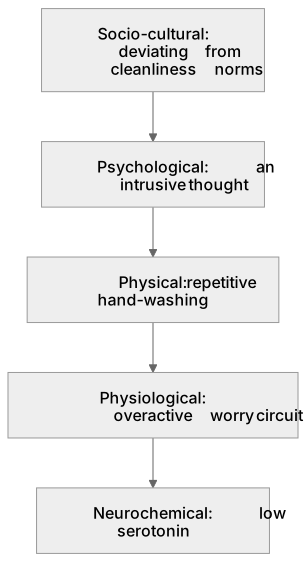
Put it in order
Put these steps in the order they happen.
- 1. Psychological: an intrusive thought
- 2. Physical: repetitive hand-washing
- 3. Socio-cultural: deviating from cleanliness norms
- 4. Neurochemical: low serotonin
- 5. Physiological: overactive worry circuit
Key words
Say what each word means before you turn the card.
holism
Try answering aloud or in your head before turning the card.
reductionism
Try answering aloud or in your head before turning the card.
levels of explanation
Try answering aloud or in your head before turning the card.
biological reductionism
Try answering aloud or in your head before turning the card.
See every definition
- holism
- Behaviour must be studied as a whole system because analysing it into parts destroys the thing being explained.
- reductionism
- Analysing behaviour into its constituent components, defended by parsimony, the preference for the simplest explanation that works.
- levels of explanation
- Socio-cultural, psychological, physical, physiological and neurochemical accounts of the same behaviour, ordered from most to least holistic.
- biological reductionism
- Behaviour explained by genes, neurochemistry and brain structure, the level at which drug therapies act.
Label the diagram
Some boxes have lost their names. Pick the right name for each number.
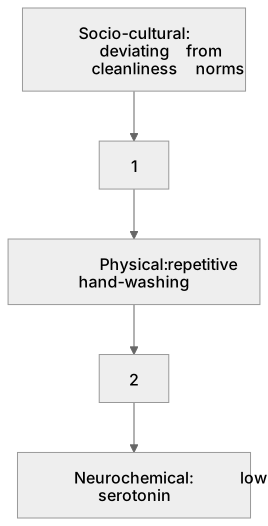
1Box 1
2Box 2
There is more to this lesson
The full lesson goes on to check your understanding and help you earn the marks. Create a free account to carry on, with your progress saved.
A week of Premium from your first lesson · Then the free plan continues · No card, no charge
Test your understanding of Issues and debates in Psychology: Holism and reductionism: levels of explanation in Psychology. Biological reductionism and environmental (stimulus-response) reductionism.
Active recall beats re-reading. Take an instant quiz now to test what you’ve learned and lock it into long-term memory.
A week of Premium from your first lesson · Then the free plan continues · No card, no charge