AQA · A-Level · Psychology
Course version: 7182-2025 · Exams from 2027
The nature-nurture debate: the relative importance of heredity and…
Full specification wording
Issues and debates in Psychology: The nature-nurture debate: the relative importance of heredity and environment in determining behaviour; the interactionist approach.
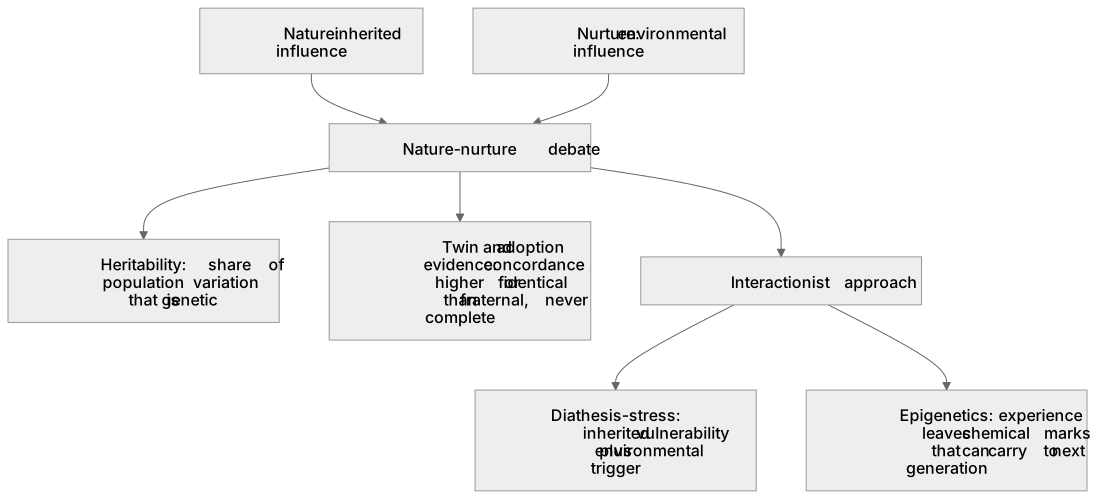
Nature means inherited influence, nurture means everything experience does, and the argument is over how the two divide up the differences between people.
Checked against the AQA 7182-2025 specification (opens in a new tab) on .
- Point 3 of 6
- 4 key terms
Study notes
From the checked teaching notes for this specification point.
The idea
Nature means inherited influence, nurture means everything experience does, and the argument is over how the two divide up the differences between people. Psychologists put numbers on it with concordance rates and heritability: intelligence sits near 0.5, which means about half the variation in a population is genetic, not half of any one person's IQ. Schizophrenia concordance runs near 48% for identical twins against 17% for fraternal, so neither side wins outright. The interactionist answer is that the two cannot be separated. Diathesis-stress needs an inherited vulnerability and an environmental trigger, and Tienari's Finnish adoption study found raised risk only where the adoptive family was rated dysfunctional. Epigenetics goes further: Dias and Ressler conditioned mice to fear a scent and saw the fear in pups that had never met it.
What earns the marks
- Nature: behaviour is inherited and largely present at birth, the nativist position associated with Descartes.
- Nurture: behaviour is acquired from the environment, the empiricist position associated with Locke's blank slate.
- Environment defined broadly, prenatal as well as postnatal, from maternal diet and stress through to peer group and culture.
- Heritability: a coefficient running from zero to one that describes how much of the variation in a population is genetic, near 0.5 for intelligence.
- Twin and adoption evidence: concordance is higher for identical than for fraternal twins but never complete, so neither influence is sufficient alone.
- The interactionist approach: diathesis-stress, an inherited vulnerability expressed only when an environmental trigger arrives (Tienari's adoption data).
- Epigenetics: experience leaves chemical marks that switch genes on and off, and those marks can carry into the next generation (Dias and Ressler).
- AO3: the question may be unanswerable as posed, because genes and environment correlate; an inherited temperament shapes the environment a child then receives.
- AO3: implications are socially sensitive, since strong nature positions have been used to argue for eugenics and strong nurture positions for behaviour shaping.
Common mistakes and how to put them right
Reading a heritability coefficient as a fact about an individual.
Put it right: Near 0.5 says half the variation in a group is genetic; it says nothing about one person.
Claiming twin studies prove nature.
Put it right: Identical twins share an upbringing as well as their DNA, and concordance is never complete.
Leaving the interactionist approach as 'both matter'.
Put it right: Credit comes from a named mechanism: diathesis-stress, gene-environment correlation or epigenetics.
Splitting one person's behaviour into percentages of nature and nurture, which is not what any of the evidence measures.
Exam tips
- Pick one behaviour and track it through the whole answer; a schizophrenia thread supplies concordance figures and diathesis-stress in a single move.
- Top-band answers say why the debate is badly posed, not merely that both sides contribute something.
- In a stem question, quote the family detail first and label it as a shared gene or a shared environment before you explain anything.
Try the lesson
The start of the Issues and debates in Psychology: The nature-nurture debate: the relative importance of heredity and environment in determining behaviour; the interactionist approach. lesson, made from checked teaching notes for this specification point.
Have a go first
Which of the following statements best describes the interactionist approach to the nature-nurture debate in psychology?
Listen
Nature means inherited influence, nurture means everything experience does, and the argument is over how the two divide up the differences between people. Psychologists put numbers on it with concordance rates and heritability: intelligence sits near 0.5, which means about half the variation in a population is genetic, not half of any one person's IQ. Schizophrenia concordance runs near 48% for identical twins against 17% for fraternal, so neither side wins outright. The interactionist answer is that the two cannot be separated. Diathesis-stress needs an inherited vulnerability and an environmental trigger, and Tienari's Finnish adoption study found raised risk only where the adoptive family was rated dysfunctional. Epigenetics goes further: Dias and Ressler conditioned mice to fear a scent and saw the fear in pups that had never met it. A strong answer earns marks for these points. Nature: behaviour is inherited and largely present at birth, the nativist position associated with Descartes. Nurture: behaviour is acquired from the environment, the empiricist position associated with Locke's blank slate. Environment defined broadly, prenatal as well as postnatal, from maternal diet and stress through to peer group and culture. Heritability: a coefficient running from zero to one that describes how much of the variation in a population is genetic, near 0.5 for intelligence. Exam tip: Pick one behaviour and track it through the whole answer; a schizophrenia thread supplies concordance figures and diathesis-stress in a single move.
See it
Key words
Say what each word means before you turn the card.
heredity and nativism
Try answering aloud or in your head before turning the card.
environment and empiricism
Try answering aloud or in your head before turning the card.
heritability and concordance rates
Try answering aloud or in your head before turning the card.
diathesis-stress and interactionism
Try answering aloud or in your head before turning the card.
See every definition
- heredity and nativism
- Behaviour is inherited and largely present at birth, the nativist position associated with Descartes.
- environment and empiricism
- Behaviour is acquired from the environment, the empiricist position associated with Locke's blank slate.
- heritability and concordance rates
- A coefficient from zero to one describing how much of the variation in a population is genetic, near 0.5 for intelligence, with concordance higher for identical than fraternal twins but never complete.
- diathesis-stress and interactionism
- An inherited vulnerability expressed only when an environmental trigger arrives, as in Tienari's adoption data.
Label the diagram
Some boxes have lost their names. Pick the right name for each number.
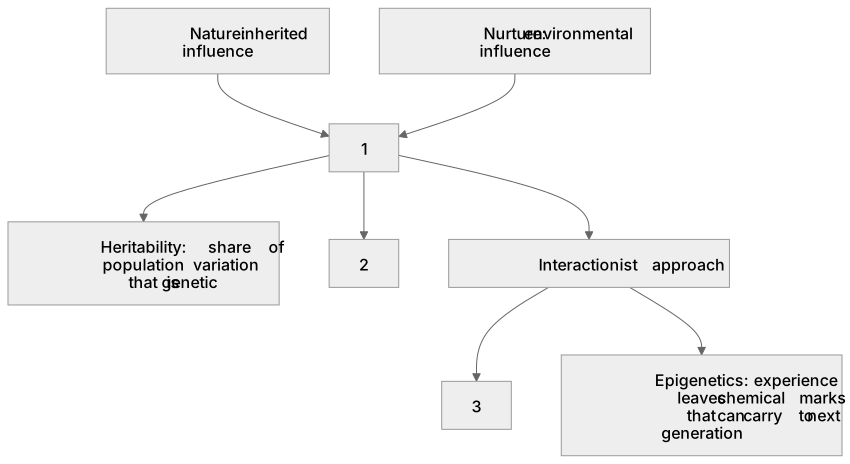
1Box 1
2Box 2
3Box 3
There is more to this lesson
The full lesson goes on to check your understanding and help you earn the marks. Create a free account to carry on, with your progress saved.
A week of Premium from your first lesson · Then the free plan continues · No card, no charge
Test your understanding of Issues and debates in Psychology: The nature-nurture debate: the relative importance of heredity and environment in determining behaviour; the interactionist approach.
Active recall beats re-reading. Take an instant quiz now to test what you’ve learned and lock it into long-term memory.
A week of Premium from your first lesson · Then the free plan continues · No card, no charge