AQA · A-Level · Psychology
Course version: 7182-2025 · Exams from 2027
The working memory model: central executive, phonological loop,…
Full specification wording
Memory: The working memory model: central executive, phonological loop, visuo-spatial sketchpad and episodic buffer. Features of the model: coding and capacity.
Baddeley and Hitch (1974) replaced the single short-term box with a work space of three parts, later adding a fourth.
Checked against the AQA 7182-2025 specification (opens in a new tab) on .
- Point 2 of 4
- 4 key terms
Study notes
From the checked teaching notes for this specification point.
The idea
Baddeley and Hitch (1974) replaced the single short-term box with a work space of three parts, later adding a fourth. The central executive directs attention and allocates tasks; it is modality-free and stores virtually nothing. The phonological loop codes sound, with a store holding what you hear and an articulatory process rehearsing roughly two seconds of speech. The visuo-spatial sketchpad codes visual and spatial information, holding three or four objects. The episodic buffer binds information, holds about four chunks, and links to long-term memory. Dual-task findings show two visual jobs at once interfere, but a visual and a verbal job do not. However, the central executive is described so vaguely that it cannot be tested.
What earns the marks
- Central executive described as a limited-capacity attentional controller that allocates the subsystems and is modality-free, holding virtually no material of its own.
- Phonological loop split into the phonological store and the articulatory process, coding acoustically, with about two seconds of capacity and the word-length effect as evidence.
- Visuo-spatial sketchpad described as coding visual and spatial information with a capacity of three to four objects.
- Episodic buffer described as a limited general store with a capacity of about four chunks that binds information from the other components and links it to long-term memory.
- Evaluation: dual-task studies, where two tasks competing for one subsystem impair each other and tasks in different subsystems do not.
- Evaluation: the central executive criticised as vague and unfalsifiable, or KF used to support separable short-term stores.
Common mistakes and how to put them right
Listing the four components without their coding and capacity, which is exactly what the specification names as the features to know.
Calling the central executive a store, when it directs attention and is modality-free, holding almost nothing.
Treating this as a model of all memory rather than of short-term memory, which wrecks any comparison with the multi-store model.
Saying dual-task studies 'prove' the model, when they support the separation of the subsystems and nothing more.
Exam tips
- In an application question, take each activity in the scenario, name the component it loads, and say why performance suffers or survives.
- A comparison with the multi-store model counts as evaluation only if you state what this model explains that the older one cannot.
- Quote the word-length effect or the articulatory suppression finding rather than asserting that the loop has limited capacity.
Try the lesson
The start of the Memory: The working memory model: central executive, phonological loop, visuo-spatial sketchpad and episodic buffer. Features of the model: coding and capacity. lesson, made from checked teaching notes for this specification point.
Have a go first
Which component of the working memory model is responsible for temporarily storing visual and spatial information?
Listen
Baddeley and Hitch (1974) replaced the single short-term box with a work space of three parts, later adding a fourth. The central executive directs attention and allocates tasks; it is modality-free and stores virtually nothing. The phonological loop codes sound, with a store holding what you hear and an articulatory process rehearsing roughly two seconds of speech. The visuo-spatial sketchpad codes visual and spatial information, holding three or four objects. The episodic buffer binds information, holds about four chunks, and links to long-term memory. Dual-task findings show two visual jobs at once interfere, but a visual and a verbal job do not. However, the central executive is described so vaguely that it cannot be tested. A strong answer earns marks for these points. central executive described as a limited-capacity attentional controller that allocates the subsystems and is modality-free, holding virtually no material of its own. phonological loop split into the phonological store and the articulatory process, coding acoustically, with about two seconds of capacity and the word-length effect as evidence. visuo-spatial sketchpad described as coding visual and spatial information with a capacity of three to four objects. episodic buffer described as a limited general store with a capacity of about four chunks that binds information from the other components and links it to long-term memory. Exam tip: in an application question, take each activity in the scenario, name the component it loads, and say why performance suffers or survives.
See it
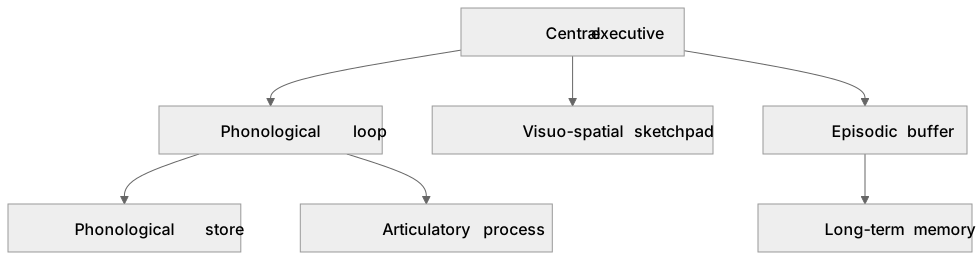
Key words
Say what each word means before you turn the card.
central executive
Try answering aloud or in your head before turning the card.
phonological loop
Try answering aloud or in your head before turning the card.
visuo-spatial sketchpad
Try answering aloud or in your head before turning the card.
episodic buffer
Try answering aloud or in your head before turning the card.
See every definition
- central executive
- A limited-capacity attentional controller that allocates the subsystems and is modality-free, holding virtually no material of its own.
- phonological loop
- Codes acoustically, split into the phonological store and the articulatory process, with about two seconds of capacity.
- visuo-spatial sketchpad
- Codes visual and spatial information, with a capacity of three to four objects.
- episodic buffer
- A limited general store with a capacity of about four chunks that binds information from the other components and links it to long-term memory.
Label the diagram
Some boxes have lost their names. Pick the right name for each number.
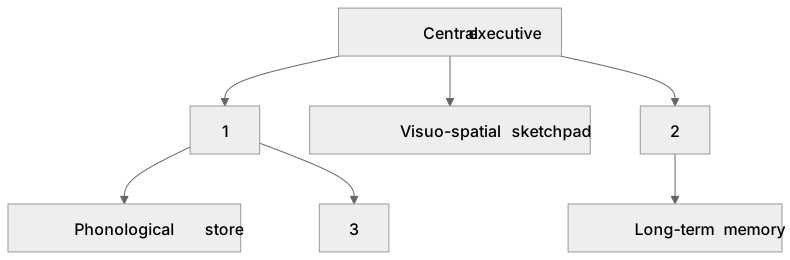
1Box 1
2Box 2
3Box 3
There is more to this lesson
The full lesson goes on to check your understanding and help you earn the marks. Create a free account to carry on, with your progress saved.
A week of Premium from your first lesson · Then the free plan continues · No card, no charge
Test your understanding of Memory: The working memory model: central executive, phonological loop, visuo-spatial sketchpad and episodic buffer. Features of the model: coding and capacity.
Active recall beats re-reading. Take an instant quiz now to test what you’ve learned and lock it into long-term memory.
A week of Premium from your first lesson · Then the free plan continues · No card, no charge