AQA · A-Level · Psychology
Course version: 7182-2025 · Exams from 2027
Explanations for forgetting: proactive and retroactive interference and…
Full specification wording
Memory: Explanations for forgetting: proactive and retroactive interference and retrieval failure due to absence of cues.
Two very different accounts.
Checked against the AQA 7182-2025 specification (opens in a new tab) on .
- Point 3 of 4
- 4 key terms
Study notes
From the checked teaching notes for this specification point.
The idea
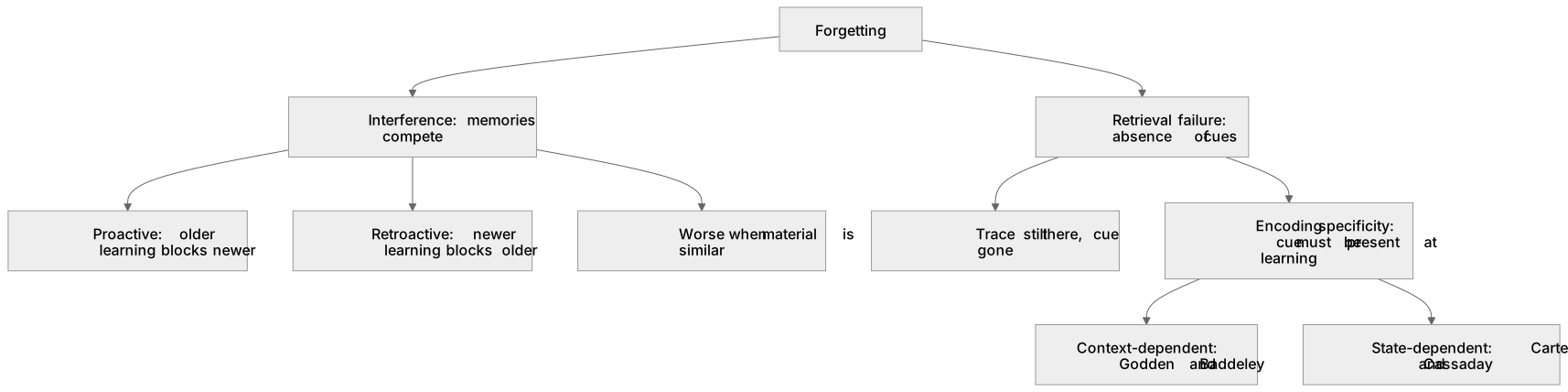
Two very different accounts. Interference says memories compete, and the damage is worst when the material is similar. Proactive means older learning blocks newer; retroactive means newer learning blocks older. McGeoch and McDonald (1931) taught a word list to perfection, then gave a second list, and recall of the first fell to 12.5% when the new words were synonyms against 37.1% when they were numbers, which shows similarity is the active variable. Retrieval failure says the trace is still there but the cue has gone. Encoding specificity predicts that a cue only works if it was present at learning, and Godden and Baddeley (1975) had divers learn and recall on land or underwater, with recall about 40% worse whenever the two settings mismatched. Carter and Cassaday (1998) showed the same for internal state using antihistamines.
What earns the marks
- Interference defined as competition between memories, with the direction stated: proactive is older on newer, retroactive is newer on older.
- An everyday example each way, and similarity named as the condition that makes the effect worse.
- McGeoch and McDonald's synonym condition quoted as evidence that similarity, not merely extra learning, causes the loss.
- Retrieval failure explained as material that is available but not accessible, with encoding specificity and the missing cue.
- Context-dependent forgetting separated from state-dependent forgetting, with Godden and Baddeley and with Carter and Cassaday.
- Evaluation: artificial word lists and short intervals limit generalisation, and interference cannot explain why forgotten material returns once the right cue is given.
Common mistakes and how to put them right
Reversing the two forms of interference.
Put it right: 'pro' runs forwards, so the older memory acts forwards onto the newer one.
Writing that interference destroys the memory, when the studies show a blocked route to it rather than an erased trace.
Describing the divers study without saying which conditions matched and which did not, so the finding has nothing to attach to.
Exam tips
- If the question names one explanation, the other earns credit only as a comparison inside the evaluation.
- In a scenario, decide first whether a cue is missing or another memory is competing, because everything you write follows from that choice.
- Quote a figure from one study rather than three study names, since a named result is what separates a top band answer.
Try the lesson
The start of the Memory: Explanations for forgetting: proactive and retroactive interference and retrieval failure due to absence of cues. lesson, made from checked teaching notes for this specification point.
Have a go first
Which of the following statements provides the most accurate description of proactive interference?
Listen
Two very different accounts. Interference says memories compete, and the damage is worst when the material is similar. Proactive means older learning blocks newer; retroactive means newer learning blocks older. McGeoch and McDonald (1931) taught a word list to perfection, then gave a second list, and recall of the first fell to 12.5% when the new words were synonyms against 37.1% when they were numbers, which shows similarity is the active variable. Retrieval failure says the trace is still there but the cue has gone. Encoding specificity predicts that a cue only works if it was present at learning, and Godden and Baddeley (1975) had divers learn and recall on land or underwater, with recall about 40% worse whenever the two settings mismatched. Carter and Cassaday (1998) showed the same for internal state using antihistamines. A strong answer earns marks for these points. interference defined as competition between memories, with the direction stated: proactive is older on newer, retroactive is newer on older. an everyday example each way, and similarity named as the condition that makes the effect worse. McGeoch and McDonald's synonym condition quoted as evidence that similarity, not merely extra learning, causes the loss. retrieval failure explained as material that is available but not accessible, with encoding specificity and the missing cue. Exam tip: if the question names one explanation, the other earns credit only as a comparison inside the evaluation.
See it
Put the events in order
Put these events in the order they happened, earliest first.
- 1. McGeoch and McDonald taught a word list then a second list
- 2. Carter and Cassaday showed state-dependent forgetting using antihistamines
- 3. Godden and Baddeley had divers learn and recall on land or underwater
Key words
Say what each word means before you turn the card.
interference
Try answering aloud or in your head before turning the card.
retrieval failure
Try answering aloud or in your head before turning the card.
encoding specificity
Try answering aloud or in your head before turning the card.
similarity
Try answering aloud or in your head before turning the card.
See every definition
- interference
- Competition between memories, where proactive means older learning blocks newer and retroactive means newer learning blocks older.
- retrieval failure
- The trace is still there but the cue has gone, so material is available but not accessible.
- encoding specificity
- A cue only works if it was present at learning.
- similarity
- The condition that makes interference worse, shown by recall of the first list falling most when the new words were synonyms.
Label the diagram
Some boxes have lost their names. Pick the right name for each number.
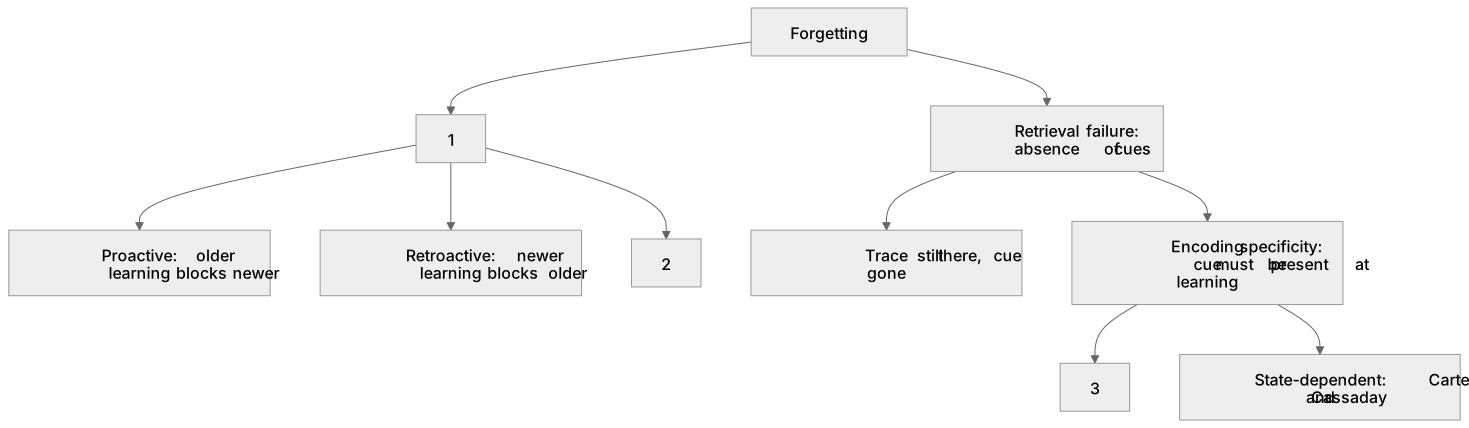
1Box 1
2Box 2
3Box 3
There is more to this lesson
The full lesson goes on to check your understanding and help you earn the marks. Create a free account to carry on, with your progress saved.
A week of Premium from your first lesson · Then the free plan continues · No card, no charge
Test your understanding of Memory: Explanations for forgetting: proactive and retroactive interference and retrieval failure due to absence of cues.
Active recall beats re-reading. Take an instant quiz now to test what you’ve learned and lock it into long-term memory.
A week of Premium from your first lesson · Then the free plan continues · No card, no charge