AQA · A-Level · Psychology
Course version: 7182-2025 · Exams from 2027
Factors affecting attraction in romantic relationships: self-disclosure;…
Full specification wording
Relationships: Factors affecting attraction in romantic relationships: self-disclosure; physical attractiveness, including the matching hypothesis; filter theory, including social demography, similarity in attitudes and complementarity.
Three separate mechanisms, so learn them separately.
Checked against the AQA 7182-2025 specification (opens in a new tab) on .
- Point 1 of 4
- 4 key terms
Study notes
From the checked teaching notes for this specification point.
The idea
Three separate mechanisms, so learn them separately. Self disclosure builds intimacy through reciprocity: Altman and Taylor picture the person as an onion whose layers are peeled back in breadth and depth, and Reis and Shaver add that a disclosure must be returned and responded to or the relationship stalls. Physical attractiveness works through the halo effect, since Dion (1972) found attractive faces were rated kinder and more successful, so beauty buys traits it never earned. The matching hypothesis says we settle for someone of similar attractiveness to avoid rejection, although Walster's computer dance failed to support it because students simply liked the best looking partner. Filter theory (Kerckhoff and Davis, 1962) narrows a field of availables by social demography, then by similarity of attitudes early on, then by complementarity in couples together over eighteen months.
What earns the marks
- Self disclosure defined as revealing private information, with reciprocity and appropriate depth as the conditions for it to increase attraction.
- Social penetration theory named, breadth and depth distinguished, Reis and Shaver's point about responsiveness added.
- Halo effect explained through Dion (1972), with the physical attractiveness stereotype that what is beautiful is good.
- Matching hypothesis stated as choosing a partner of comparable attractiveness after realistically judging one's own value.
- Filter theory's three filters in order: social demography (proximity, class, education), similarity of attitudes, complementarity of needs.
- AO3: Walster's own computer dance study did not support the matching hypothesis, because there was no risk of rejection in the design.
- AO3: Kerckhoff and Davis's eighteen month cut off is arbitrary, and Levinger failed to replicate the filters.
- AO3: social demography has weakened as a filter now that online dating removes proximity from the equation.
Common mistakes and how to put them right
Saying the matching hypothesis means partners are matched on personality or wealth.
Put it right: It is specifically about perceived physical attractiveness.
Claiming Walster's study proved matching.
Put it right: It found the opposite, and the credit comes from explaining why the design let participants ignore rejection risk.
Describing self disclosure as simply talking a lot.
Put it right: Too much too soon reduces attraction, and reciprocity is the part that is credited.
Treating complementarity as the same as similarity.
Put it right: Complementarity is needs that fit together, such as one partner who likes to care and one who likes to be cared for.
Exam tips
- If the question names one factor, write about that factor only. A paragraph on filter theory in a question about self disclosure gathers no marks.
- Use the correlation problem as ready made AO3: similar attitudes may be the result of being attracted and converging, not the cause of the attraction.
- For scenario items, tie each named character to one filter, and say which filter is operating at their stage of the relationship.
Try the lesson
The start of the Relationships: Factors affecting attraction in romantic relationships: self-disclosure; physical attractiveness, including the matching hypothesis; filter theory, including social demography, similarity in attitudes and complementarity. lesson, made from checked teaching notes for this specification point.
Have a go first
According to the matching hypothesis, which factor is most likely to determine the choice of a romantic partner?
Listen
Three separate mechanisms, so learn them separately. Self disclosure builds intimacy through reciprocity: Altman and Taylor picture the person as an onion whose layers are peeled back in breadth and depth, and Reis and Shaver add that a disclosure must be returned and responded to or the relationship stalls. Physical attractiveness works through the halo effect, since Dion (1972) found attractive faces were rated kinder and more successful, so beauty buys traits it never earned. The matching hypothesis says we settle for someone of similar attractiveness to avoid rejection, although Walster's computer dance failed to support it because students simply liked the best looking partner. Filter theory (Kerckhoff and Davis, 1962) narrows a field of availables by social demography, then by similarity of attitudes early on, then by complementarity in couples together over eighteen months. A strong answer earns marks for these points. Self disclosure defined as revealing private information, with reciprocity and appropriate depth as the conditions for it to increase attraction. Social penetration theory named, breadth and depth distinguished, Reis and Shaver's point about responsiveness added. Halo effect explained through Dion (1972), with the physical attractiveness stereotype that what is beautiful is good. Matching hypothesis stated as choosing a partner of comparable attractiveness after realistically judging one's own value. Exam tip: If the question names one factor, write about that factor only. A paragraph on filter theory in a question about self disclosure gathers no marks.
See it
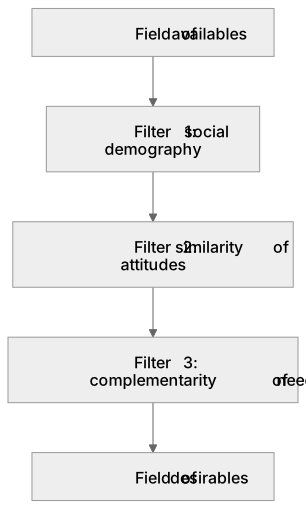
Put it in order
Put these steps in the order they happen.
- 1. Filter 1: social demography
- 2. Filter 2: similarity of attitudes
- 3. Field of availables
- 4. Field of desirables
- 5. Filter 3: complementarity of needs
Key words
Say what each word means before you turn the card.
self-disclosure
Try answering aloud or in your head before turning the card.
halo effect
Try answering aloud or in your head before turning the card.
matching hypothesis
Try answering aloud or in your head before turning the card.
filter theory
Try answering aloud or in your head before turning the card.
See every definition
- self-disclosure
- Revealing private information, which builds intimacy through reciprocity and appropriate depth, with breadth and depth of layers peeled back.
- halo effect
- Attractive faces are rated kinder and more successful, so beauty buys traits it never earned, as the physical attractiveness stereotype.
- matching hypothesis
- We settle for someone of similar attractiveness to avoid rejection, after realistically judging one's own value.
- filter theory
- A field of availables is narrowed by social demography, then similarity of attitudes early on, then complementarity in couples together over eighteen months.
Label the diagram
Some boxes have lost their names. Pick the right name for each number.
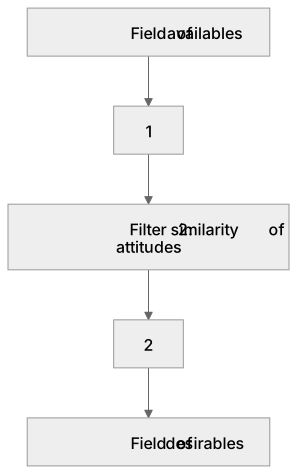
1Box 1
2Box 2
There is more to this lesson
The full lesson goes on to check your understanding and help you earn the marks. Create a free account to carry on, with your progress saved.
A week of Premium from your first lesson · Then the free plan continues · No card, no charge
Test your understanding of Relationships: Factors affecting attraction in romantic relationships: self-disclosure; physical attractiveness, including the matching hypothesis; filter theory, including social demography, similarity in attitudes and complementarity.
Active recall beats re-reading. Take an instant quiz now to test what you’ve learned and lock it into long-term memory.
A week of Premium from your first lesson · Then the free plan continues · No card, no charge