AQA · A-Level · Psychology
Course version: 7182-2025 · Exams from 2027
Theories of romantic relationships: social exchange theory, equity theory…
Full specification wording
Relationships: Theories of romantic relationships: social exchange theory, equity theory and Rusbult’s investment model of commitment, satisfaction, comparison with alternatives and investment. Duck’s phase model of relationship breakdown: intra-psychic, dyadic, social and grave dressing phases.
These theories treat love as accounting, and each fixes a flaw in the one before.
Checked against the AQA 7182-2025 specification (opens in a new tab) on .
- Point 2 of 4
- 4 key terms
Study notes
From the checked teaching notes for this specification point.
The idea
These theories treat love as accounting, and each fixes a flaw in the one before. Social exchange (Thibaut and Kelley) says we weigh rewards against costs and judge the profit against two standards, a comparison level set by past relationships and a comparison level for alternatives. Equity theory answers that fairness beats profit, since a partner who is over benefitted feels guilt and one who is under benefitted feels resentment. Rusbult then explains why people stay when profit is negative: commitment rests on satisfaction, poor alternatives and investment, the time, money and children already sunk in. Rusbult and Martz (1995) found abused women returned to partners when investment was high and alternatives were poor. Duck adds a timeline of breakdown, moving from private brooding to confrontation, then to going public and finally to the story each partner tells afterwards.
What earns the marks
- Social exchange theory stated as rewards minus costs, with comparison level and comparison level for alternatives defined separately.
- Equity theory distinguished from social exchange: the perceived ratio of inputs to outputs matters more than the size of the profit.
- Rusbult's three factors named precisely: satisfaction, quality of alternatives and investment, with intrinsic and extrinsic investment distinguished.
- Rusbult and Martz (1995) applied to explain why a partner stays in an abusive relationship.
- Duck's four phases named in order with their thresholds: intra-psychic, dyadic, social, grave dressing.
- AO3: Clark and Mills argue that partners in communal relationships do not monitor rewards, so the economic metaphor misdescribes real couples.
- AO3: Duck's model is descriptive rather than explanatory, and rests on retrospective accounts from people whose relationships already ended.
Common mistakes and how to put them right
Confusing the two comparison levels.
Put it right: The comparison level is what you think you deserve based on past relationships, the comparison level for alternatives is whether someone better is available.
Reducing equity theory to equality.
Put it right: Equity is a fair ratio of what each puts in to what each gets out, so unequal contributions can still be equitable.
Leaving investment out of the investment model, or naming commitment as a fourth factor rather than as the outcome the three factors produce.
Getting Duck's phases out of order, or omitting the thresholds that move a partner from one phase to the next.
Exam tips
- Quote the stem in application questions. A couple arguing in front of friends is in the social phase, while a partner privately resenting the housework is intra-psychic.
- Use direction of causality as AO3: dissatisfaction may cause a partner to start counting costs rather than counted costs causing the dissatisfaction.
- Save a line on real world value, since Duck's model suggests intervention, with skills training in the intra-psychic phase and mediation in the dyadic phase.
Try the lesson
The start of the Relationships: Theories of romantic relationships: social exchange theory, equity theory and Rusbult’s investment model of commitment, satisfaction, comparison with alternatives and investment. Duck’s phase model of relationship breakdown: intra-psychic, dyadic, social and grave dressing phases. lesson, made from checked teaching notes for this specification point.
Have a go first
In Duck’s phase model of relationship breakdown, what is the primary focus of the grave dressing phase?
Listen
These theories treat love as accounting, and each fixes a flaw in the one before. Social exchange (Thibaut and Kelley) says we weigh rewards against costs and judge the profit against two standards, a comparison level set by past relationships and a comparison level for alternatives. Equity theory answers that fairness beats profit, since a partner who is over benefitted feels guilt and one who is under benefitted feels resentment. Rusbult then explains why people stay when profit is negative: commitment rests on satisfaction, poor alternatives and investment, the time, money and children already sunk in. Rusbult and Martz (1995) found abused women returned to partners when investment was high and alternatives were poor. Duck adds a timeline of breakdown, moving from private brooding to confrontation, then to going public and finally to the story each partner tells afterwards. A strong answer earns marks for these points. Social exchange theory stated as rewards minus costs, with comparison level and comparison level for alternatives defined separately. Equity theory distinguished from social exchange: the perceived ratio of inputs to outputs matters more than the size of the profit. Rusbult's three factors named precisely: satisfaction, quality of alternatives and investment, with intrinsic and extrinsic investment distinguished. Rusbult and Martz (1995) applied to explain why a partner stays in an abusive relationship. Exam tip: Quote the stem in application questions. A couple arguing in front of friends is in the social phase, while a partner privately resenting the housework is intra-psychic.
See it
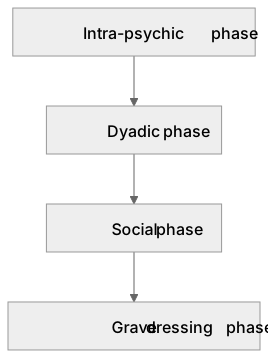
Put it in order
Put these steps in the order they happen.
- 1. Social phase
- 2. Grave dressing phase
- 3. Dyadic phase
- 4. Intra-psychic phase
Key words
Say what each word means before you turn the card.
social exchange theory
Try answering aloud or in your head before turning the card.
equity theory
Try answering aloud or in your head before turning the card.
investment model
Try answering aloud or in your head before turning the card.
Duck's phase model
Try answering aloud or in your head before turning the card.
See every definition
- social exchange theory
- We weigh rewards against costs and judge the profit against two standards, a comparison level set by past relationships and a comparison level for alternatives.
- equity theory
- Fairness beats profit, since a partner who is over benefitted feels guilt and one who is under benefitted feels resentment.
- investment model
- Commitment rests on satisfaction, poor alternatives and investment, the time, money and children already sunk in.
- Duck's phase model
- A timeline of breakdown moving from private brooding to confrontation, then to going public and finally to the story each partner tells afterwards.
Label the diagram
Some boxes have lost their names. Pick the right name for each number.
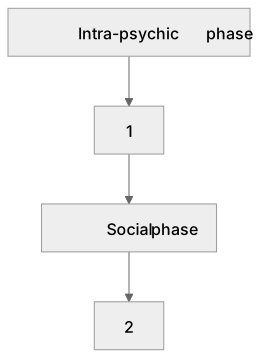
1Box 1
2Box 2
There is more to this lesson
The full lesson goes on to check your understanding and help you earn the marks. Create a free account to carry on, with your progress saved.
A week of Premium from your first lesson · Then the free plan continues · No card, no charge
Test your understanding of Relationships: Theories of romantic relationships: social exchange theory, equity theory and Rusbult’s investment model of commitment, satisfaction, comparison with alternatives and investment. Duck’s phase model of relationship breakdown: intra-psychic, dyadic, social and grave dressing phases.
Active recall beats re-reading. Take an instant quiz now to test what you’ve learned and lock it into long-term memory.
A week of Premium from your first lesson · Then the free plan continues · No card, no charge