AQA · A-Level · Psychology
Course version: 7182-2025 · Exams from 2027
Online relationships: self-disclosure, use of deception, effects of…
Full specification wording
Relationships: Online relationships: self-disclosure, use of deception, effects of absence of gating.
Online relationships, or computer-mediated communication (CMC), differ greatly from face-to-face interactions.
Checked against the AQA 7182-2025 specification (opens in a new tab) on .
- Point 3 of 4
- 4 key terms
Study notes
From the checked teaching notes for this specification point.
The idea
Online relationships, or computer-mediated communication (CMC), differ greatly from face-to-face interactions. Self-disclosure is often higher in CMC because anonymity reduces the fear of negative judgement, leading to rapid intimacy (the hyperpersonal model). However, this same anonymity facilitates the use of deception, allowing individuals to manipulate their online identities or misrepresent traits. A defining feature of CMC is the effects of the absence of gating. In person, 'gates' like physical attractiveness or social anxiety can hinder relationship formation. The absence of these gates online allows relationships to develop based on self-disclosure rather than superficial features, empowering those who struggle socially.
What earns the marks
- Define self-disclosure in CMC, referencing theories like Walther's hyperpersonal model or reduced cues theory.
- Explain how the absence of gating removes traditional barriers, such as physical appearance or speech impediments, to relationship formation.
- Discuss the use of deception in online relationships, such as editing online profiles to present an idealised self.
- Evaluate theories of online relationships using empirical evidence, such as Whitty and Joinson's findings on the directness of online questioning.
Common mistakes and how to put them right
Confusing the hyperpersonal model with reduced cues theory.
Put it right: Ensure you state that the hyperpersonal model suggests CMC leads to greater self-disclosure, whereas reduced cues theory suggests it leads to de-individuation and less self-disclosure.
Failing to define what a 'gate' is before discussing its absence.
Put it right: Explicitly define a gate as any obstacle to the formation of a relationship, such as physical unattractiveness or social anxiety.
Treating all online relationships as identical.
Put it right: Acknowledge that self-disclosure and deception vary depending on the platform, for example, dating apps versus gaming forums.
Exam tips
- Use the concept of 'selective self-presentation' to link self-disclosure and the use of deception in your essays.
- When evaluating the absence of gating, consider the real-world application for individuals with social anxiety or physical disabilities.
- Contrast computer-mediated communication with face-to-face interactions to highlight the unique effects of gating and anonymity.
Try the lesson
The start of the Relationships: Online relationships: self-disclosure, use of deception, effects of absence of gating. lesson, made from checked teaching notes for this specification point.
Have a go first
Which of the following best describes the 'absence of gating' in online relationships?
Listen
Online relationships, or computer-mediated communication (CMC), differ greatly from face-to-face interactions. Self-disclosure is often higher in CMC because anonymity reduces the fear of negative judgement, leading to rapid intimacy (the hyperpersonal model). However, this same anonymity facilitates the use of deception, allowing individuals to manipulate their online identities or misrepresent traits. A defining feature of CMC is the effects of the absence of gating. In person, 'gates' like physical attractiveness or social anxiety can hinder relationship formation. The absence of these gates online allows relationships to develop based on self-disclosure rather than superficial features, empowering those who struggle socially. A strong answer earns marks for these points. Define self-disclosure in CMC, referencing theories like Walther's hyperpersonal model or reduced cues theory. Explain how the absence of gating removes traditional barriers, such as physical appearance or speech impediments, to relationship formation. Discuss the use of deception in online relationships, such as editing online profiles to present an idealised self. Evaluate theories of online relationships using empirical evidence, such as Whitty and Joinson's findings on the directness of online questioning. A common slip: Confusing the hyperpersonal model with reduced cues theory. Instead, Ensure you state that the hyperpersonal model suggests CMC leads to greater self-disclosure, whereas reduced cues theory suggests it leads to de-individuation and less self-disclosure. Exam tip: Use the concept of 'selective self-presentation' to link self-disclosure and the use of deception in your essays.
See it
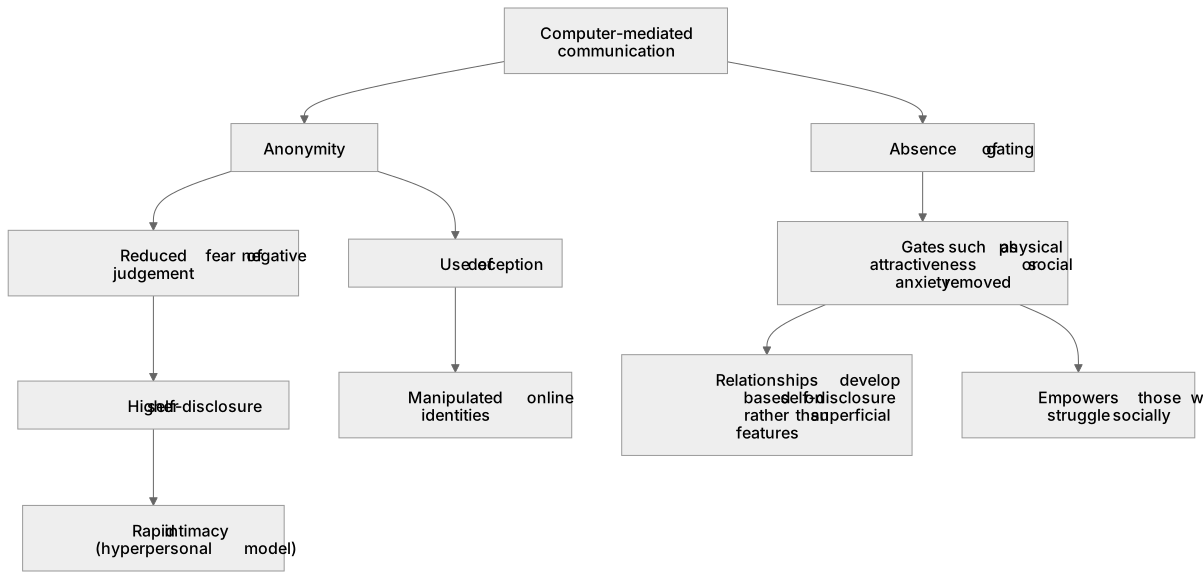
Key words
Say what each word means before you turn the card.
Computer-mediated communication
Try answering aloud or in your head before turning the card.
Absence of gating
Try answering aloud or in your head before turning the card.
Deception
Try answering aloud or in your head before turning the card.
Self-disclosure
Try answering aloud or in your head before turning the card.
See every definition
- Computer-mediated communication
- Communication that differs greatly from face-to-face interactions, in which self-disclosure is often higher because anonymity reduces the fear of negative judgement.
- Absence of gating
- A defining feature of computer-mediated communication in which gates such as physical attractiveness or social anxiety, which can hinder relationship formation in person, are absent online.
- Deception
- Something facilitated by anonymity, allowing individuals to manipulate their online identities or misrepresent traits.
- Self-disclosure
- Something that is often higher in computer-mediated communication and on which relationships can develop online rather than on superficial features.
Label the diagram
Some boxes have lost their names. Pick the right name for each number.
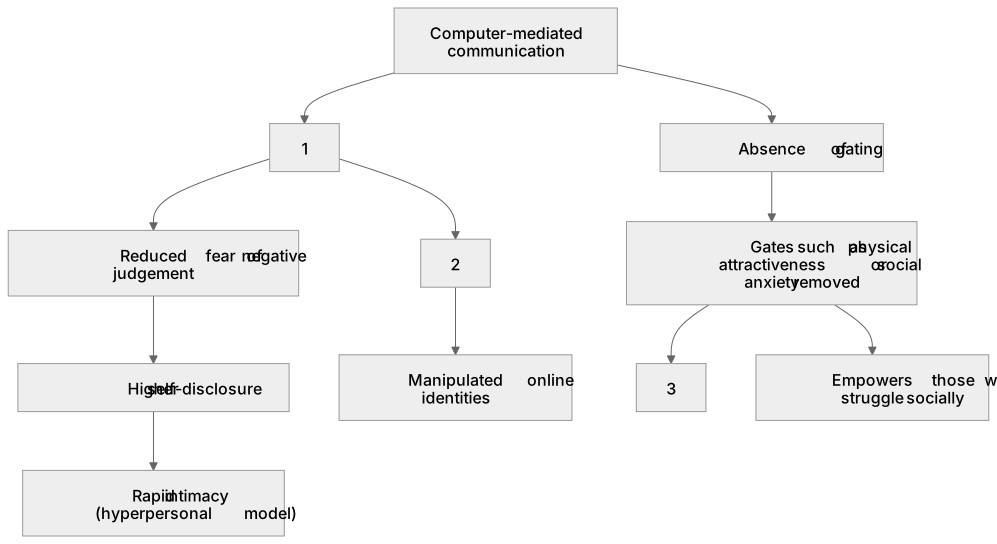
1Box 1
2Box 2
3Box 3
There is more to this lesson
The full lesson goes on to check your understanding and help you earn the marks. Create a free account to carry on, with your progress saved.
A week of Premium from your first lesson · Then the free plan continues · No card, no charge
Test your understanding of Relationships: Online relationships: self-disclosure, use of deception, effects of absence of gating.
Active recall beats re-reading. Take an instant quiz now to test what you’ve learned and lock it into long-term memory.
A week of Premium from your first lesson · Then the free plan continues · No card, no charge