AQA · A-Level · Psychology
Course version: 7182-2025 · Exams from 2027
Research methods: Case studies.
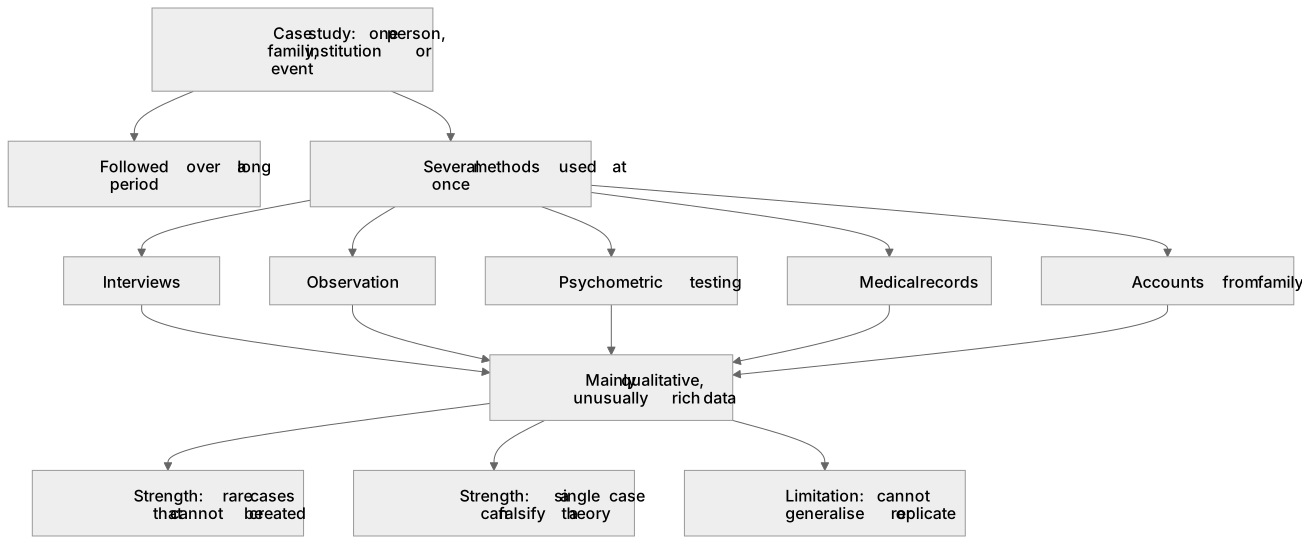
This is a detailed investigation of one person, family, institution or event, usually followed over a long period and usually using several methods at once: interviews, observation, psychometric…
Checked against the AQA 7182-2025 specification (opens in a new tab) on .
- Point 7 of 7
Study notes
From the checked teaching notes for this specification point.
The idea
This is a detailed investigation of one person, family, institution or event, usually followed over a long period and usually using several methods at once: interviews, observation, psychometric testing, medical records and accounts from family, so the data are mainly qualitative and unusually rich. The rare instances are the point. Removal of HM’s hippocampus left him able to learn new motor skills while unable to form new episodic memories, which is direct evidence that memory is not one store, and KF’s poor digit span alongside intact long-term recall contradicted the multi-store model’s single route. The strength is also the weakness: one person cannot be generalised from, nothing can be replicated, interpretation leans on the researcher, and family history is collected from memories that may be wrong.
What earns the marks
- Defined as an in-depth, usually longitudinal study of a single individual, group, institution or event.
- Multiple methods used together - interview, observation, psychometric tests, records and reports from others - so the account is triangulated.
- Data are mainly qualitative, although quantitative measures such as IQ or memory-span scores are routinely included.
- A named example with what it demonstrated, such as HM retaining procedural learning while losing the ability to form new episodic memories.
- Strength: the only way to study cases too rare or too unethical to create, which is where much of what is known about brain damage comes from.
- Strength: a single case can falsify a general theory, as KF’s intact long-term memory alongside impaired short-term memory did to the multi-store model.
- Limitation: the case is by definition unusual, so generalising to a population is unsafe.
- Limitation: the researcher’s interpretation shapes the account, replication is impossible, and retrospective family reports are of uncertain accuracy.
Common mistakes and how to put them right
Describing it as one method, usually an interview, and losing the mark for the range of techniques combined in it.
Saying it has low validity without distinguishing.
Put it right: The detail about the individual can be very valid, and it is generalisation that fails.
Confusing the method with an illustrative example used to support a theory in an essay.
Evaluating only negatively, when falsifying a theory and reaching otherwise unreachable cases are creditable strengths.
Exam tips
- Name a real case and what it showed; a specific example turns a generic evaluation sentence into a credited one.
- Where the stem describes one participant studied in depth over time, identify the method and quote the detail from the stem that proves it.
- Balance the answer, because an evaluation that is all limitations cannot reach the top band on a discuss question.
- If asked how the findings could be checked, suggest further cases with the same profile rather than replication of this one.
Try the lesson
The start of the Research methods: Case studies. lesson, made from checked teaching notes for this specification point.
Have a go first
What is the primary defining feature of a case study in psychological research?
Listen
This is a detailed investigation of one person, family, institution or event, usually followed over a long period and usually using several methods at once: interviews, observation, psychometric testing, medical records and accounts from family, so the data are mainly qualitative and unusually rich. The rare instances are the point. Removal of HM’s hippocampus left him able to learn new motor skills while unable to form new episodic memories, which is direct evidence that memory is not one store, and KF’s poor digit span alongside intact long-term recall contradicted the multi-store model’s single route. The strength is also the weakness: one person cannot be generalised from, nothing can be replicated, interpretation leans on the researcher, and family history is collected from memories that may be wrong. A strong answer earns marks for these points. Defined as an in-depth, usually longitudinal study of a single individual, group, institution or event. Multiple methods used together - interview, observation, psychometric tests, records and reports from others - so the account is triangulated. Data are mainly qualitative, although quantitative measures such as IQ or memory-span scores are routinely included. A named example with what it demonstrated, such as HM retaining procedural learning while losing the ability to form new episodic memories. Exam tip: Name a real case and what it showed; a specific example turns a generic evaluation sentence into a credited one.
See it
Label the diagram
Some boxes have lost their names. Pick the right name for each number.
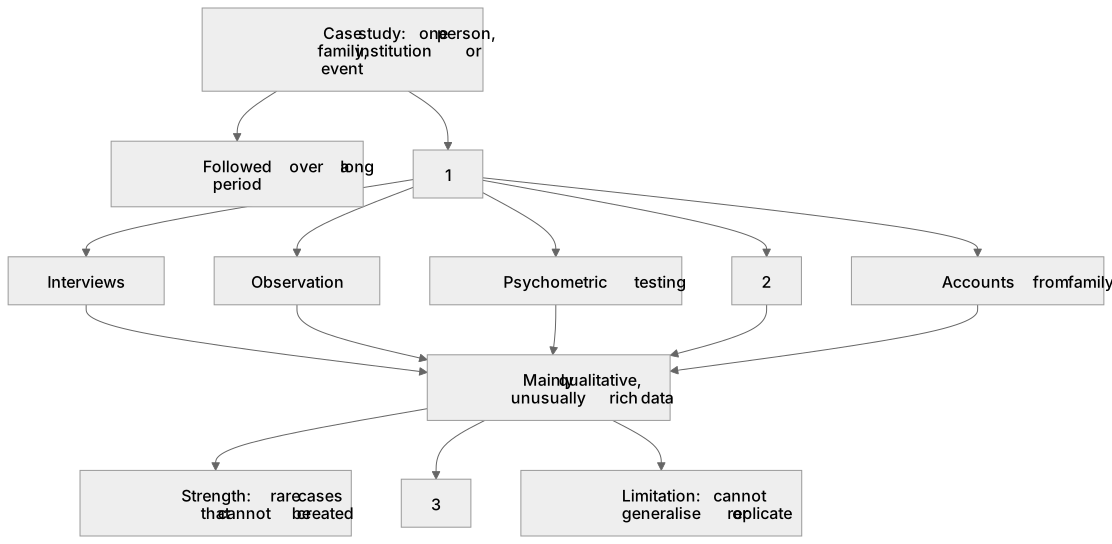
1Box 1
2Box 2
3Box 3
There is more to this lesson
The full lesson goes on to check your understanding and help you earn the marks. Create a free account to carry on, with your progress saved.
A week of Premium from your first lesson · Then the free plan continues · No card, no charge
Test your understanding of Research methods: Case studies.
Active recall beats re-reading. Take an instant quiz now to test what you’ve learned and lock it into long-term memory.
A week of Premium from your first lesson · Then the free plan continues · No card, no charge