AQA · A-Level · Psychology
Course version: 7182-2025 · Exams from 2027
Research methods: Content analysis.
Content analysis turns existing media—adverts, diaries, tweets—into data, observing artefacts rather than people.
Checked against the AQA 7182-2025 specification (opens in a new tab) on .
- Point 6 of 7
- 4 key terms
Study notes
From the checked teaching notes for this specification point.
The idea
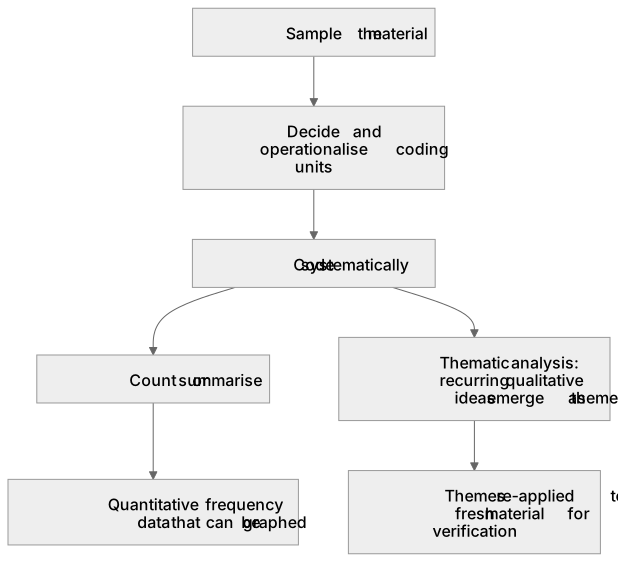
Content analysis turns existing media—adverts, diaries, tweets—into data, observing artefacts rather than people. The procedure involves sampling material, agreeing coding units in advance, and tallying appearances. Coding yields quantitative frequency counts that can be graphed. Thematic analysis instead lets recurring qualitative ideas emerge as themes, which are re-applied to fresh material for verification. For example, Manstead and McCulloch coded 170 British TV adverts, finding men often in autonomous roles and women in dependent ones. The material is real and unaffected by being studied, eliminating demand characteristics, but coding relies on subjective judgement, meaning inter-rater reliability must be established.
What earns the marks
- Defined as an indirect observational technique applied to communications and artefacts rather than to people behaving in front of a researcher.
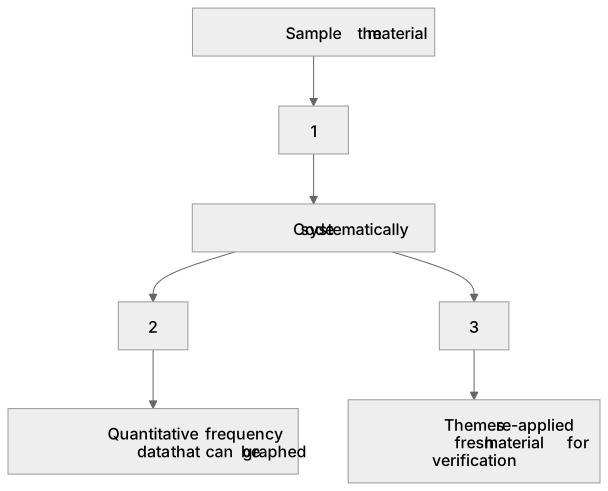
- Procedure in order: sample the material, decide and operationalise the coding units or categories, code systematically, count or summarise.
- Coding produces quantitative frequency data; thematic analysis produces qualitative themes that are then tested against new material.
- A named example with its finding, such as Manstead and McCulloch’s coding of 170 television adverts showing men in autonomous and women in dependent roles.
- Strengths: the material was produced for real purposes, so external validity is high, and studying it creates no demand characteristics.
- Strengths: publicly available material raises few ethical problems, and clearly stated coding units make the study replicable.
- Limitations: observer bias in deciding what counts, material analysed outside the context that produced it, and categories that carry the researcher’s own culture.
- Reliability established by a second researcher coding the same material independently and the two sets of tallies being correlated.
Common mistakes and how to put them right
Describing it as an experiment, or as simply reading through the material and writing an impression of it.
Offering coding categories that are interpretations, such as "sexist", instead of countable units such as "the number of adverts with a male voice-over".
Losing the distinction between coding, which is quantitative, and thematic analysis, which is qualitative.
Asserting there are no ethical issues at all, when private material such as diaries or therapy notes still needs consent.
Exam tips
- Answer "how would you carry this out" as an ordered procedure, with the coding units taken from the material named in the stem.
- Say which type of data the method will produce, because that decides the graph and the statistical test in later parts of the question.
- Evaluate by comparison: contrast it with interviewing the same people, where demand characteristics would appear.
- If the question says analyse qualitatively, describe themes emerging and being verified, not a tally chart.
Try the lesson
The start of the Research methods: Content analysis. lesson, made from checked teaching notes for this specification point.
Have a go first
Which of the following best describes the process of content analysis in psychological research?
Listen
Content analysis turns existing media—adverts, diaries, tweets—into data, observing artefacts rather than people. The procedure involves sampling material, agreeing coding units in advance, and tallying appearances. Coding yields quantitative frequency counts that can be graphed. Thematic analysis instead lets recurring qualitative ideas emerge as themes, which are re-applied to fresh material for verification. For example, Manstead and McCulloch coded 170 British TV adverts, finding men often in autonomous roles and women in dependent ones. The material is real and unaffected by being studied, eliminating demand characteristics, but coding relies on subjective judgement, meaning inter-rater reliability must be established. A strong answer earns marks for these points. Defined as an indirect observational technique applied to communications and artefacts rather than to people behaving in front of a researcher. Procedure in order: sample the material, decide and operationalise the coding units or categories, code systematically, count or summarise. Coding produces quantitative frequency data; thematic analysis produces qualitative themes that are then tested against new material. A named example with its finding, such as Manstead and McCulloch’s coding of 170 television adverts showing men in autonomous and women in dependent roles. Exam tip: Answer "how would you carry this out" as an ordered procedure, with the coding units taken from the material named in the stem.
See it
Key words
Say what each word means before you turn the card.
Content analysis
Try answering aloud or in your head before turning the card.
Coding
Try answering aloud or in your head before turning the card.
Thematic analysis
Try answering aloud or in your head before turning the card.
Inter-rater reliability
Try answering aloud or in your head before turning the card.
See every definition
- Content analysis
- An indirect observational technique applied to communications and artefacts rather than to people behaving in front of a researcher.
- Coding
- Produces quantitative frequency data by tallying appearances, with coding units decided and operationalised in advance.
- Thematic analysis
- Lets recurring qualitative ideas emerge as themes, which are re-applied to fresh material for verification.
- Inter-rater reliability
- Established by a second researcher coding the same material independently and the two sets of tallies being correlated.
Label the diagram
Some boxes have lost their names. Pick the right name for each number.
1Box 1
2Box 2
3Box 3
There is more to this lesson
The full lesson goes on to check your understanding and help you earn the marks. Create a free account to carry on, with your progress saved.
A week of Premium from your first lesson · Then the free plan continues · No card, no charge
Test your understanding of Research methods: Content analysis.
Active recall beats re-reading. Take an instant quiz now to test what you’ve learned and lock it into long-term memory.
A week of Premium from your first lesson · Then the free plan continues · No card, no charge