AQA · A-Level · Psychology
Course version: 7182-2025 · Exams from 2027
Psychological explanations for schizophrenia: family dysfunction and…
Full specification wording
Schizophrenia: Psychological explanations for schizophrenia: family dysfunction and cognitive explanations, including dysfunctional thought processing.
These explanations put the cause in relationships and in thinking rather than in the brain.
Checked against the AQA 7182-2025 specification (opens in a new tab) on .
- Point 3 of 6
- 4 key terms
Study notes
From the checked teaching notes for this specification point.
The idea
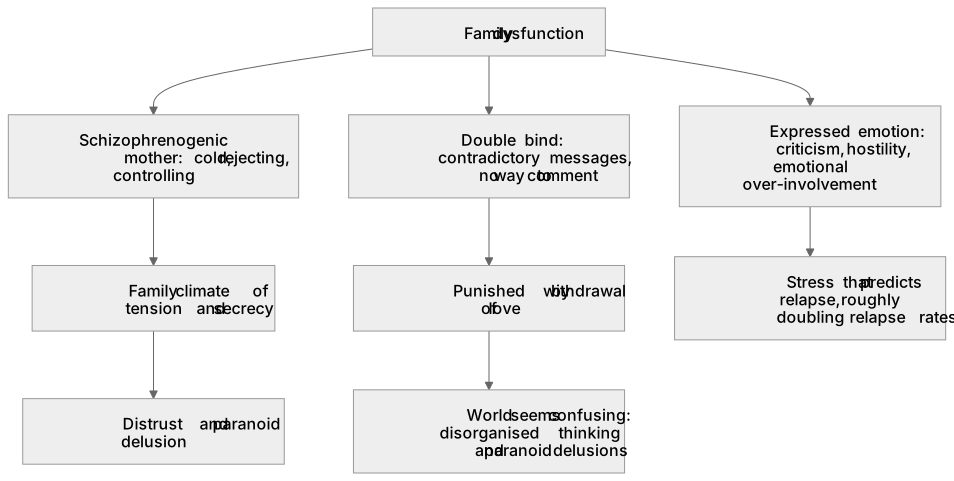
These explanations put the cause in relationships and in thinking rather than in the brain. Fromm-Reichmann described the schizophrenogenic mother, cold and controlling, creating a family climate of tension and secrecy that breeds distrust and then paranoid delusion. Bateson's double bind traps a child in contradictory messages punished by withdrawn love, so the world comes to seem dangerous. Expressed emotion, meaning criticism, hostility and emotional over-involvement in relatives, is a stressor that predicts relapse rather than onset, roughly doubling relapse rates. Frith names two faults in thought: metarepresentation, our ability to recognise thoughts as our own, whose failure gives voices and thought insertion, and central control, whose failure derails speech. Stirling found patients took twice as long on the Stroop task.
What earns the marks
- Family dysfunction explanations claim abnormal communication and relationships within the family cause or maintain the disorder.
- The schizophrenogenic mother (Fromm-Reichmann) is cold, rejecting and controlling, and creates a family climate of tension and secrecy that leads to distrust and paranoid delusions.
- Cognitive explanations locate the problem in dysfunctional thought processing rather than in the family.
- Stirling et al. supported central control dysfunction: patients took about twice as long as controls on the Stroop test, where an automatic response must be suppressed.
Common mistakes and how to put them right
Confusing the double bind with expressed emotion.
Put it right: The double bind is contradictory communication proposed as a cause of onset; expressed emotion is negative emotional tone that predicts relapse in someone already diagnosed.
Presenting the schizophrenogenic mother and double bind as established fact.
Put it right: Both rest on retrospective clinical impressions of the parents of unwell adults, and the evidence base is weak, which is the evaluation the marks are for.
Ignoring the ethical implications of parent-blaming.
Put it right: Socially sensitive research that blames mothers adds guilt to families already carrying the care burden, and this is a strong AO3 point.
Treating cognitive explanations as explaining the origin.
Put it right: They describe the proximal cause, what is happening in the mind now, and say nothing about the distal cause, what started it.
Describing Frith with no named study.
Put it right: The Stroop finding is what turns a description of central control into credited evidence.
Exam tips
- Where a scenario shows a parent contradicting themselves or criticising constantly, name the concept (double bind, expressed emotion) and quote the line from the stem that shows it; application marks are for the link, not the theory.
- Use the success of CBT for psychosis as evidence for the cognitive explanation, but note that a treatment working does not prove the cause (the treatment-causation fallacy).
- In a "discuss psychological explanations" answer, cover family and cognitive explanations rather than one at length, then evaluate each; the question names both.
- Contrast with the biological explanation for extra AO3: neither family nor cognitive accounts explain the twin concordance data, which points to an interactionist model.
Try the lesson
The start of the Schizophrenia: Psychological explanations for schizophrenia: family dysfunction and cognitive explanations, including dysfunctional thought processing. lesson, made from checked teaching notes for this specification point.
Have a go first
Which of the following best describes the concept of 'expressed emotion' as a psychological explanation for schizophrenia?
Listen
These explanations put the cause in relationships and in thinking rather than in the brain. Fromm-Reichmann described the schizophrenogenic mother, cold and controlling, creating a family climate of tension and secrecy that breeds distrust and then paranoid delusion. Bateson's double bind traps a child in contradictory messages punished by withdrawn love, so the world comes to seem dangerous. Expressed emotion, meaning criticism, hostility and emotional over-involvement in relatives, is a stressor that predicts relapse rather than onset, roughly doubling relapse rates. Frith names two faults in thought: metarepresentation, our ability to recognise thoughts as our own, whose failure gives voices and thought insertion, and central control, whose failure derails speech. Stirling found patients took twice as long on the Stroop task. A strong answer earns marks for these points. Family dysfunction explanations claim abnormal communication and relationships within the family cause or maintain the disorder. The schizophrenogenic mother (Fromm-Reichmann) is cold, rejecting and controlling, and creates a family climate of tension and secrecy that leads to distrust and paranoid delusions. The double bind (Bateson) is a child receiving contradictory messages with no way to comment on them and punishment by withdrawal of love; the child comes to see the world as confusing, which shows in disorganised thinking and paranoid delusions. Bateson called it a risk factor, not the cause. Expressed emotion is verbal criticism, hostility and emotional over-involvement in a relative; it is a source of stress that raises the chance of relapse in a recovering patient, with high-EE homes roughly doubling relapse compared with low-EE homes. Exam tip: Where a scenario shows a parent contradicting themselves or criticising constantly, name the concept (double bind, expressed emotion) and quote the line from the stem that shows it; application marks are for the link, not the theory.
See it
Key words
Say what each word means before you turn the card.
Family dysfunction as a cause
Try answering aloud or in your head before turning the card.
The schizophrenogenic mother and the double bind
Try answering aloud or in your head before turning the card.
Expressed emotion and relapse
Try answering aloud or in your head before turning the card.
Metarepresentation and central control
Try answering aloud or in your head before turning the card.
See every definition
- Family dysfunction as a cause
- Abnormal communication and relationships within the family cause or maintain the disorder.
- The schizophrenogenic mother and the double bind
- A cold, rejecting and controlling mother creates tension and secrecy leading to distrust and paranoid delusions, while the double bind is contradictory messages with no way to comment and punishment by withdrawal of love.
- Expressed emotion and relapse
- Verbal criticism, hostility and emotional over-involvement in a relative is a source of stress that raises the chance of relapse in a recovering patient, roughly doubling relapse compared with low-EE homes.
- Metarepresentation and central control
- Metarepresentation is the ability to reflect on thoughts and behaviour as one's own, and central control is the ability to suppress automatic responses while performing deliberate ones.
Label the diagram
Some boxes have lost their names. Pick the right name for each number.
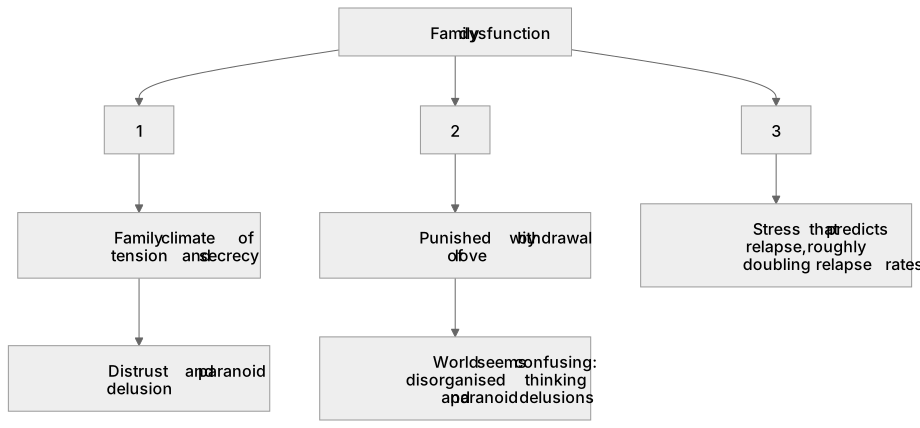
1Box 1
2Box 2
3Box 3
There is more to this lesson
The full lesson goes on to check your understanding and help you earn the marks. Create a free account to carry on, with your progress saved.
A week of Premium from your first lesson · Then the free plan continues · No card, no charge
Test your understanding of Schizophrenia: Psychological explanations for schizophrenia: family dysfunction and cognitive explanations, including dysfunctional thought processing.
Active recall beats re-reading. Take an instant quiz now to test what you’ve learned and lock it into long-term memory.
A week of Premium from your first lesson · Then the free plan continues · No card, no charge