AQA · A-Level · Psychology
Course version: 7182-2025 · Exams from 2027
Schizophrenia: Drug therapy: typical and atypical antipsychotics.
Antipsychotics dampen the dopamine system; they manage symptoms and do not cure.
Checked against the AQA 7182-2025 specification (opens in a new tab) on .
- Point 4 of 6
- 4 key terms
Study notes
From the checked teaching notes for this specification point.
The idea
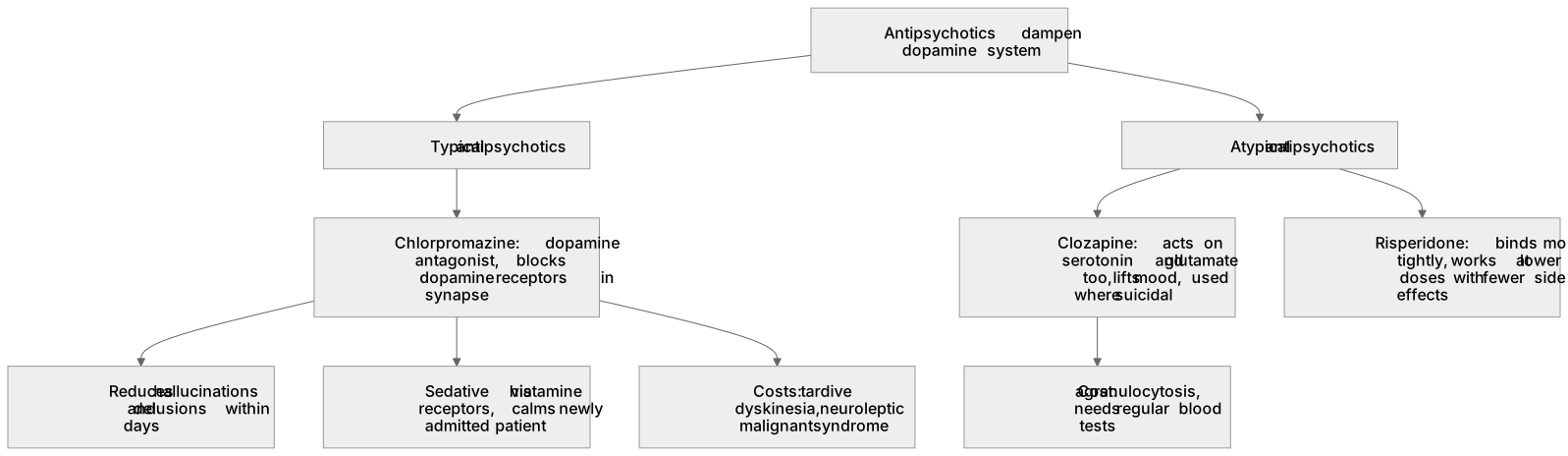
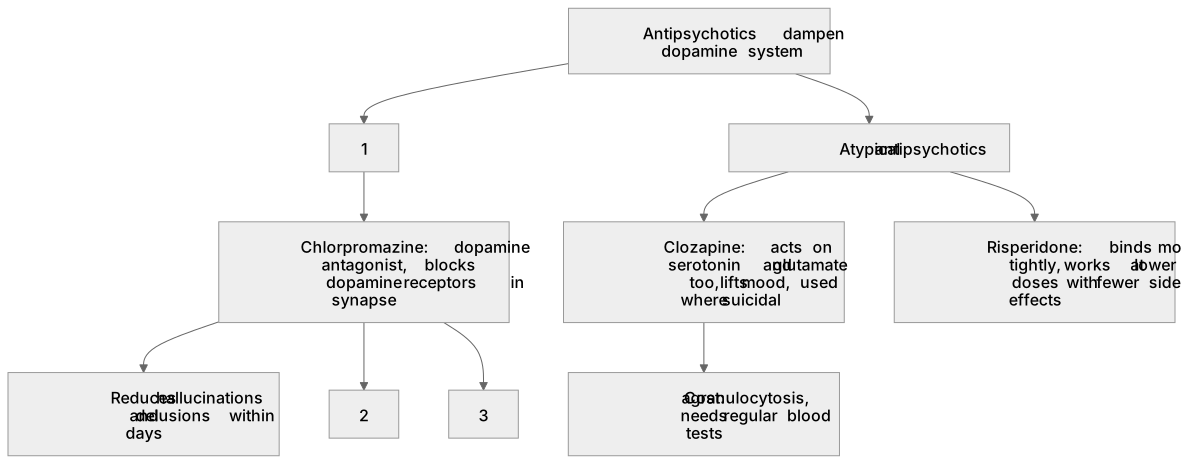
Antipsychotics dampen the dopamine system; they manage symptoms and do not cure. Typical drugs such as chlorpromazine, in use since the 1950s, are dopamine antagonists that block dopamine receptors in the synapse, and within days that reduces hallucinations and delusions. Chlorpromazine is also a powerful sedative acting on histamine receptors, which is why it calms a newly admitted patient. Atypicals act more widely: clozapine works on serotonin and glutamate too, so it lifts mood and is prescribed where a patient is suicidal, while risperidone binds more tightly and so works at lower doses with fewer side effects. Thornley's review found chlorpromazine beat placebo on symptom severity. The costs are real, from tardive dyskinesia to fatal neuroleptic malignant syndrome.
What earns the marks
- Antipsychotics are the main treatment, taken in the short term to calm an acute episode or in the long term to prevent relapse, and they reduce symptoms rather than cure the condition.
- Typical antipsychotics such as chlorpromazine are dopamine antagonists: they block dopamine receptors in the synapse, reducing dopamine action, which fits the original dopamine hypothesis and reduces positive symptoms.
- Chlorpromazine has a strong sedative effect through histamine receptors, so it is used to calm patients on admission, and dosage has fallen over time from the very high levels used in the past.
- Atypical antipsychotics such as clozapine also act on serotonin and glutamate receptors, which improves mood and reduces anxiety and depression, and clozapine is prescribed where a patient is at risk of suicide.
- Risperidone is a more recent atypical that binds more strongly to dopamine receptors, so it is effective in smaller doses and produces fewer side effects than typical drugs.
- Typical drugs carry serious side effects: weight gain, dizziness, sleepiness, and tardive dyskinesia, the involuntary facial movements caused by dopamine supersensitivity.
- Neuroleptic malignant syndrome is a rare but potentially fatal reaction causing high temperature, delirium and coma; clozapine can cause agranulocytosis, so patients need regular blood tests.
Common mistakes and how to put them right
Saying antipsychotics cure schizophrenia.
Put it right: They suppress symptoms while taken, and relapse is common when medication stops, which is why compliance is a central issue.
Muddling the two types.
Put it right: Typical drugs are dopamine antagonists with strong side effects; atypical drugs act on a wider range of receptors, with a better side-effect profile, and both block dopamine.
Naming tardive dyskinesia without saying what it is. Marks come from describing involuntary movements of the face and tongue caused by dopamine supersensitivity, not from the term alone.
Assuming effectiveness evidence is clean.
Put it right: Healy pointed out that some trial data were published more than once, exaggerating the apparent evidence, and that the calming effect can be mistaken for a reduction in psychosis.
Leaving out the ethical argument.
Put it right: Antipsychotics used to make patients easier for staff to manage, the chemical-cosh criticism, raise a human-rights issue that is worth a full AO3 paragraph.
Exam tips
- Always link the drug back to the dopamine hypothesis; the mechanism mark is for explaining that blocking dopamine receptors reduces dopamine action, not for naming the drug.
- For evaluation, weigh effectiveness evidence against side effects and against the point that reducing dopamine only makes sense if the dopamine hypothesis is correct.
- In an application question, use the detail in the stem. A suicidal patient points to clozapine; a patient troubled by side effects points to risperidone or a lower dose.
- Name at least one specific typical and one specific atypical drug. An answer written entirely about "antipsychotics" cannot reach the top band.
Try the lesson
The start of the Schizophrenia: Drug therapy: typical and atypical antipsychotics. lesson, made from checked teaching notes for this specification point.
Have a go first
What is the primary mechanism of action for typical antipsychotic drugs used in the treatment of schizophrenia?
Listen
Antipsychotics dampen the dopamine system; they manage symptoms and do not cure. Typical drugs such as chlorpromazine, in use since the 1950s, are dopamine antagonists that block dopamine receptors in the synapse, and within days that reduces hallucinations and delusions. Chlorpromazine is also a powerful sedative acting on histamine receptors, which is why it calms a newly admitted patient. Atypicals act more widely: clozapine works on serotonin and glutamate too, so it lifts mood and is prescribed where a patient is suicidal, while risperidone binds more tightly and so works at lower doses with fewer side effects. Thornley's review found chlorpromazine beat placebo on symptom severity. The costs are real, from tardive dyskinesia to fatal neuroleptic malignant syndrome. A strong answer earns marks for these points. Antipsychotics are the main treatment, taken in the short term to calm an acute episode or in the long term to prevent relapse, and they reduce symptoms rather than cure the condition. Typical antipsychotics such as chlorpromazine are dopamine antagonists: they block dopamine receptors in the synapse, reducing dopamine action, which fits the original dopamine hypothesis and reduces positive symptoms. Chlorpromazine has a strong sedative effect through histamine receptors, so it is used to calm patients on admission, and dosage has fallen over time from the very high levels used in the past. Atypical antipsychotics such as clozapine also act on serotonin and glutamate receptors, which improves mood and reduces anxiety and depression, and clozapine is prescribed where a patient is at risk of suicide. Exam tip: Always link the drug back to the dopamine hypothesis; the mechanism mark is for explaining that blocking dopamine receptors reduces dopamine action, not for naming the drug.
See it
Key words
Say what each word means before you turn the card.
Dopamine antagonists and receptor blocking
Try answering aloud or in your head before turning the card.
Typical versus atypical antipsychotics
Try answering aloud or in your head before turning the card.
Side effects and tardive dyskinesia
Try answering aloud or in your head before turning the card.
Effectiveness evidence and publication bias
Try answering aloud or in your head before turning the card.
See every definition
- Dopamine antagonists and receptor blocking
- Drugs that block dopamine receptors in the synapse, reducing dopamine action, which fits the original dopamine hypothesis and reduces positive symptoms.
- Typical versus atypical antipsychotics
- Typical drugs are dopamine antagonists with strong side effects, while atypical drugs act on a wider range of receptors with a better side-effect profile, and both block dopamine.
- Side effects and tardive dyskinesia
- Typical drugs carry weight gain, dizziness and sleepiness, and tardive dyskinesia is the involuntary facial movements caused by dopamine supersensitivity.
- Effectiveness evidence and publication bias
- Thornley's review found chlorpromazine beat placebo on symptom severity, but Healy pointed out that some trial data were published more than once, exaggerating the apparent evidence.
Label the diagram
Some boxes have lost their names. Pick the right name for each number.
1Box 1
2Box 2
3Box 3
There is more to this lesson
The full lesson goes on to check your understanding and help you earn the marks. Create a free account to carry on, with your progress saved.
A week of Premium from your first lesson · Then the free plan continues · No card, no charge
Test your understanding of Schizophrenia: Drug therapy: typical and atypical antipsychotics.
Active recall beats re-reading. Take an instant quiz now to test what you’ve learned and lock it into long-term memory.
A week of Premium from your first lesson · Then the free plan continues · No card, no charge