AQA · A-Level · Psychology
Course version: 7182-2025 · Exams from 2027
The importance of an interactionist approach in explaining and treating…
Full specification wording
Schizophrenia: The importance of an interactionist approach in explaining and treating schizophrenia; the diathesis-stress model.
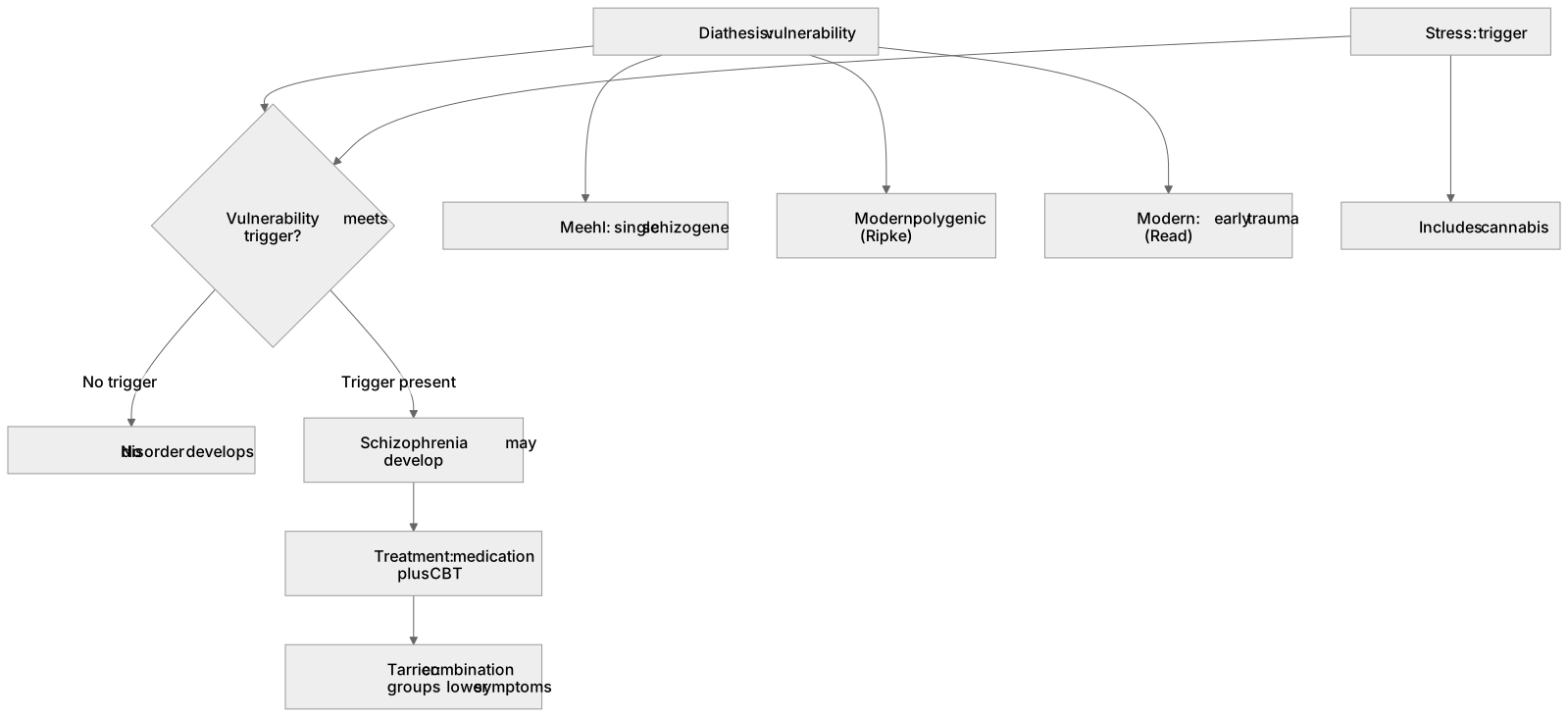
Neither biology nor environment on its own predicts who becomes ill, so the interactionist view says a vulnerability has to meet a trigger.
Checked against the AQA 7182-2025 specification (opens in a new tab) on .
- Point 6 of 6
- 3 key terms
Study notes
From the checked teaching notes for this specification point.
The idea
Neither biology nor environment on its own predicts who becomes ill, so the interactionist view says a vulnerability has to meet a trigger. Meehl's original model made the diathesis a single gene: without it, no amount of stress could produce schizophrenia, while a carrier under chronic stress might. Modern versions widen both halves. Ripke's work replaces the single gene with many, and Read argues early trauma is itself a diathesis because it leaves the stress-response system permanently over-reactive. Stress is now anything that risks triggering onset, including cannabis, which disturbs dopamine and raises risk several times over. Treatment follows the same logic: Tarrier allocated patients to medication with CBT, medication with counselling, or medication alone, and the combined groups showed lower symptom levels.
What earns the marks
- The interactionist approach acknowledges biological, psychological and societal factors together, rather than treating schizophrenia as purely genetic or purely environmental.
- Diathesis means vulnerability and stress means a negative experience that triggers it: both are needed, so a vulnerable person who meets no trigger does not develop the disorder.
- Meehl's original model: the diathesis was entirely genetic, a single "schizogene" producing a schizotypic personality, and chronic stress, including a schizophrenogenic mother, could trigger it in a carrier only.
- The modern diathesis is polygenic, following Ripke, and psychological as well as genetic: Read's neurodevelopmental model treats early childhood trauma as a diathesis that leaves the HPA axis over-active.
- Treatment under an interactionist model combines antipsychotic medication with psychological therapy, most often CBT, rather than choosing between them.
- The treatment-causation fallacy: because a drug helps does not prove a biological cause, so combining therapies does not require a decision about which explanation is right.
Common mistakes and how to put them right
Describing the model as "nature and nurture both matter" and stopping.
Put it right: The marks are for the specific claim that vulnerability alone and stress alone are each insufficient.
Using Meehl's single schizogene as the current model.
Put it right: Modern genetics finds many genes of small effect, which is a development of the model and a good AO3 point.
Assuming the diathesis must be genetic.
Put it right: Read's work makes childhood trauma a diathesis in its own right, so the vulnerability half is not automatically biological.
Forgetting that stress in this model is not only life events.
Put it right: Cannabis is the example the specification content is usually examined on.
Exam tips
- Use the diathesis-stress model to integrate biological and psychological explanations and explain why identical-twin concordance remains below 100%.
- In application questions, split the stem in two, naming what is the diathesis (family history, early trauma) and what is the stressor (cannabis, a bereavement, moving away from home).
- Give the original and the modern version of the model. Contrasting Meehl with polygenic diathesis and trauma diathesis is a ready-made evaluation point.
- When evaluating combined treatment, note that improved symptom scores without lower readmission rates is a partial success, not a straightforward one.
Try the lesson
The start of the Schizophrenia: The importance of an interactionist approach in explaining and treating schizophrenia; the diathesis-stress model. lesson, made from checked teaching notes for this specification point.
Have a go first
In the context of schizophrenia, what does the diathesis-stress model propose?
Listen
Neither biology nor environment on its own predicts who becomes ill, so the interactionist view says a vulnerability has to meet a trigger. Meehl's original model made the diathesis a single gene: without it, no amount of stress could produce schizophrenia, while a carrier under chronic stress might. Modern versions widen both halves. Ripke's work replaces the single gene with many, and Read argues early trauma is itself a diathesis because it leaves the stress-response system permanently over-reactive. Stress is now anything that risks triggering onset, including cannabis, which disturbs dopamine and raises risk several times over. Treatment follows the same logic: Tarrier allocated patients to medication with CBT, medication with counselling, or medication alone, and the combined groups showed lower symptom levels. A strong answer earns marks for these points. The interactionist approach acknowledges biological, psychological and societal factors together, rather than treating schizophrenia as purely genetic or purely environmental. Diathesis means vulnerability and stress means a negative experience that triggers it: both are needed, so a vulnerable person who meets no trigger does not develop the disorder. Meehl's original model: the diathesis was entirely genetic, a single "schizogene" producing a schizotypic personality, and chronic stress, including a schizophrenogenic mother, could trigger it in a carrier only. The modern diathesis is polygenic, following Ripke, and psychological as well as genetic: Read's neurodevelopmental model treats early childhood trauma as a diathesis that leaves the HPA axis over-active. Exam tip: Use the diathesis-stress model to integrate biological and psychological explanations and explain why identical-twin concordance remains below 100%.
See it
Key words
Say what each word means before you turn the card.
Interactionist explanation of schizophrenia
Try answering aloud or in your head before turning the card.
Diathesis and stress as joint requirements
Try answering aloud or in your head before turning the card.
Meehl's original model and its modern revision
Try answering aloud or in your head before turning the card.
See every definition
- Interactionist explanation of schizophrenia
- Acknowledges biological, psychological and societal factors together, rather than treating schizophrenia as purely genetic or purely environmental.
- Diathesis and stress as joint requirements
- Vulnerability and a negative experience that triggers it are both needed, so a vulnerable person who meets no trigger does not develop the disorder.
- Meehl's original model and its modern revision
- The diathesis was entirely genetic, a single schizogene producing a schizotypic personality, while the modern diathesis is polygenic and psychological as well as genetic.
There is more to this lesson
The full lesson goes on to check your understanding and help you earn the marks. Create a free account to carry on, with your progress saved.
A week of Premium from your first lesson · Then the free plan continues · No card, no charge
Test your understanding of Schizophrenia: The importance of an interactionist approach in explaining and treating schizophrenia; the diathesis-stress model.
Active recall beats re-reading. Take an instant quiz now to test what you’ve learned and lock it into long-term memory.
A week of Premium from your first lesson · Then the free plan continues · No card, no charge