AQA · A-Level · Psychology
Course version: 7182-2025 · Exams from 2027
Cognitive behaviour therapy and family therapy as used in the treatment of…
Full specification wording
Schizophrenia: Cognitive behaviour therapy and family therapy as used in the treatment of schizophrenia.
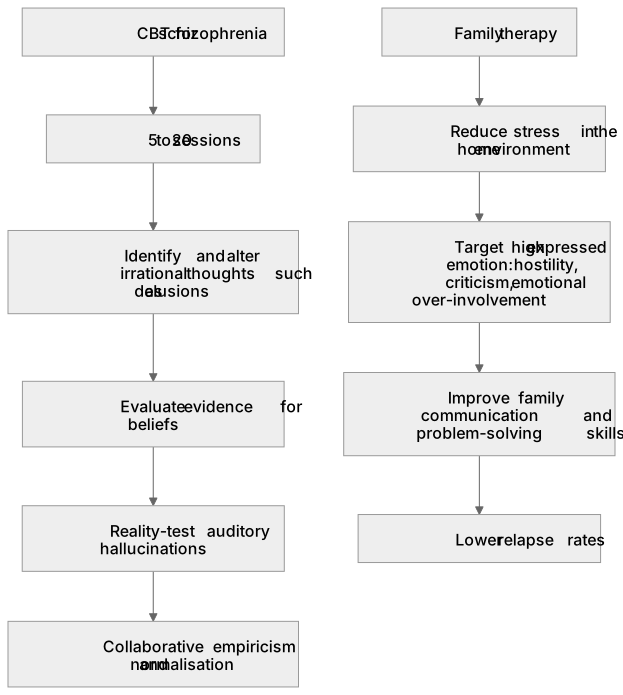
Cognitive behaviour therapy (CBT) for schizophrenia involves 5 to 20 sessions aiming to identify and alter irrational thoughts, such as delusions, by evaluating evidence for these beliefs.
Checked against the AQA 7182-2025 specification (opens in a new tab) on .
- Point 5 of 6
- 4 key terms
Study notes
From the checked teaching notes for this specification point.
The idea
Cognitive behaviour therapy (CBT) for schizophrenia involves 5 to 20 sessions aiming to identify and alter irrational thoughts, such as delusions, by evaluating evidence for these beliefs. For example, a patient might test the reality of auditory hallucinations through collaborative empiricism and normalisation. Family therapy focuses on reducing stress within the home environment, specifically targeting high expressed emotion (EE) like hostility, criticism, and emotional over-involvement. By improving family communication and problem-solving skills, it lowers relapse rates. Neither therapy cures schizophrenia, but both equip patients and families with coping mechanisms to manage symptoms, reduce distress, and improve daily functioning.
What earns the marks
- CBT helps patients identify irrational thoughts and reality-test their hallucinations or delusions.
- CBT uses techniques like normalisation to reduce anxiety associated with psychotic symptoms.
- Family therapy aims to reduce levels of expressed emotion (EE), specifically criticism, hostility, and emotional over-involvement.
- Family therapy improves communication and problem-solving skills within the family unit to prevent relapse.
- Evaluation points often focus on the appropriateness of psychological therapies, noting they require active engagement which may be difficult for severely ill patients.
Common mistakes and how to put them right
Claiming that CBT cures schizophrenia.
Put it right: State that CBT helps manage symptoms and reduces distress, but does not cure the underlying condition.
Confusing family therapy with general counselling.
Put it right: Specify that family therapy actively targets expressed emotion (EE) and provides psychoeducation to relatives.
Stating that psychological therapies work immediately while contrasting them with medication.
Put it right: Explain that both CBT and family therapy require time, commitment, and multiple sessions to show efficacy.
Exam tips
- Use specific terminology like 'expressed emotion' and 'normalisation' when describing how these therapies work.
- When evaluating, contrast the active patient engagement required for CBT with the passive nature of taking antipsychotic medication.
- Reference specific evidence to support your evaluation of their effectiveness, ensuring you distinguish between symptom reduction and relapse prevention.
Try the lesson
The start of the Schizophrenia: Cognitive behaviour therapy and family therapy as used in the treatment of schizophrenia. lesson, made from checked teaching notes for this specification point.
Have a go first
What is the primary aim of family therapy when used in the treatment of schizophrenia?
Listen
Cognitive behaviour therapy (CBT) for schizophrenia involves 5 to 20 sessions aiming to identify and alter irrational thoughts, such as delusions, by evaluating evidence for these beliefs. For example, a patient might test the reality of auditory hallucinations through collaborative empiricism and normalisation. Family therapy focuses on reducing stress within the home environment, specifically targeting high expressed emotion (EE) like hostility, criticism, and emotional over-involvement. By improving family communication and problem-solving skills, it lowers relapse rates. Neither therapy cures schizophrenia, but both equip patients and families with coping mechanisms to manage symptoms, reduce distress, and improve daily functioning. A strong answer earns marks for these points. CBT helps patients identify irrational thoughts and reality-test their hallucinations or delusions. CBT uses techniques like normalisation to reduce anxiety associated with psychotic symptoms. Family therapy aims to reduce levels of expressed emotion (EE), specifically criticism, hostility, and emotional over-involvement. Family therapy improves communication and problem-solving skills within the family unit to prevent relapse. A common slip: Claiming that CBT cures schizophrenia. Instead, State that CBT helps manage symptoms and reduces distress, but does not cure the underlying condition. Exam tip: Use specific terminology like 'expressed emotion' and 'normalisation' when describing how these therapies work.
See it
Key words
Say what each word means before you turn the card.
Cognitive behaviour therapy
Try answering aloud or in your head before turning the card.
Expressed emotion
Try answering aloud or in your head before turning the card.
Normalisation
Try answering aloud or in your head before turning the card.
Family therapy
Try answering aloud or in your head before turning the card.
See every definition
- Cognitive behaviour therapy
- Involves 5 to 20 sessions aiming to identify and alter irrational thoughts, such as delusions, by evaluating evidence for these beliefs.
- Expressed emotion
- High levels include hostility, criticism and emotional over-involvement, which family therapy specifically targets to reduce stress within the home environment.
- Normalisation
- A technique used to reduce anxiety associated with psychotic symptoms, alongside collaborative empiricism, in testing the reality of auditory hallucinations.
- Family therapy
- Focuses on reducing stress within the home environment and, by improving family communication and problem-solving skills, lowers relapse rates.
Label the diagram
Some boxes have lost their names. Pick the right name for each number.
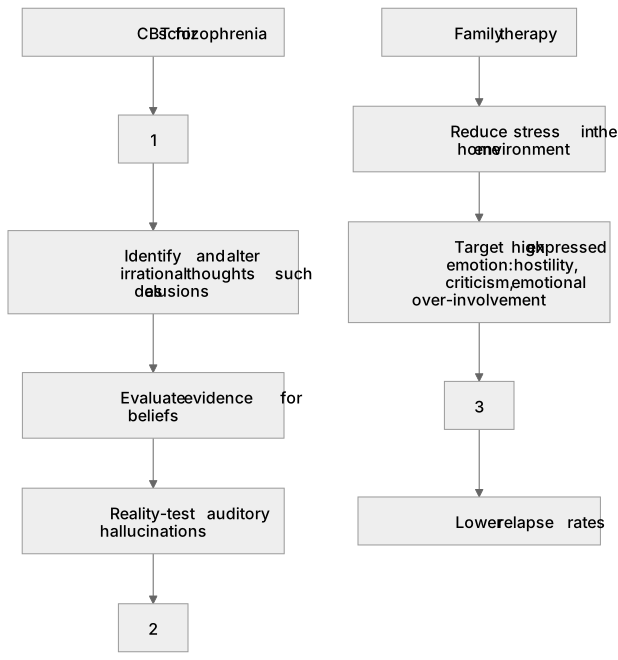
1Box 1
2Box 2
3Box 3
There is more to this lesson
The full lesson goes on to check your understanding and help you earn the marks. Create a free account to carry on, with your progress saved.
A week of Premium from your first lesson · Then the free plan continues · No card, no charge
Test your understanding of Schizophrenia: Cognitive behaviour therapy and family therapy as used in the treatment of schizophrenia.
Active recall beats re-reading. Take an instant quiz now to test what you’ve learned and lock it into long-term memory.
A week of Premium from your first lesson · Then the free plan continues · No card, no charge