AQA · A-Level · Psychology
Course version: 7182-2025 · Exams from 2027
Scientific processes: Demand characteristics and investigator effects.
Participants are not passive.
Checked against the AQA 7182-2025 specification (opens in a new tab) on .
- Point 10 of 17
- 4 key terms
Study notes
From the checked teaching notes for this specification point.
The idea
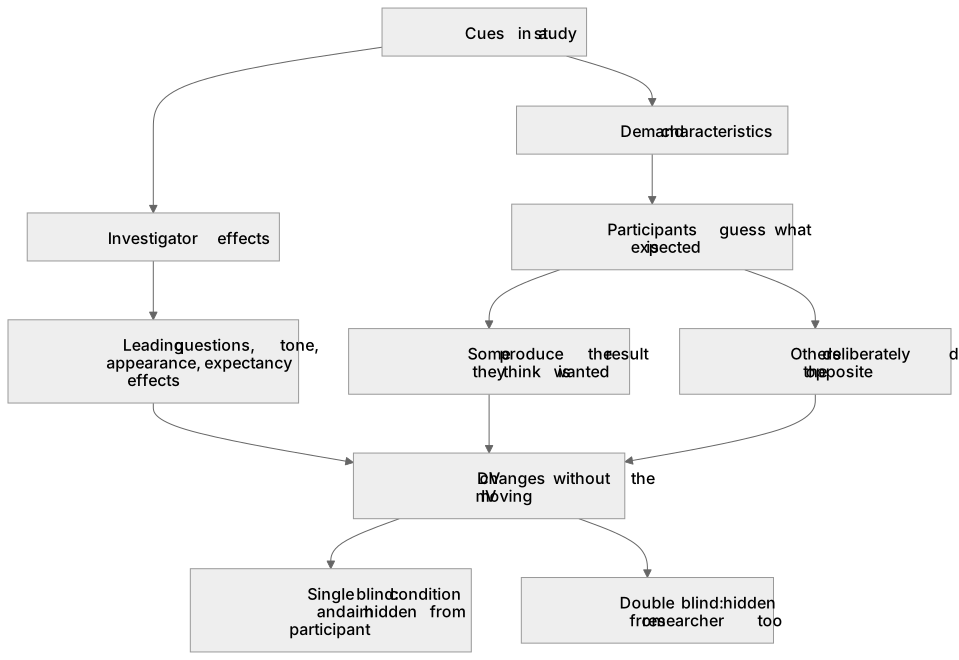
Participants are not passive. Cues in a study, from the consent form to the task itself, let them guess what is expected and act on the guess; these cues are demand characteristics. Some help by producing the result they think is wanted, others deliberately do the opposite. Orne showed participants working at pointless tasks simply because the setting demanded it. The researcher creates investigator effects through leading questions, tone, appearance and expectancy effects, changing the DV without the IV moving. A single blind hides the condition and aim from the participant to reduce demand characteristics, while a double blind hides them from the researcher too.
What earns the marks
- Defines the participant effect as cues that reveal the aim, leading to a change in behaviour.
- Distinguishes those who try to please the researcher from those who deliberately underperform.
- Defines the researcher effect as any influence of the investigator, other than the IV, on the DV.
- Gives examples such as leading questions, tone of voice, appearance or expectancy effects.
- Names controls: single blind, double blind, standardised instructions and a cover story, and links them to internal validity.
Common mistakes and how to put them right
Treating the two terms as interchangeable, when one comes from the participant and one from the researcher.
Saying participants 'try harder' without explaining that this changes the DV independently of the IV.
Describing a double blind as the participant not knowing, which is a single blind.
Claiming deception always removes the problem, ignoring that the setting itself still carries cues.
Exam tips
- Pin the effect to the DV: explicitly state that scores change for a reason other than the IV, which compromises internal validity.
- Use the scenario's own cue, for example the researcher watching and taking notes, rather than an abstract definition.
- When suggesting a control, say who is kept ignorant of what, because that detail distinguishes single from double blind.
Try the lesson
The start of the Scientific processes: Demand characteristics and investigator effects. lesson, made from checked teaching notes for this specification point.
Have a go first
Which of the following is the most accurate description of demand characteristics in a psychological experiment?
Listen
Participants are not passive. Cues in a study, from the consent form to the task itself, let them guess what is expected and act on the guess; these cues are demand characteristics. Some help by producing the result they think is wanted, others deliberately do the opposite. Orne showed participants working at pointless tasks simply because the setting demanded it. The researcher creates investigator effects through leading questions, tone, appearance and expectancy effects, changing the DV without the IV moving. A single blind hides the condition and aim from the participant to reduce demand characteristics, while a double blind hides them from the researcher too. A strong answer earns marks for these points. Defines the participant effect as cues that reveal the aim, leading to a change in behaviour. Distinguishes those who try to please the researcher from those who deliberately underperform. Defines the researcher effect as any influence of the investigator, other than the IV, on the DV. Gives examples such as leading questions, tone of voice, appearance or expectancy effects. Exam tip: Pin the effect to the DV: explicitly state that scores change for a reason other than the IV, which compromises internal validity.
See it
Key words
Say what each word means before you turn the card.
Demand characteristics
Try answering aloud or in your head before turning the card.
Investigator effects
Try answering aloud or in your head before turning the card.
Single blind
Try answering aloud or in your head before turning the card.
Double blind
Try answering aloud or in your head before turning the card.
See every definition
- Demand characteristics
- Cues in a study, from the consent form to the task itself, that let participants guess what is expected and act on the guess.
- Investigator effects
- Influences created by the researcher through leading questions, tone, appearance and expectancy effects, changing the DV without the IV moving.
- Single blind
- A procedure that hides the condition and aim from the participant to reduce demand characteristics.
- Double blind
- A procedure that hides the condition and aim from the researcher as well as the participant.
Label the diagram
Some boxes have lost their names. Pick the right name for each number.
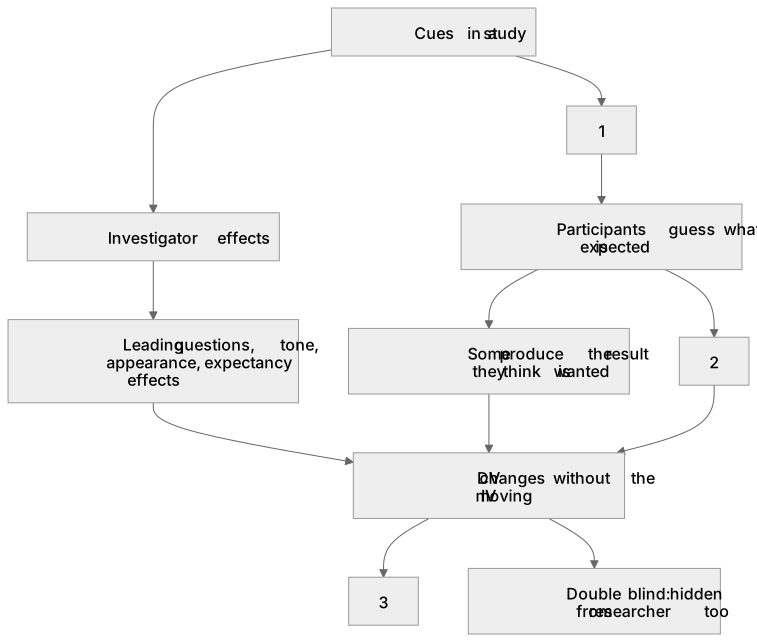
1Box 1
2Box 2
3Box 3
There is more to this lesson
The full lesson goes on to check your understanding and help you earn the marks. Create a free account to carry on, with your progress saved.
A week of Premium from your first lesson · Then the free plan continues · No card, no charge
Test your understanding of Scientific processes: Demand characteristics and investigator effects.
Active recall beats re-reading. Take an instant quiz now to test what you’ve learned and lock it into long-term memory.
A week of Premium from your first lesson · Then the free plan continues · No card, no charge