AQA · A-Level · Psychology
Course version: 7182-2025 · Exams from 2027
Control: random allocation and counterbalancing, randomisation,…
Full specification wording
Scientific processes: Control: random allocation and counterbalancing, randomisation, standardisation and control groups.
Researchers use specific techniques to minimise bias and extraneous variables.
Checked against the AQA 7182-2025 specification (opens in a new tab) on .
- Point 9 of 17
- 4 key terms
Study notes
From the checked teaching notes for this specification point.
The idea
Researchers use specific techniques to minimise bias and extraneous variables. Random allocation ensures every participant has an equal chance of being assigned to any condition, reducing participant variables. In repeated measures designs, counterbalancing controls for order effects by having half the participants complete condition A then B, and the rest B then A. Randomisation uses chance methods to determine the order of trials, reducing investigator effects. Standardisation ensures all participants experience exactly the same environment and instructions. Finally, control groups provide a baseline measure by receiving no experimental treatment, allowing researchers to isolate the true effect of the independent variable.
What earns the marks
- Describe random allocation as a method to evenly distribute participant differences across experimental conditions.
- Explain counterbalancing as a technique to mitigate order effects in repeated measures designs, typically using the ABBA method.
- Define standardisation as keeping all situational variables and procedures identical for every participant.
- Explain the purpose of a control group as establishing a baseline to compare against the experimental group.
- Identify randomisation as the use of chance to dictate the order of stimulus presentation or procedural steps.
Common mistakes and how to put them right
Confusing random sampling with random allocation.
Put it right: Random sampling selects the participants from a population, whereas random allocation assigns already selected participants to conditions.
Stating that counterbalancing eliminates order effects.
Put it right: It does not remove them, but rather balances their impact across the different conditions.
Failing to specify how standardisation is achieved.
Put it right: Simply stating 'keep things the same' is insufficient compared to specifying 'using standardised written instructions'.
Exam tips
- When designing an experiment in an exam, explicitly state how you would randomly allocate participants, such as drawing names from a hat.
- Use the term 'baseline' when explaining the purpose of a control group in evaluating the independent variable's effect.
- Specify exactly what is being standardised in a given scenario, such as the time of day or the exact wording of the brief.
Try the lesson
The start of the Scientific processes: Control: random allocation and counterbalancing, randomisation, standardisation and control groups. lesson, made from checked teaching notes for this specification point.
Have a go first
Which of the following best describes the purpose of counterbalancing in a repeated measures design?
Listen
Researchers use specific techniques to minimise bias and extraneous variables. Random allocation ensures every participant has an equal chance of being assigned to any condition, reducing participant variables. In repeated measures designs, counterbalancing controls for order effects by having half the participants complete condition A then B, and the rest B then A. Randomisation uses chance methods to determine the order of trials, reducing investigator effects. Standardisation ensures all participants experience exactly the same environment and instructions. Finally, control groups provide a baseline measure by receiving no experimental treatment, allowing researchers to isolate the true effect of the independent variable. A strong answer earns marks for these points. Describe random allocation as a method to evenly distribute participant differences across experimental conditions. Explain counterbalancing as a technique to mitigate order effects in repeated measures designs, typically using the ABBA method. Define standardisation as keeping all situational variables and procedures identical for every participant. Explain the purpose of a control group as establishing a baseline to compare against the experimental group. Exam tip: When designing an experiment in an exam, explicitly state how you would randomly allocate participants, such as drawing names from a hat.
See it

Key words
Say what each word means before you turn the card.
Random allocation
Try answering aloud or in your head before turning the card.
Counterbalancing
Try answering aloud or in your head before turning the card.
Standardisation
Try answering aloud or in your head before turning the card.
Control group
Try answering aloud or in your head before turning the card.
See every definition
- Random allocation
- A method ensuring every participant has an equal chance of being assigned to any condition, reducing participant variables.
- Counterbalancing
- A technique to mitigate order effects in repeated measures designs, typically using the ABBA method.
- Standardisation
- Keeping all situational variables and procedures identical for every participant.
- Control group
- A group that provides a baseline measure by receiving no experimental treatment, allowing researchers to isolate the true effect of the independent variable.
Label the diagram
Some boxes have lost their names. Pick the right name for each number.
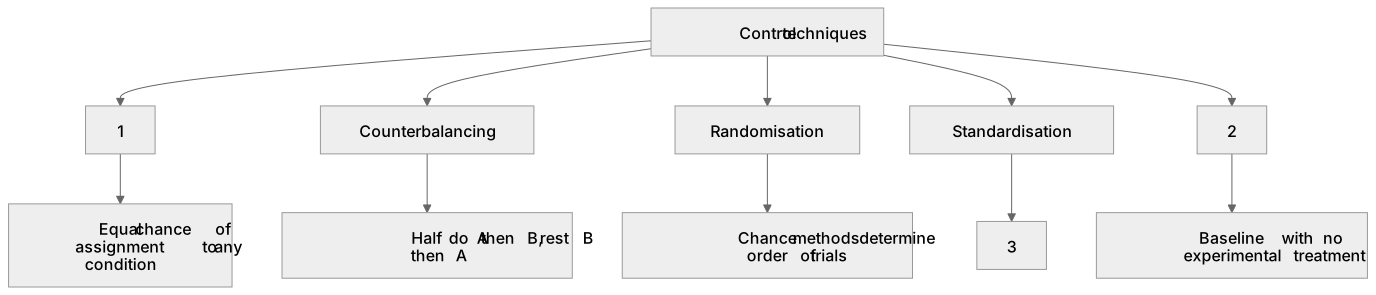
1Box 1
2Box 2
3Box 3
There is more to this lesson
The full lesson goes on to check your understanding and help you earn the marks. Create a free account to carry on, with your progress saved.
A week of Premium from your first lesson · Then the free plan continues · No card, no charge
Test your understanding of Scientific processes: Control: random allocation and counterbalancing, randomisation, standardisation and control groups.
Active recall beats re-reading. Take an instant quiz now to test what you’ve learned and lock it into long-term memory.
A week of Premium from your first lesson · Then the free plan continues · No card, no charge