AQA · A-Level · Psychology
Course version: 7182-2025 · Exams from 2027
Observational design: behavioural categories; event sampling; time sampling.
Full specification wording
Scientific processes: Observational design: behavioural categories; event sampling; time sampling.
Behavioural categories turn a vague construct into a checklist an observer can tick without interpreting anything: aggression becomes pushing, kicking, biting and shouting, with every category…
Checked against the AQA 7182-2025 specification (opens in a new tab) on .
- Point 6 of 17
- 4 key terms
Study notes
From the checked teaching notes for this specification point.
The idea
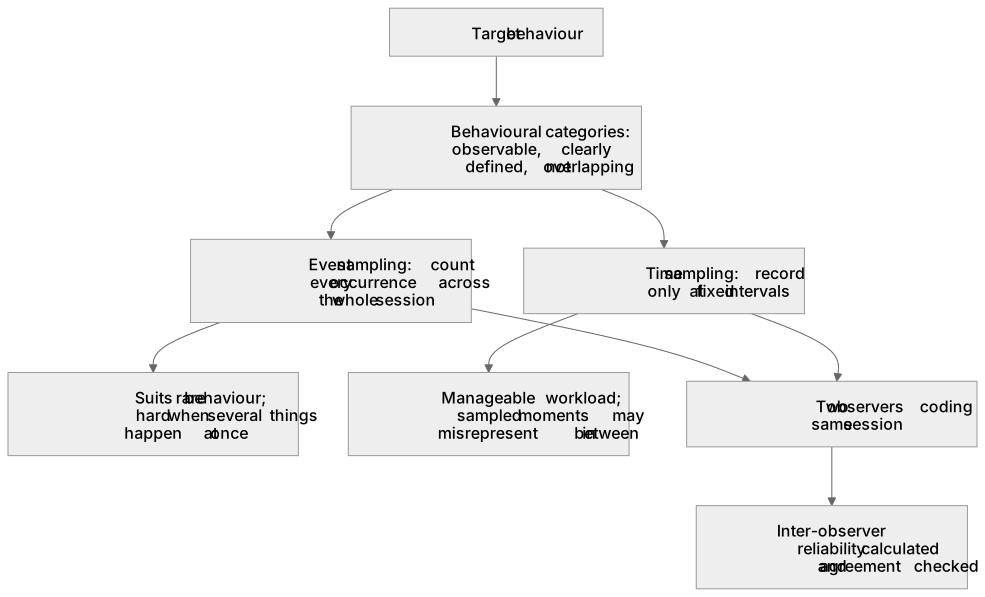
Behavioural categories turn a vague construct into a checklist an observer can tick without interpreting anything: aggression becomes pushing, kicking, biting and shouting, with every category observable, clearly defined and not overlapping. Event sampling counts each occurrence of the target behaviour across the whole session, which suits behaviour that happens rarely but is hard to keep up with when several things happen at once. Time sampling records only what is happening at fixed intervals, for example every 15 seconds, as Ainsworth did in the Strange Situation: it makes the workload manageable, but the sampled moments may misrepresent everything in between. Two observers coding the same session allow inter-observer reliability to be calculated and agreement checked.
What earns the marks
- Defines behavioural categories as a breakdown of the target behaviour into observable, operationalised items.
- States that categories must be objective, mutually exclusive and cover all relevant behaviour, so no inference is needed.
- Describes event sampling as counting every occurrence throughout the observation.
- Describes time sampling as recording behaviour at fixed intervals, with a stated interval.
- Evaluates the sampling methods for missed behaviour and unrepresentative intervals, and links coding to inter-observer reliability.
Common mistakes and how to put them right
Offering categories such as 'being aggressive' or 'seems anxious' that still require the observer to interpret.
Swapping the two sampling methods, or describing time sampling as recording everything over a long period.
Ignoring that overlapping categories make it impossible to tally a behaviour consistently.
Discussing covert and overt observation when the question asks about design rather than type.
Exam tips
- When asked for behavioural categories, give three or four concrete actions in the scenario's own context, not a definition of the term.
- Justify the sampling method by how often the behaviour occurs: event sampling for rare behaviour, time sampling for continuous behaviour.
- Have a reliability point ready, since observation questions very often end with assessing or improving it.
Try the lesson
The start of the Scientific processes: Observational design: behavioural categories; event sampling; time sampling. lesson, made from checked teaching notes for this specification point.
Have a go first
A researcher is observing children's play behaviour in a nursery. They decide to record the children's behaviour at exactly five-minute intervals over a two-hour period. Which observational sampling method is the researcher using?
Listen
Behavioural categories turn a vague construct into a checklist an observer can tick without interpreting anything: aggression becomes pushing, kicking, biting and shouting, with every category observable, clearly defined and not overlapping. Event sampling counts each occurrence of the target behaviour across the whole session, which suits behaviour that happens rarely but is hard to keep up with when several things happen at once. Time sampling records only what is happening at fixed intervals, for example every 15 seconds, as Ainsworth did in the Strange Situation: it makes the workload manageable, but the sampled moments may misrepresent everything in between. Two observers coding the same session allow inter-observer reliability to be calculated and agreement checked. A strong answer earns marks for these points. Defines behavioural categories as a breakdown of the target behaviour into observable, operationalised items. States that categories must be objective, mutually exclusive and cover all relevant behaviour, so no inference is needed. Describes event sampling as counting every occurrence throughout the observation. Describes time sampling as recording behaviour at fixed intervals, with a stated interval. Exam tip: When asked for behavioural categories, give three or four concrete actions in the scenario's own context, not a definition of the term.
See it
Key words
Say what each word means before you turn the card.
Operationalised behavioural categories
Try answering aloud or in your head before turning the card.
Event sampling
Try answering aloud or in your head before turning the card.
Time sampling
Try answering aloud or in your head before turning the card.
Inter-observer reliability
Try answering aloud or in your head before turning the card.
See every definition
- Operationalised behavioural categories
- A breakdown of the target behaviour into observable, clearly defined items that do not overlap, so the observer can tick without interpreting anything.
- Event sampling
- Counting each occurrence of the target behaviour across the whole session, which suits behaviour that happens rarely.
- Time sampling
- Recording only what is happening at fixed intervals, which makes the workload manageable but the sampled moments may misrepresent everything in between.
- Inter-observer reliability
- Calculated when two observers code the same session, allowing agreement to be checked.
Label the diagram
Some boxes have lost their names. Pick the right name for each number.
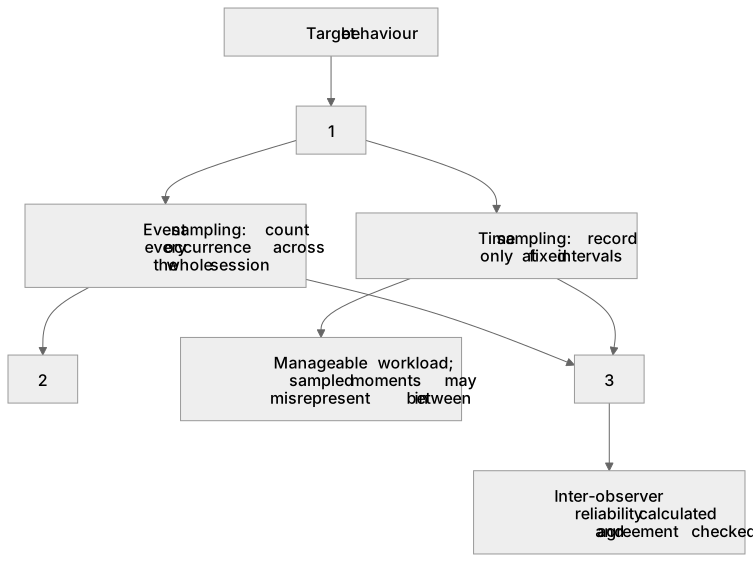
1Box 1
2Box 2
3Box 3
There is more to this lesson
The full lesson goes on to check your understanding and help you earn the marks. Create a free account to carry on, with your progress saved.
A week of Premium from your first lesson · Then the free plan continues · No card, no charge
Test your understanding of Scientific processes: Observational design: behavioural categories; event sampling; time sampling.
Active recall beats re-reading. Take an instant quiz now to test what you’ve learned and lock it into long-term memory.
A week of Premium from your first lesson · Then the free plan continues · No card, no charge