AQA · A-Level · Psychology
Course version: 7182-2025 · Exams from 2027
Questionnaire construction, including use of open and closed questions;…
Full specification wording
Scientific processes: Questionnaire construction, including use of open and closed questions; design of interviews.
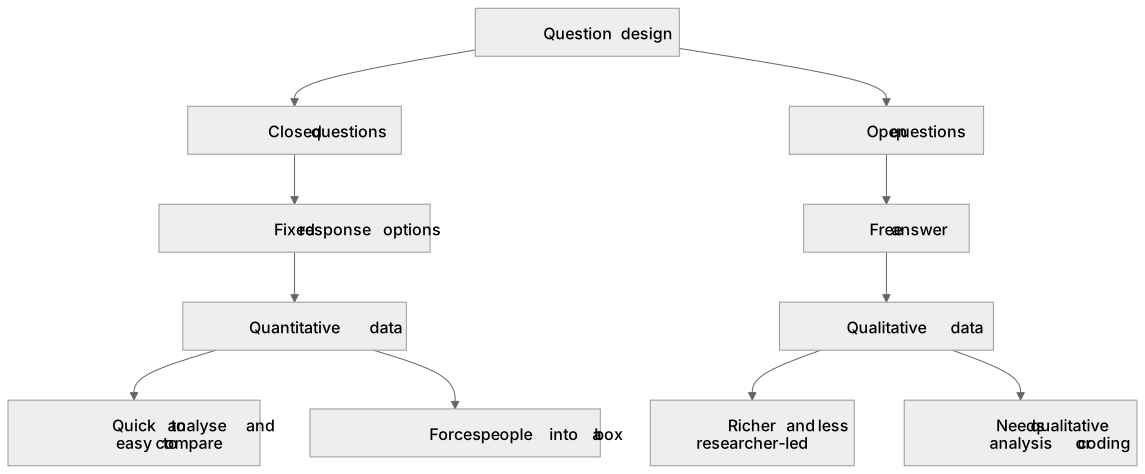
Closed questions fix the response options, such as yes or no, a rating or a Likert scale, and produce numbers that are quick to analyse and easy to compare, but they force people into a box and…
Checked against the AQA 7182-2025 specification (opens in a new tab) on .
- Point 7 of 17
- 4 key terms
Study notes
From the checked teaching notes for this specification point.
The idea
Closed questions fix the response options, such as yes or no, a rating or a Likert scale, and produce numbers that are quick to analyse and easy to compare, but they force people into a box and say nothing about why. Open questions invite a free answer, which is richer and less researcher-led, though the replies then need qualitative analysis or coding through content analysis. Well-built items are short, unambiguous and free of jargon, leading wording, double-barrelled questions and emotive language, and fillers can disguise the aim. Interviews sit on the same axis: a structured interview follows a fixed schedule in a fixed order, so it is replicable but cannot follow anything up; an unstructured interview is flexible and detailed but vulnerable to interviewer bias; a semi-structured one does both.
What earns the marks
- Distinguishes closed questions, with fixed options producing quantitative data, from open questions producing qualitative data.
- Gives the trade-off: ease of analysis and comparison versus depth and detail.
- Names design principles: clarity, avoiding leading, double-barrelled, jargon-heavy and emotive items, and using filler questions.
- Describes structured, unstructured and semi-structured interviews by how far the schedule is fixed.
- Covers practical design points for interviews, such as a schedule, recording, a quiet setting and reminding the interviewee of confidentiality.
Common mistakes and how to put them right
Writing sample questions that are leading or double-barrelled while claiming to demonstrate good design.
Treating a Likert scale as an open question because the respondent 'chooses their own level of agreement'.
Evaluating with 'people might lie' and stopping there, instead of naming social desirability bias and a control such as anonymity.
Describing an unstructured interview as having no preparation at all, rather than no fixed set of questions.
Exam tips
- If asked to write questions, write them out in full and label them open or closed; a description of the type earns no credit.
- Justify each question against the stem's aim, because application marks depend on the question actually measuring that variable.
- For interviews, state the type first, then one procedural detail, then one strength tied to the data it yields.
Try the lesson
The start of the Scientific processes: Questionnaire construction, including use of open and closed questions; design of interviews. lesson, made from checked teaching notes for this specification point.
Have a go first
A researcher is designing a questionnaire to assess sleep habits. Which of the following is an example of a closed question?
Listen
Closed questions fix the response options, such as yes or no, a rating or a Likert scale, and produce numbers that are quick to analyse and easy to compare, but they force people into a box and say nothing about why. Open questions invite a free answer, which is richer and less researcher-led, though the replies then need qualitative analysis or coding through content analysis. Well-built items are short, unambiguous and free of jargon, leading wording, double-barrelled questions and emotive language, and fillers can disguise the aim. Interviews sit on the same axis: a structured interview follows a fixed schedule in a fixed order, so it is replicable but cannot follow anything up; an unstructured interview is flexible and detailed but vulnerable to interviewer bias; a semi-structured one does both. A strong answer earns marks for these points. Distinguishes closed questions, with fixed options producing quantitative data, from open questions producing qualitative data. Gives the trade-off: ease of analysis and comparison versus depth and detail. Names design principles: clarity, avoiding leading, double-barrelled, jargon-heavy and emotive items, and using filler questions. Describes structured, unstructured and semi-structured interviews by how far the schedule is fixed. Exam tip: If asked to write questions, write them out in full and label them open or closed; a description of the type earns no credit.
See it
Key words
Say what each word means before you turn the card.
Closed questions
Try answering aloud or in your head before turning the card.
Open questions
Try answering aloud or in your head before turning the card.
Structured interview
Try answering aloud or in your head before turning the card.
Unstructured interview
Try answering aloud or in your head before turning the card.
See every definition
- Closed questions
- Questions that fix the response options, such as yes or no, a rating or a Likert scale, and produce numbers that are quick to analyse and easy to compare.
- Open questions
- Questions that invite a free answer, which is richer and less researcher-led, though the replies then need qualitative analysis or coding through content analysis.
- Structured interview
- An interview that follows a fixed schedule in a fixed order, so it is replicable but cannot follow anything up.
- Unstructured interview
- An interview that is flexible and detailed but vulnerable to interviewer bias.
Label the diagram
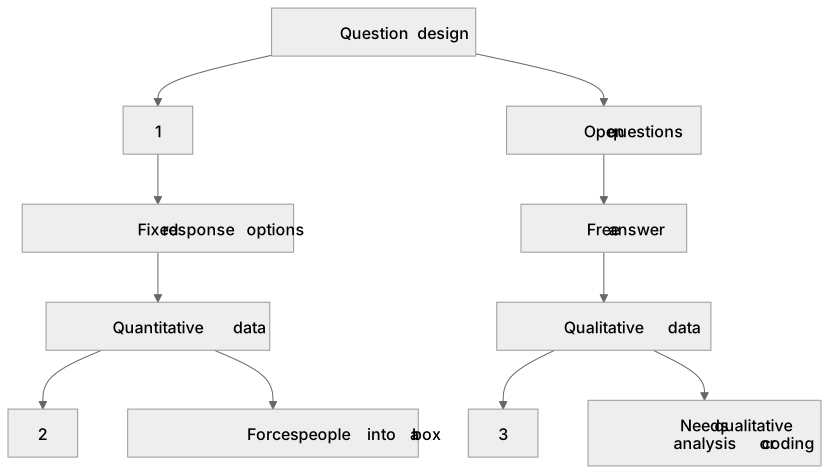
Some boxes have lost their names. Pick the right name for each number.
1Box 1
2Box 2
3Box 3
There is more to this lesson
The full lesson goes on to check your understanding and help you earn the marks. Create a free account to carry on, with your progress saved.
A week of Premium from your first lesson · Then the free plan continues · No card, no charge
Test your understanding of Scientific processes: Questionnaire construction, including use of open and closed questions; design of interviews.
Active recall beats re-reading. Take an instant quiz now to test what you’ve learned and lock it into long-term memory.
A week of Premium from your first lesson · Then the free plan continues · No card, no charge