AQA · A-Level · Psychology
Course version: 7182-2025 · Exams from 2027
Scientific processes: Pilot studies and the aims of piloting.
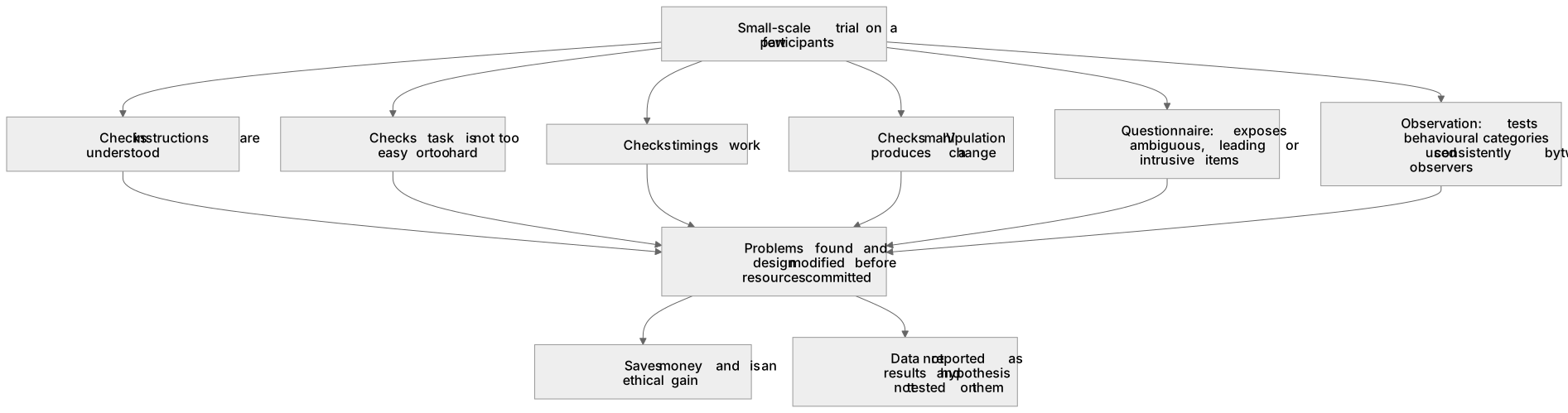
A trial run is a small-scale version of the whole procedure, carried out on a few participants before the real investigation, and its point is to find problems while they are still cheap to fix.
Checked against the AQA 7182-2025 specification (opens in a new tab) on .
- Point 4 of 17
- 4 key terms
Study notes
From the checked teaching notes for this specification point.
The idea
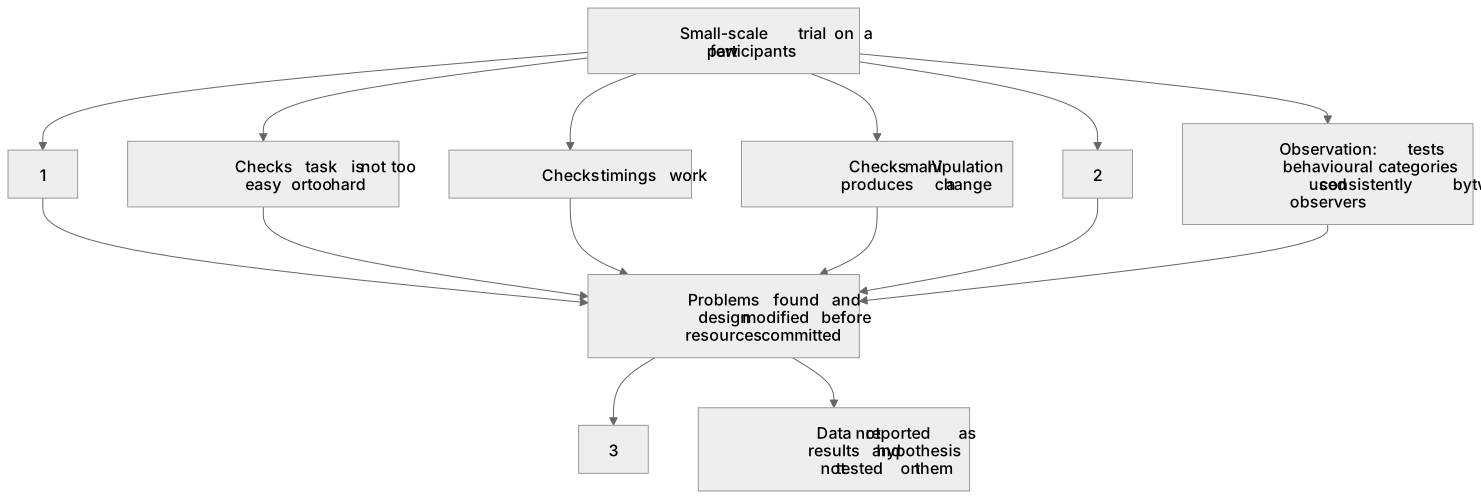
A trial run is a small-scale version of the whole procedure, carried out on a few participants before the real investigation, and its point is to find problems while they are still cheap to fix. It checks that instructions are understood, that the task is neither so easy that everyone is at ceiling nor so hard that nobody scores, that the timings work, and that the manipulation of the IV actually produces a change. With a questionnaire it exposes ambiguous, leading or intrusive items; in an observation it tests whether the behavioural categories can be used consistently by two observers. It also saves money and is an ethical gain, because fewer people are put through a flawed design. The data collected are not reported as results and the hypothesis is not tested on them.
What earns the marks
- Defines it as a small-scale trial of the procedure on a few participants before the main study.
- States a purpose: checking instructions, materials, timings or the effectiveness of the IV manipulation.
- Explains that problems are identified and the design modified before resources are committed.
- Applies it to a named method, for example refining questionnaire items or trialling behavioural categories for observer agreement.
- Notes the economic and ethical benefit of not exposing a full sample to a flawed design.
Common mistakes and how to put them right
Saying it is done 'to check the results are right', when it tests the procedure rather than the hypothesis.
Describing it as a small study whose data are combined with the main findings.
Giving only the vague purpose 'to see if it works' with no specific feature being trialled.
Forgetting to link it to the method in the scenario, so the answer stays generic.
Exam tips
- Always say what specifically would be trialled in that scenario and what change could follow from it, as marks come in pairs of problem and fix.
- Mention the modification explicitly: 'the researcher could then reword the item' scores where 'to check the questionnaire' does not.
- Use it as an improvement point in evaluation questions about a flawed study design.
Try the lesson
The start of the Scientific processes: Pilot studies and the aims of piloting. lesson, made from checked teaching notes for this specification point.
Have a go first
What is the primary purpose of conducting a pilot study in psychological research?
Listen
A trial run is a small-scale version of the whole procedure, carried out on a few participants before the real investigation, and its point is to find problems while they are still cheap to fix. It checks that instructions are understood, that the task is neither so easy that everyone is at ceiling nor so hard that nobody scores, that the timings work, and that the manipulation of the IV actually produces a change. With a questionnaire it exposes ambiguous, leading or intrusive items; in an observation it tests whether the behavioural categories can be used consistently by two observers. It also saves money and is an ethical gain, because fewer people are put through a flawed design. The data collected are not reported as results and the hypothesis is not tested on them. A strong answer earns marks for these points. Defines it as a small-scale trial of the procedure on a few participants before the main study. States a purpose: checking instructions, materials, timings or the effectiveness of the IV manipulation. Explains that problems are identified and the design modified before resources are committed. Applies it to a named method, for example refining questionnaire items or trialling behavioural categories for observer agreement. Exam tip: Always say what specifically would be trialled in that scenario and what change could follow from it, as marks come in pairs of problem and fix.
See it
Key words
Say what each word means before you turn the card.
Trialling a procedure
Try answering aloud or in your head before turning the card.
Refining materials and instructions
Try answering aloud or in your head before turning the card.
Economy of time and resources
Try answering aloud or in your head before turning the card.
Ethical protection of participants
Try answering aloud or in your head before turning the card.
See every definition
- Trialling a procedure
- A small-scale version of the whole procedure, carried out on a few participants before the real investigation, to find problems while they are still cheap to fix.
- Refining materials and instructions
- Checking that instructions are understood and that a questionnaire's ambiguous, leading or intrusive items are exposed, so the design can be modified before resources are committed.
- Economy of time and resources
- Finding a design fault before a full sample has been put through it, so that money is saved.
- Ethical protection of participants
- An ethical gain, because fewer people are put through a flawed design.
Label the diagram
Some boxes have lost their names. Pick the right name for each number.
1Box 1
2Box 2
3Box 3
There is more to this lesson
The full lesson goes on to check your understanding and help you earn the marks. Create a free account to carry on, with your progress saved.
A week of Premium from your first lesson · Then the free plan continues · No card, no charge
Test your understanding of Scientific processes: Pilot studies and the aims of piloting.
Active recall beats re-reading. Take an instant quiz now to test what you’ve learned and lock it into long-term memory.
A week of Premium from your first lesson · Then the free plan continues · No card, no charge