AQA · A-Level · Psychology
Course version: 7182-2025 · Exams from 2027
Sampling: the difference between population and sample; sampling methods…
Full specification wording
Scientific processes: Sampling: the difference between population and sample; sampling methods including: random, systematic, stratified, opportunity and volunteer; implications of sampling methods, including bias and generalisation.
Sampling involves selecting a representative group (sample) from a larger target group (population) to conduct research.
Checked against the AQA 7182-2025 specification (opens in a new tab) on .
- Point 3 of 17
- 3 key terms
Study notes
From the checked teaching notes for this specification point.
The idea
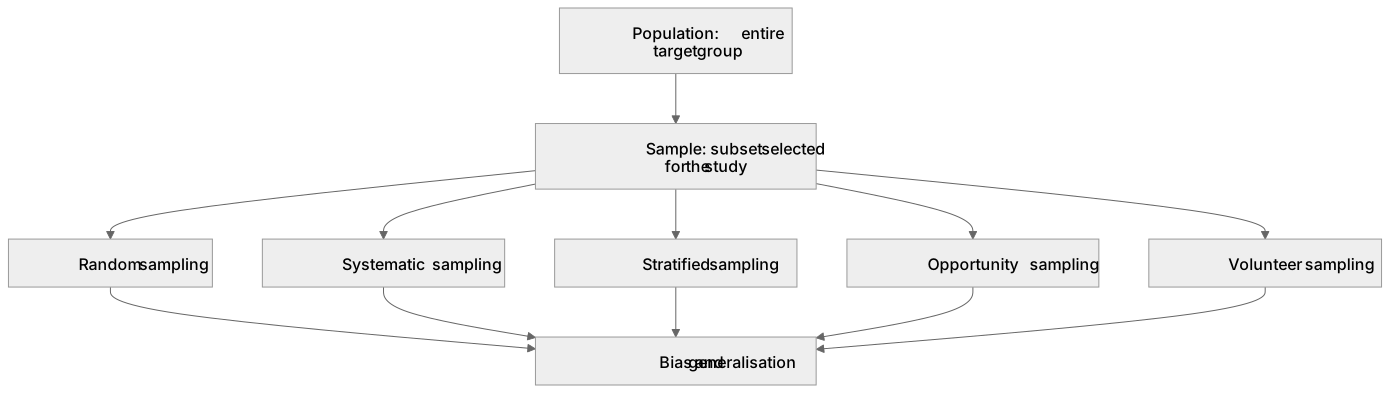
Sampling involves selecting a representative group (sample) from a larger target group (population) to conduct research. Random sampling gives everyone an equal chance of selection, while systematic sampling uses a predetermined system, like every nth person. Stratified sampling reflects the population's exact proportions by dividing it into strata. Opportunity sampling selects those readily available, and volunteer sampling relies on participants self-selecting. The chosen method heavily impacts bias and generalisation.
For example: Volunteer samples often suffer from volunteer bias, limiting the ability to generalise findings to the wider population, whereas stratified samples offer high representativeness.
What earns the marks
- A population is the entire target group, whereas a sample is the specific subset selected for the study.
- Random sampling requires a complete list of the population and a lottery method to ensure equal selection probability.
- Stratified sampling involves calculating the correct proportions of subgroups (strata) to ensure the sample accurately reflects the population.
- Opportunity and volunteer sampling are highly prone to bias, which significantly reduces the ability to generalise findings.
Common mistakes and how to put them right
Confusing random and opportunity sampling.
Put it right: This is opportunity sampling, as not everyone in the target population has an equal chance.
Misunderstanding systematic sampling: Describing it as just picking people in order.
Put it right: It requires a fixed interval (every nth person) from a sampling frame.
Misusing the term generalisation.
Put it right: Explicitly link the sampling method's bias to the validity of generalising.
Exam tips
- When evaluating sampling methods, always explicitly link the method to the concepts of bias and generalisability.
- Be prepared to calculate the number of participants needed for a specific stratum in a stratified sample using percentages.
- Use the term 'target population' rather than just 'people' when defining who the sample is drawn from.
Try the lesson
The start of the Scientific processes: Sampling: the difference between population and sample; sampling methods including: random, systematic, stratified, opportunity and volunteer; implications of sampling methods, including bias and generalisation. lesson, made from checked teaching notes for this specification point.
Have a go first
Which of the following best describes a systematic sampling method?
Listen
Sampling involves selecting a representative group (sample) from a larger target group (population) to conduct research. Random sampling gives everyone an equal chance of selection, while systematic sampling uses a predetermined system, like every nth person. Stratified sampling reflects the population's exact proportions by dividing it into strata. Opportunity sampling selects those readily available, and volunteer sampling relies on participants self-selecting. The chosen method heavily impacts bias and generalisation. For example, volunteer samples often suffer from volunteer bias, limiting the ability to generalise findings to the wider population, whereas stratified samples offer high representativeness. A strong answer earns marks for these points. A population is the entire target group, whereas a sample is the specific subset selected for the study. Random sampling requires a complete list of the population and a lottery method to ensure equal selection probability. Stratified sampling involves calculating the correct proportions of subgroups (strata) to ensure the sample accurately reflects the population. Opportunity and volunteer sampling are highly prone to bias, which significantly reduces the ability to generalise findings. A common slip: Confusing random and opportunity sampling: Students often say picking people randomly on the street is random sampling. Instead, this is opportunity sampling, as not everyone in the target population has an equal chance. Exam tip: When evaluating sampling methods, always explicitly link the method to the concepts of bias and generalisability.
See it
Key words
Say what each word means before you turn the card.
Representativeness
Try answering aloud or in your head before turning the card.
Bias
Try answering aloud or in your head before turning the card.
Generalisation
Try answering aloud or in your head before turning the card.
See every definition
- Representativeness
- The extent to which a sample reflects the population, with stratified sampling offering high representativeness by reflecting the population's exact proportions.
- Bias
- A distortion in a sample that affects the findings, with opportunity and volunteer sampling being highly prone to it.
- Generalisation
- The ability to extend findings to the wider population, which is limited when a sampling method's bias is high.
Label the diagram
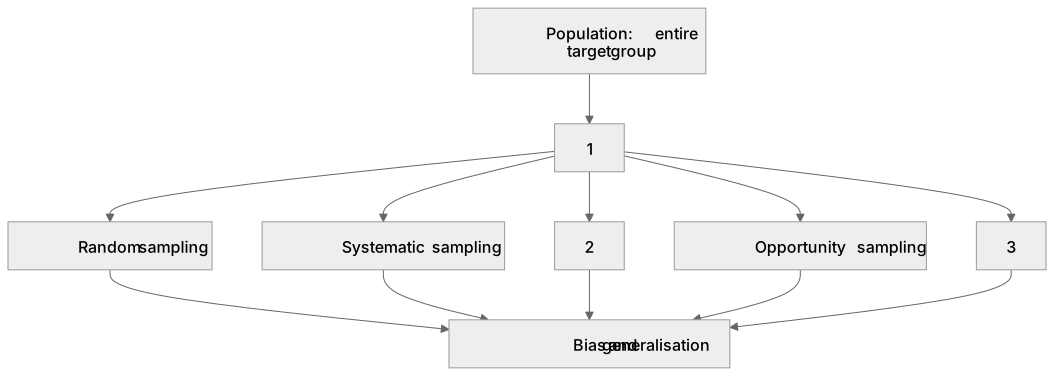
Some boxes have lost their names. Pick the right name for each number.
1Box 1
2Box 2
3Box 3
There is more to this lesson
The full lesson goes on to check your understanding and help you earn the marks. Create a free account to carry on, with your progress saved.
A week of Premium from your first lesson · Then the free plan continues · No card, no charge
Test your understanding of Scientific processes: Sampling: the difference between population and sample; sampling methods including: random, systematic, stratified, opportunity and volunteer; implications of sampling methods, including bias and generalisation.
Active recall beats re-reading. Take an instant quiz now to test what you’ve learned and lock it into long-term memory.
A week of Premium from your first lesson · Then the free plan continues · No card, no charge