AQA · A-Level · Psychology
Course version: 7182-2025 · Exams from 2027
Reporting psychological investigations. Sections of a scientific report:…
Full specification wording
Scientific processes: Reporting psychological investigations. Sections of a scientific report: abstract, introduction, method, results, discussion and referencing.
A report follows a fixed order because readers use it in a fixed way.
Checked against the AQA 7182-2025 specification (opens in a new tab) on .
- Point 17 of 17
- 4 key terms
Study notes
From the checked teaching notes for this specification point.
The idea
A report follows a fixed order because readers use it in a fixed way. The abstract is a short summary of the aim, hypothesis, method, results and conclusion, read first to decide whether the paper is worth reading at all. The introduction reviews relevant theory and studies, narrowing from the broad area to this particular aim and prediction. The method is written so that someone else could repeat the study exactly: design, participants and sampling, apparatus, procedure including the standardised instructions, and ethics. Results give descriptive statistics first, then the inferential test, its calculated and critical values, the significance level and the decision on the null hypothesis. The discussion interprets the findings, admits limitations and suggests further work; references credit every source.
What earns the marks
- Lists the sections in order: abstract, introduction, method, results, discussion, references.
- Describes the abstract as a concise summary of the whole study, typically a short paragraph.
- Describes the introduction as a funnel from general theory and past research to the aim and hypothesis.
- Describes the method in named subsections and states that it must allow replication.
- Describes results as descriptive then inferential statistics, and the discussion as interpretation, limitations and implications.
Common mistakes and how to put them right
Placing conclusions in the results section rather than in the discussion.
Describing the abstract as an introduction to the topic instead of a summary of the whole report.
Omitting the subsections of the method, which is where replication marks are earned.
Forgetting referencing altogether, or giving an incomplete citation without journal and date.
Exam tips
- If asked what goes in a section, give two or three specific contents rather than naming the section again.
- Use replication as the reason the method is detailed; that justification is regularly worth a mark.
- Where the stem provides data, say which statistics belong in results and which interpretation belongs in the discussion.
Try the lesson
The start of the Scientific processes: Reporting psychological investigations. Sections of a scientific report: abstract, introduction, method, results, discussion and referencing. lesson, made from checked teaching notes for this specification point.
Have a go first
Which section of a scientific report provides a brief summary of the entire investigation, including the aims, hypotheses, method, results, and conclusions?
Listen
A report follows a fixed order because readers use it in a fixed way. The abstract is a short summary of the aim, hypothesis, method, results and conclusion, read first to decide whether the paper is worth reading at all. The introduction reviews relevant theory and studies, narrowing from the broad area to this particular aim and prediction. The method is written so that someone else could repeat the study exactly: design, participants and sampling, apparatus, procedure including the standardised instructions, and ethics. Results give descriptive statistics first, then the inferential test, its calculated and critical values, the significance level and the decision on the null hypothesis. The discussion interprets the findings, admits limitations and suggests further work; references credit every source. A strong answer earns marks for these points. Lists the sections in order: abstract, introduction, method, results, discussion, references. Describes the abstract as a concise summary of the whole study, typically a short paragraph. Describes the introduction as a funnel from general theory and past research to the aim and hypothesis. Describes the method in named subsections and states that it must allow replication. Exam tip: If asked what goes in a section, give two or three specific contents rather than naming the section again.
See it
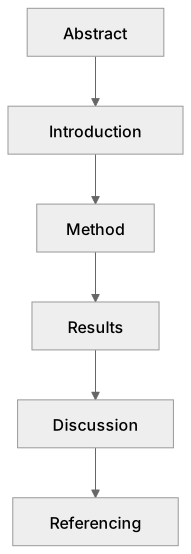
Put it in order
Put these steps in the order they happen.
- 1. Method
- 2. Introduction
- 3. Abstract
- 4. Referencing
- 5. Discussion
- 6. Results
Key words
Say what each word means before you turn the card.
Abstract
Try answering aloud or in your head before turning the card.
Introduction
Try answering aloud or in your head before turning the card.
Method
Try answering aloud or in your head before turning the card.
Discussion
Try answering aloud or in your head before turning the card.
See every definition
- Abstract
- A short summary of the aim, hypothesis, method, results and conclusion, read first to decide whether the paper is worth reading at all.
- Introduction
- Reviews relevant theory and studies, narrowing from the broad area to this particular aim and prediction.
- Method
- Written so that someone else could repeat the study exactly: design, participants and sampling, apparatus, procedure including the standardised instructions, and ethics.
- Discussion
- Interprets the findings, admits limitations and suggests further work.
Label the diagram
Some boxes have lost their names. Pick the right name for each number.
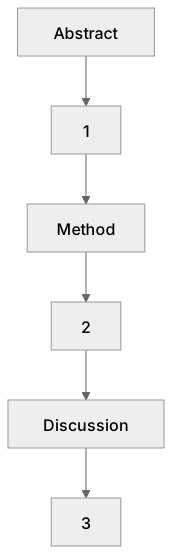
1Box 1
2Box 2
3Box 3
There is more to this lesson
The full lesson goes on to check your understanding and help you earn the marks. Create a free account to carry on, with your progress saved.
A week of Premium from your first lesson · Then the free plan continues · No card, no charge
Test your understanding of Scientific processes: Reporting psychological investigations. Sections of a scientific report: abstract, introduction, method, results, discussion and referencing.
Active recall beats re-reading. Take an instant quiz now to test what you’ve learned and lock it into long-term memory.
A week of Premium from your first lesson · Then the free plan continues · No card, no charge