AQA · A-Level · Psychology
Course version: 7182-2025 · Exams from 2027
Minority influence including reference to consistency, commitment and…
Full specification wording
Social influence: Minority influence including reference to consistency, commitment and flexibility.
A small group changing what the majority privately believes works differently from conformity: it produces conversion and internalisation rather than public compliance, and it is slow.
Checked against the AQA 7182-2025 specification (opens in a new tab) on .
- Point 4 of 4
- 4 key terms
Study notes
From the checked teaching notes for this specification point.
The idea
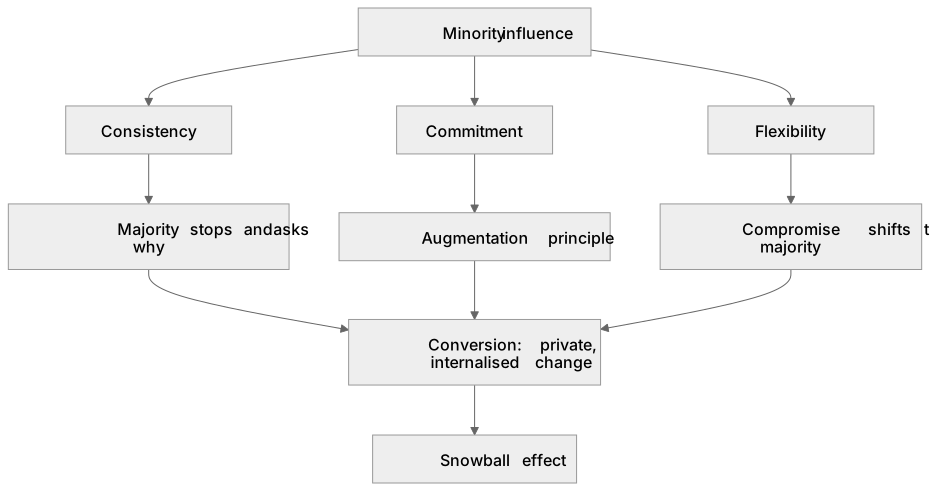
A small group changing what the majority privately believes works differently from conformity: it produces conversion and internalisation rather than public compliance, and it is slow. Moscovici had two confederates call clearly blue slides green. A consistent minority moved participants to agree on 8.42% of trials, against 1.25% when the minority was inconsistent and 0.25% in the control. Agreement between members and over time makes the majority stop and ask why anyone would hold such a view. Personal cost adds weight, since a group that risks something is taken more seriously, which is the augmentation principle. A rigid position is dismissed as dogmatic: in Nemeth's mock jury only the confederate willing to compromise moved the group. Deeper processing then spreads the view by a snowball effect.
What earns the marks
- The process is conversion: the majority is made to think about the message, so change is private and internalised rather than public compliance.
- Consistency: agreement between the members of the minority and agreement over time draws attention and signals a serious alternative view.
- Evidence: Moscovici's blue-green slide study produced agreement with the minority on 8.42% of trials when the minority was consistent, against 1.25% when it was not.
- Commitment: a minority that accepts personal risk or sacrifice is taken more seriously, which is the augmentation principle.
- Flexibility: Nemeth showed that a minority refusing to compromise is dismissed as rigid, while one that adjusts its position shifts the majority.
- The snowball effect: as more of the majority convert, the minority view gathers momentum until it becomes the new majority position.
- Evaluation: Martin found a message backed by a minority was more resistant to a counter-argument than the same message from a majority, which supports the deeper-processing account.
- Evaluation: identifying the colour of a slide carries no consequences, so the research lacks external validity when applied to jury decisions or political campaigns.
- Evaluation: laboratory groups have no history and face no hostility, whereas real minorities are abused and ostracised, so the difficulty of the task is understated.
Common mistakes and how to put them right
Describing this as a small group conforming to the majority.
Put it right: The direction is reversed - the few change the many.
Treating consistency as one person repeating themselves, when it has to be shown both across the members of the group and across time.
Getting flexibility backwards and arguing that a minority should never give ground, when the finding is that some compromise increases influence.
Quoting 8.42% as though it were a large effect without noting that it is agreement on a small proportion of trials.
Exam tips
- Explain the process, not just the three factors. The marks are in saying why consistency makes the majority think, not in naming it.
- In an application question, match each factor to a specific detail of the campaign described in the stem.
- Have a clear contrast with conformity ready, because questions often ask you to compare influence that runs in the two directions.
Try the lesson
The start of the Social influence: Minority influence including reference to consistency, commitment and flexibility. lesson, made from checked teaching notes for this specification point.
Have a go first
In the context of minority influence, what is meant by the term 'flexibility'?
Listen
A small group changing what the majority privately believes works differently from conformity: it produces conversion and internalisation rather than public compliance, and it is slow. Moscovici had two confederates call clearly blue slides green. A consistent minority moved participants to agree on 8.42% of trials, against 1.25% when the minority was inconsistent and 0.25% in the control. Agreement between members and over time makes the majority stop and ask why anyone would hold such a view. Personal cost adds weight, since a group that risks something is taken more seriously, which is the augmentation principle. A rigid position is dismissed as dogmatic: in Nemeth's mock jury only the confederate willing to compromise moved the group. Deeper processing then spreads the view by a snowball effect. A strong answer earns marks for these points. The process is conversion: the majority is made to think about the message, so change is private and internalised rather than public compliance. Consistency: agreement between the members of the minority and agreement over time draws attention and signals a serious alternative view. Evidence: Moscovici's blue-green slide study produced agreement with the minority on 8.42% of trials when the minority was consistent, against 1.25% when it was not. Commitment: a minority that accepts personal risk or sacrifice is taken more seriously, which is the augmentation principle. Exam tip: Explain the process, not just the three factors. The marks are in saying why consistency makes the majority think, not in naming it.
See it
Key words
Say what each word means before you turn the card.
Conversion
Try answering aloud or in your head before turning the card.
Consistency
Try answering aloud or in your head before turning the card.
Commitment
Try answering aloud or in your head before turning the card.
Flexibility
Try answering aloud or in your head before turning the card.
See every definition
- Conversion
- The majority is made to think about the message, so change is private and internalised rather than public compliance.
- Consistency
- Agreement between the members of the minority and agreement over time draws attention and signals a serious alternative view.
- Commitment
- A minority that accepts personal risk or sacrifice is taken more seriously, which is the augmentation principle.
- Flexibility
- A minority refusing to compromise is dismissed as rigid, while one that adjusts its position shifts the majority.
Label the diagram
Some boxes have lost their names. Pick the right name for each number.
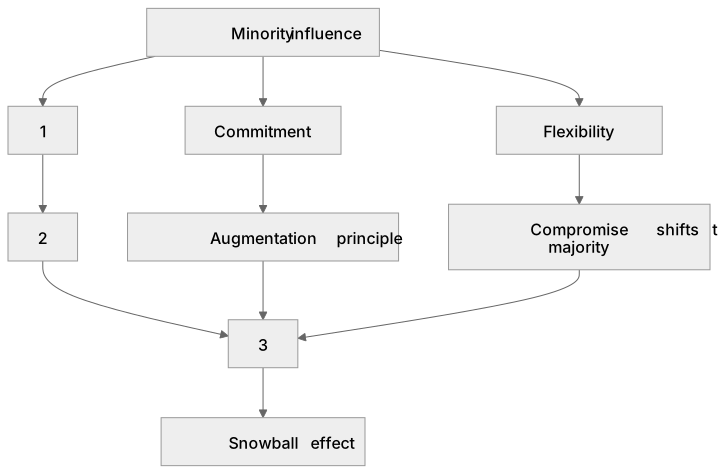
1Box 1
2Box 2
3Box 3
There is more to this lesson
The full lesson goes on to check your understanding and help you earn the marks. Create a free account to carry on, with your progress saved.
A week of Premium from your first lesson · Then the free plan continues · No card, no charge
Test your understanding of Social influence: Minority influence including reference to consistency, commitment and flexibility.
Active recall beats re-reading. Take an instant quiz now to test what you’ve learned and lock it into long-term memory.
A week of Premium from your first lesson · Then the free plan continues · No card, no charge