AQA · A-Level · Psychology
Course version: 7182-2025 · Exams from 2027
Explanations of resistance to social influence, including social support…
Full specification wording
Social influence: Explanations of resistance to social influence, including social support and locus of control.
Resisting pressure is far easier when someone else has broken ranks first.
Checked against the AQA 7182-2025 specification (opens in a new tab) on .
- Point 3 of 4
- 4 key terms
Study notes
From the checked teaching notes for this specification point.
The idea
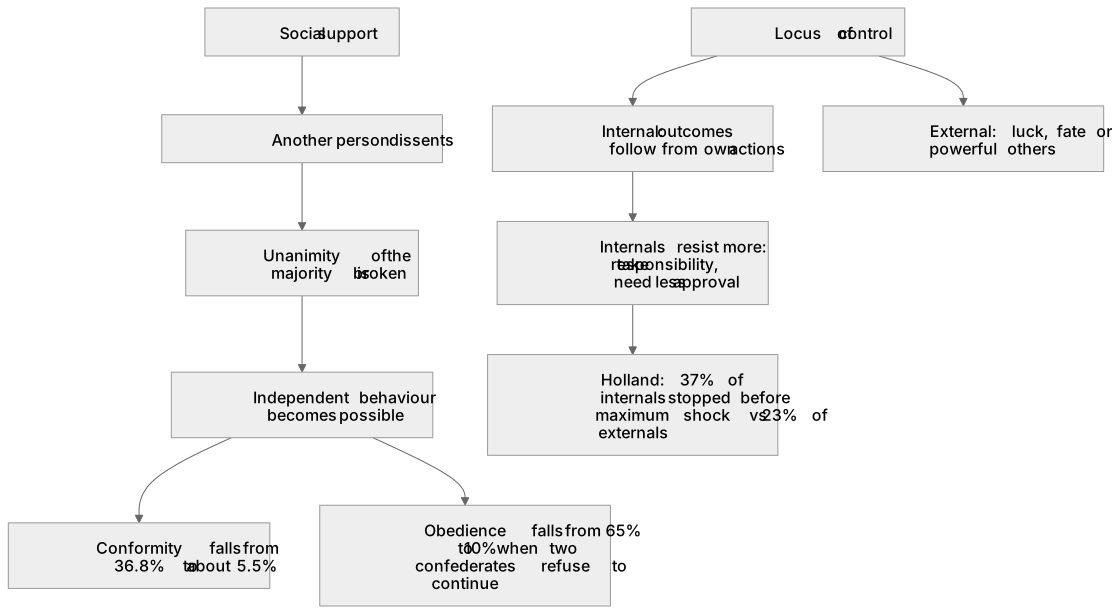
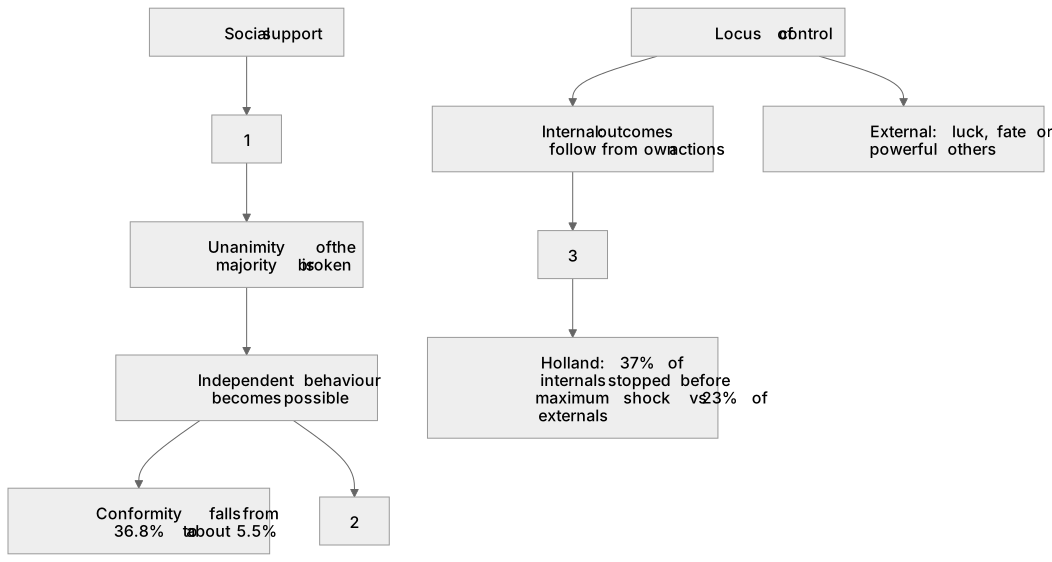
Resisting pressure is far easier when someone else has broken ranks first. Social support works by destroying the unanimity of the group: a dissenting confederate cut conformity in the line task from 36.8% to about 5.5%, and Allen and Levine showed the ally need not even be credible, since a dissenter wearing thick glasses who admitted poor eyesight still freed participants to disagree. Two confederates who refused to continue cut obedience from 65% to 10%, because they model that defiance is possible. Locus of control is a personality dimension: internals believe outcomes follow from their own actions, externals credit luck, fate or powerful others. Internals resist more because they take responsibility and need less approval, and Holland found 37% of them stopped before the maximum shock against 23% of externals.
What earns the marks
- Social support: the presence of another person who dissents breaks the unanimity of the majority and makes independent behaviour possible.
- Evidence in obedience: when two confederates refused to continue, obedience fell from 65% to 10%, because disobedient models make defiance appear legitimate.
- Locus of control: a continuum from high internal to high external, where internals attribute outcomes to their own behaviour and externals to luck, fate or powerful others.
- Why internals resist: they take personal responsibility for their actions, are more self-confident and achievement-oriented, and have less need for social approval.
- Evidence: Holland found 37% of internals refused to give the maximum shock compared with 23% of externals, so locus of control has some predictive value.
- Evaluation: Twenge found people have become more external over several decades while also becoming more resistant to authority, which is the opposite of what the explanation predicts.
- Evaluation: Rotter argued locus of control only shapes behaviour in novel situations, so it cannot explain resistance where a person is drawing on past experience.
- Evaluation: social support is situational and locus of control dispositional, so together they predict that the same person will resist in some groups and not others.
Common mistakes and how to put them right
Saying the ally has to give the correct answer.
Put it right: A confederate giving a different wrong answer also reduced conformity, which is exactly the point about unanimity.
Treating locus of control as two types of person rather than a continuum running from high internal to high external.
Writing that internals do not conform or obey.
Put it right: The claim is a higher probability of resisting, and most internals in Holland research still obeyed.
Confusing social support with conformity to a smaller group.
Put it right: The ally makes independent behaviour possible; it does not create a new majority to follow.
Exam tips
- Resistance is nearly always examined through a scenario, so name the concept, quote the cue from the stem and then explain the mechanism, rather than explaining the concept in the abstract.
- The strongest evaluation contrasts the two explanations, since one is situational and the other dispositional.
- If asked to evaluate locus of control, the meta-analysis showing people became more external yet more resistant is worth more than a general remark about correlational evidence.
Try the lesson
The start of the Social influence: Explanations of resistance to social influence, including social support and locus of control. lesson, made from checked teaching notes for this specification point.
Have a go first
Which of the following best describes how an internal locus of control helps an individual resist social influence?
Listen
Resisting pressure is far easier when someone else has broken ranks first. Social support works by destroying the unanimity of the group: a dissenting confederate cut conformity in the line task from 36.8% to about 5.5%, and Allen and Levine showed the ally need not even be credible, since a dissenter wearing thick glasses who admitted poor eyesight still freed participants to disagree. Two confederates who refused to continue cut obedience from 65% to 10%, because they model that defiance is possible. Locus of control is a personality dimension: internals believe outcomes follow from their own actions, externals credit luck, fate or powerful others. Internals resist more because they take responsibility and need less approval, and Holland found 37% of them stopped before the maximum shock against 23% of externals. A strong answer earns marks for these points. Social support: the presence of another person who dissents breaks the unanimity of the majority and makes independent behaviour possible. Evidence in conformity: a dissenting confederate reduced conformity from 36.8% to about 5.5%, and Allen and Levine showed the effect survives even when the dissenter is visibly unreliable, so it is unanimity rather than accuracy that is broken. Evidence in obedience: when two confederates refused to continue, obedience fell from 65% to 10%, because disobedient models make defiance appear legitimate. Locus of control: a continuum from high internal to high external, where internals attribute outcomes to their own behaviour and externals to luck, fate or powerful others. Exam tip: Resistance is nearly always examined through a scenario, so name the concept, quote the cue from the stem and then explain the mechanism, rather than explaining the concept in the abstract.
See it
Key words
Say what each word means before you turn the card.
Social support
Try answering aloud or in your head before turning the card.
Locus of control
Try answering aloud or in your head before turning the card.
Internals
Try answering aloud or in your head before turning the card.
Modelling of disobedience
Try answering aloud or in your head before turning the card.
See every definition
- Social support
- The presence of another person who dissents breaks the unanimity of the majority and makes independent behaviour possible.
- Locus of control
- A continuum from high internal to high external, where internals attribute outcomes to their own behaviour and externals to luck, fate or powerful others.
- Internals
- People who take personal responsibility for their actions, are more self-confident and achievement-oriented, and have less need for social approval, so they resist more.
- Modelling of disobedience
- When two confederates refused to continue, obedience fell from 65% to 10%, because disobedient models make defiance appear legitimate.
Label the diagram
Some boxes have lost their names. Pick the right name for each number.
1Box 1
2Box 2
3Box 3
There is more to this lesson
The full lesson goes on to check your understanding and help you earn the marks. Create a free account to carry on, with your progress saved.
A week of Premium from your first lesson · Then the free plan continues · No card, no charge
Test your understanding of Social influence: Explanations of resistance to social influence, including social support and locus of control.
Active recall beats re-reading. Take an instant quiz now to test what you’ve learned and lock it into long-term memory.
A week of Premium from your first lesson · Then the free plan continues · No card, no charge