AQA · A-Level · Psychology
Course version: 7182-2025 · Exams from 2027
Types of conformity: internalisation, and compliance. Explanations for…
Full specification wording
Social influence: Types of conformity: internalisation, and compliance. Explanations for conformity: informational social influence and normative social influence, and variables affecting conformity including group size, unanimity and task difficulty as investigated by Asch.
Conformity is yielding to group pressure.
Checked against the AQA 7182-2025 specification (opens in a new tab) on .
- Point 1 of 4
- 4 key terms
Study notes
From the checked teaching notes for this specification point.
The idea
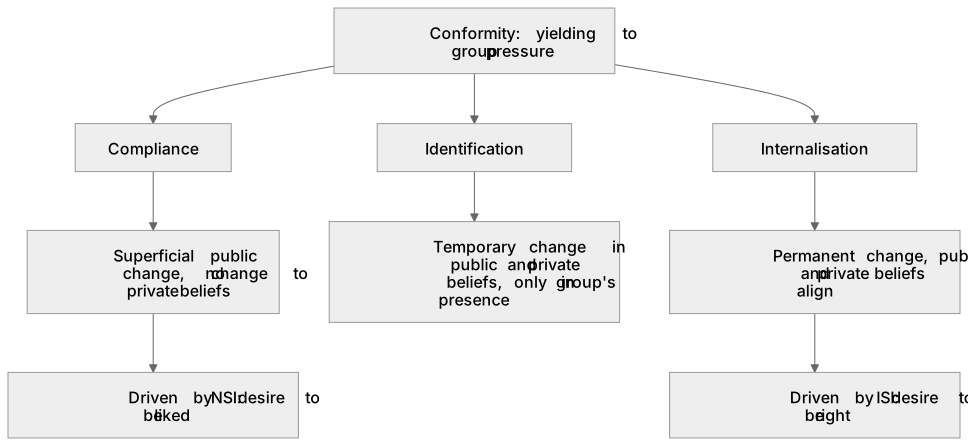
Conformity is yielding to group pressure. Compliance is a superficial change to fit in, without changing private beliefs. Identification is a temporary change in public and private beliefs to align with a valued group, only in their presence. Internalisation is a permanent change where public and private beliefs align, driven by Informational Social Influence (ISI)—the desire to be right. Normative Social Influence (NSI) drives compliance to be liked. Asch investigated variables affecting conformity. Conformity increased with group size up to three confederates, then plateaued. Breaking unanimity with a dissenter reduced conformity. Increasing task difficulty increased conformity, shifting the driver from NSI to ISI.
What earns the marks
- Define compliance as a temporary public change without private belief change, driven by NSI.
- Define identification as a change in public behaviour and private beliefs only while associated with a specific group.
- Define internalisation as a permanent public and private change, driven by ISI.
- Explain how Asch demonstrated that increasing group size increases conformity up to a majority of three.
- Describe how breaking unanimity by introducing a dissenting confederate reduces conformity.
- Explain that increasing task difficulty increases conformity due to ambiguity.
Common mistakes and how to put them right
Confusing NSI and ISI.
Put it right: NSI is about being liked, ISI is about being right.
Ignoring identification; correction: explicitly distinguish identification from compliance and internalisation.
Misunderstanding Asch's group size findings.
Put it right: Conformity peaks at three confederates and plateaus.
Exam tips
- Use examples like adopting a student lifestyle (identification) versus becoming a vegetarian permanently (internalisation).
- Link Asch's variations (group size, unanimity, task difficulty) to NSI and ISI.
Try the lesson
The start of the Social influence: Types of conformity: internalisation, and compliance. Explanations for conformity: informational social influence and normative social influence, and variables affecting conformity including group size, unanimity and task difficulty as investigated by Asch. lesson, made from checked teaching notes for this specification point.
Have a go first
Which of the following best describes the type of conformity known as compliance?
Listen
Conformity is yielding to group pressure. Compliance is a superficial change to fit in, without changing private beliefs. Identification is a temporary change in public and private beliefs to align with a valued group, only in their presence. Internalisation is a permanent change where public and private beliefs align, driven by Informational Social Influence (ISI)—the desire to be right. Normative Social Influence (NSI) drives compliance to be liked. Asch investigated variables affecting conformity. Conformity increased with group size up to three confederates, then plateaued. Breaking unanimity with a dissenter reduced conformity. Increasing task difficulty increased conformity, shifting the driver from NSI to ISI. A strong answer earns marks for these points. Define compliance as a temporary public change without private belief change, driven by NSI. Define identification as a change in public behaviour and private beliefs only while associated with a specific group. Define internalisation as a permanent public and private change, driven by ISI. Explain how Asch demonstrated that increasing group size increases conformity up to a majority of three. A common slip: Confusing NSI and ISI. Instead, NSI is about being liked, ISI is about being right. Exam tip: Use examples like adopting a student lifestyle (identification) versus becoming a vegetarian permanently (internalisation).
See it
Watch it explained
What is the one idea the video explains? Say it in a sentence.
Read the described scene instead
Conformity is yielding to group pressure. This lesson distinguishes compliance, identification and internalisation, then links explanations to Asch’s variables. Compliance is a superficial public change to fit in, without changing private beliefs. Identification is a temporary change in public and private beliefs while you are with a valued group. Internalisation is a permanent change where public and private beliefs align. Normative social influence drives compliance: the desire to be liked. Informational social influence drives internalisation: the desire to be right. So NSI is about fitting in, while ISI is about accuracy. Asch tested variables affecting conformity. Group size mattered: conformity increased up to three confederates, then plateaued. Before I explain unanimity, pause and predict what a dissenter might do. Breaking unanimity with a dissenter reduced conformity. Asch also varied task difficulty. Increasing task difficulty increased conformity because the task became more ambiguous. This shifts the driver from normative social influence toward informational social influence. Do not confuse NSI and ISI: NSI is about being liked, ISI is about being right. Do not ignore identification; distinguish it from compliance and internalisation. And remember Asch’s group-size finding: conformity peaks at three confederates and then plateaus. So conformity has three types: compliance, identification and internalisation. NSI drives compliance; ISI drives internalisation. Asch showed conformity rises with group size up to three, falls when unanimity is broken, and rises with task difficulty.
Key words
Say what each word means before you turn the card.
Compliance
Try answering aloud or in your head before turning the card.
Internalisation
Try answering aloud or in your head before turning the card.
Informational social influence
Try answering aloud or in your head before turning the card.
Normative social influence
Try answering aloud or in your head before turning the card.
See every definition
- Compliance
- A superficial change to fit in, without changing private beliefs, driven by normative social influence.
- Internalisation
- A permanent change where public and private beliefs align, driven by informational social influence.
- Informational social influence
- The desire to be right, which drives internalisation.
- Normative social influence
- The drive to be liked, which drives compliance.
Label the diagram
Some boxes have lost their names. Pick the right name for each number.
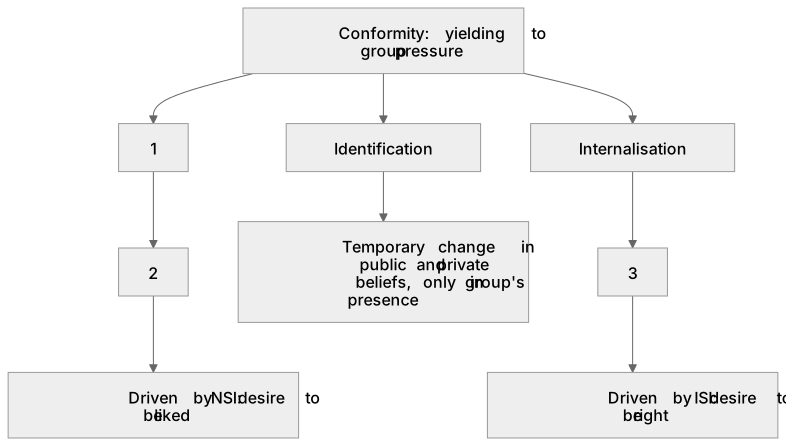
1Box 1
2Box 2
3Box 3
There is more to this lesson
The full lesson goes on to check your understanding and help you earn the marks. Create a free account to carry on, with your progress saved.
A week of Premium from your first lesson · Then the free plan continues · No card, no charge
Test your understanding of Social influence: Types of conformity: internalisation, and compliance. Explanations for conformity: informational social influence and normative social influence, and variables affecting conformity including group size, unanimity and task difficulty as investigated by Asch.
Active recall beats re-reading. Take an instant quiz now to test what you’ve learned and lock it into long-term memory.
A week of Premium from your first lesson · Then the free plan continues · No card, no charge