AQA · A-Level · Psychology
Course version: 7182-2025 · Exams from 2027
Explanations for obedience: agentic state and legitimacy of authority, and…
Full specification wording
Social influence: Explanations for obedience: agentic state and legitimacy of authority, and situational variables affecting obedience including proximity and location, as investigated by Milgram, and uniform. Dispositional explanation for obedience: the Authoritarian Personality.
Obedience is following a direct order from a figure of authority.
Checked against the AQA 7182-2025 specification (opens in a new tab) on .
- Point 2 of 4
- 3 key terms
Study notes
From the checked teaching notes for this specification point.
The idea
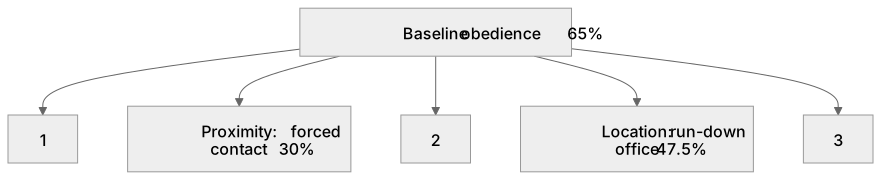
Obedience is following a direct order from a figure of authority. In the baseline study 40 men gave what they believed were shocks rising to 450 volts: every one reached 300 volts and 65% went to the maximum. Two explanations account for this. In the agentic state a person acts as an instrument of authority and passes responsibility upward, while binding factors such as the prods keep him there despite obvious moral strain. Legitimacy of authority adds that we are socialised into hierarchies, so an authority accepted as legitimate can direct destructive acts. The situation matters: obedience fell to 40% in the same room, 30% with forced contact, 22.5% by telephone, 47.5% in a run-down office and 20% with an ordinary man giving orders. Adorno instead located the cause in personality.
What earns the marks
- Agentic state: the individual comes to see himself as the instrument of an authority figure and shifts responsibility for the outcome to that figure, in contrast with the autonomous state.
- Agentic shift and binding factors: the shift occurs when a legitimate authority is perceived, and binding factors such as the prods and blaming the victim reduce the moral strain of continuing.
- Legitimacy of authority: societies are hierarchical and we are socialised to obey authority we recognise as legitimate, which explains how destructive authority can be granted the power to order cruelty.
- Proximity: obedience fell from 65% in the baseline to 40% with teacher and learner in the same room, 30% when the teacher had to force the learner's hand onto the plate, and 22.5% with orders given by telephone.
- Location: moving the study from Yale to a run-down office in Bridgeport cut obedience to 47.5%, showing that the prestige of the setting confers legitimacy.
- Evaluation: Elms and Milgram found obedient participants scored higher on the F-scale, but the evidence is correlational and cannot show that the personality caused the obedience.
- Evaluation: every F-scale item is worded so that agreeing produces a high score, so acquiescence bias means the scale may measure response style rather than authoritarianism.
- Evaluation: a dispositional explanation cannot account for whole populations behaving the same way, whereas social identity theory explains obedience as identification with the scientific enterprise.
- Evaluation: Orne and Holland argued participants did not believe the shocks were real, though Sheridan and King found high obedience when the shocks given to a puppy genuinely were.
Common mistakes and how to put them right
Writing that participants were paid to continue or were not allowed to stop.
Put it right: They were told the money was theirs whatever happened, and the pressure came from four verbal prods.
Confusing the agentic state with not caring.
Put it right: Participants showed real moral strain, sweating and protesting while they continued.
Quoting 65% for every variation.
Put it right: Each situational variable has its own figure, and the credit comes from the comparison with the baseline.
Describing the Authoritarian Personality as obedience to anyone, when the account is specifically about submission to perceived superiors and hostility to perceived inferiors.
Treating the agentic state and legitimacy of authority as one explanation.
Put it right: Legitimacy is a property of the authority; the agentic state is the mental state of the person obeying.
Exam tips
- Match the explanation to the stem: a uniform or an impressive setting calls for the situational variables, while an upbringing or a set of rigid attitudes calls for the dispositional explanation.
- An essay is stronger if the situational and dispositional explanations are set against each other rather than described one after the other.
- Quote the figures. Obedience dropped is worth little; obedience dropped from 65% to 47.5% in the Bridgeport office is the creditable version.
- Validity and ethical criticisms earn evaluation credit only when you state the consequence for what the study is able to claim.
Try the lesson
The start of the Social influence: Explanations for obedience: agentic state and legitimacy of authority, and situational variables affecting obedience including proximity and location, as investigated by Milgram, and uniform. Dispositional explanation for obedience: the Authoritarian Personality. lesson, made from checked teaching notes for this specification point.
Have a go first
Which of the following best describes the concept of the 'agentic state' as an explanation for obedience?
Listen
Obedience is following a direct order from a figure of authority. In the baseline study 40 men gave what they believed were shocks rising to 450 volts: every one reached 300 volts and 65% went to the maximum. Two explanations account for this. In the agentic state a person acts as an instrument of authority and passes responsibility upward, while binding factors such as the prods keep him there despite obvious moral strain. Legitimacy of authority adds that we are socialised into hierarchies, so an authority accepted as legitimate can direct destructive acts. The situation matters: obedience fell to 40% in the same room, 30% with forced contact, 22.5% by telephone, 47.5% in a run-down office and 20% with an ordinary man giving orders. Adorno instead located the cause in personality. A strong answer earns marks for these points. Agentic state: the individual comes to see himself as the instrument of an authority figure and shifts responsibility for the outcome to that figure, in contrast with the autonomous state. Agentic shift and binding factors: the shift occurs when a legitimate authority is perceived, and binding factors such as the prods and blaming the victim reduce the moral strain of continuing. Legitimacy of authority: societies are hierarchical and we are socialised to obey authority we recognise as legitimate, which explains how destructive authority can be granted the power to order cruelty. Proximity: obedience fell from 65% in the baseline to 40% with teacher and learner in the same room, 30% when the teacher had to force the learner's hand onto the plate, and 22.5% with orders given by telephone. Exam tip: Match the explanation to the stem: a uniform or an impressive setting calls for the situational variables, while an upbringing or a set of rigid attitudes calls for the dispositional explanation.
See it

Key words
Say what each word means before you turn the card.
Agentic state
Try answering aloud or in your head before turning the card.
Legitimacy of authority
Try answering aloud or in your head before turning the card.
Authoritarian Personality
Try answering aloud or in your head before turning the card.
See every definition
- Agentic state
- The individual comes to see himself as the instrument of an authority figure and shifts responsibility for the outcome to that figure.
- Legitimacy of authority
- Societies are hierarchical and we are socialised to obey authority we recognise as legitimate, which explains how destructive authority can be granted the power to order cruelty.
- Authoritarian Personality
- Adorno measured it with the F-scale and found high scorers were submissive to superiors, contemptuous of inferiors, rigid in their thinking and hostile to other groups.
Label the diagram
Some boxes have lost their names. Pick the right name for each number.
1Box 1
2Box 2
3Box 3
There is more to this lesson
The full lesson goes on to check your understanding and help you earn the marks. Create a free account to carry on, with your progress saved.
A week of Premium from your first lesson · Then the free plan continues · No card, no charge
Test your understanding of Social influence: Explanations for obedience: agentic state and legitimacy of authority, and situational variables affecting obedience including proximity and location, as investigated by Milgram, and uniform. Dispositional explanation for obedience: the Authoritarian Personality.
Active recall beats re-reading. Take an instant quiz now to test what you’ve learned and lock it into long-term memory.
A week of Premium from your first lesson · Then the free plan continues · No card, no charge