AQA · A-Level · Psychology
Course version: 7182-2025 · Exams from 2027
Individual differences in stress: personality types A, B and C and…
Full specification wording
Stress: Individual differences in stress: personality types A, B and C and associated behaviours; hardiness, including commitment, challenge and control.
Why the same pressure floors one person and not another.
Checked against the AQA 7182-2025 specification (opens in a new tab) on .
- Point 5 of 6
- 4 key terms
Study notes
From the checked teaching notes for this specification point.
The idea
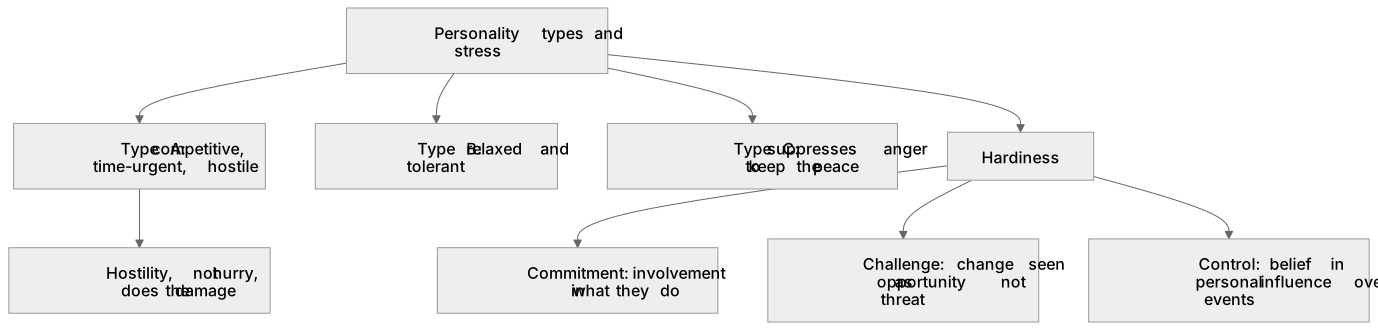
Why the same pressure floors one person and not another. Friedman and Rosenman interviewed around three thousand Californian men and sorted them by manner: Type A competitive, time-urgent and hostile, Type B relaxed and tolerant. Eight and a half years later, of the 257 who had developed coronary heart disease, roughly twice as many were Type A. Later work narrowed it: hostility, not hurry, does the damage. Temoshok's Type C suppresses anger to keep the peace and is linked, far more weakly, to poorer cancer outcomes. Kobasa found executives who stayed well under heavy strain scored high on three Cs: commitment to what they do, seeing change as challenge not threat, and a sense of control. The categories are crude, the samples male, and hardiness may just be tagging optimism.
What earns the marks
- Type A broken into its components, competitiveness, time urgency and hostility, with Type B as the relaxed, tolerant contrast rather than a stress-free person.
- Friedman and Rosenman's prospective design: a large cohort of men classified by structured interview and followed for years, with Type A showing about double the coronary heart disease rate.
- The refinement that hostility is the pathogenic component, so the original package was too broad.
- Type C characterised by emotional suppression, compliance and difficulty expressing anger, associated with poorer cancer prognosis.
- Hardiness with each C explained, not merely listed: commitment as involvement, challenge as construing change as opportunity, control as belief in personal influence over events.
- AO3: the classic samples are male, middle-aged, white-collar and American, so generalisation beyond them is unsafe.
- AO3: types impose categories on continuous traits, and hardiness measured by self-report overlaps with neuroticism and negative affectivity.
Common mistakes and how to put them right
Listing the three Cs as bare words.
Put it right: Challenge must be explained as viewing change as an opportunity rather than a threat.
Saying Type A causes heart disease, when the evidence is a prospective correlation and hostility accounts for most of it.
Presenting Type C as an established cause of cancer, which the evidence does not support.
Describing Type B as experiencing no stress, rather than responding to it differently.
Confusing hardiness with simply being resilient, without naming the three components AQA specifies.
Exam tips
- Scenario questions hand you a character sketch, so quote the detail from the stem that identifies the type before you name it.
- If asked to evaluate hardiness, the narrow sample and the reliance on self-report are the two safest and quickest criticisms.
- Do not open by defining stress. The marks sit on the individual differences, not on background.
Try the lesson
The start of the Stress: Individual differences in stress: personality types A, B and C and associated behaviours; hardiness, including commitment, challenge and control. lesson, made from checked teaching notes for this specification point.
Have a go first
When psychologists assess individual differences in stress responses, which specific pattern of behaviour is used to identify an individual with a Type C personality?
Listen
Why the same pressure floors one person and not another. Friedman and Rosenman interviewed around three thousand Californian men and sorted them by manner: Type A competitive, time-urgent and hostile, Type B relaxed and tolerant. Eight and a half years later, of the 257 who had developed coronary heart disease, roughly twice as many were Type A. Later work narrowed it: hostility, not hurry, does the damage. Temoshok's Type C suppresses anger to keep the peace and is linked, far more weakly, to poorer cancer outcomes. Kobasa found executives who stayed well under heavy strain scored high on three Cs: commitment to what they do, seeing change as challenge not threat, and a sense of control. The categories are crude, the samples male, and hardiness may just be tagging optimism. A strong answer earns marks for these points. Type A broken into its components, competitiveness, time urgency and hostility, with Type B as the relaxed, tolerant contrast rather than a stress-free person. Friedman and Rosenman's prospective design: a large cohort of men classified by structured interview and followed for years, with Type A showing about double the coronary heart disease rate. The refinement that hostility is the pathogenic component, so the original package was too broad. Type C characterised by emotional suppression, compliance and difficulty expressing anger, associated with poorer cancer prognosis. Exam tip: Scenario questions hand you a character sketch, so quote the detail from the stem that identifies the type before you name it.
See it
Key words
Say what each word means before you turn the card.
Type A
Try answering aloud or in your head before turning the card.
Type C
Try answering aloud or in your head before turning the card.
Hardiness
Try answering aloud or in your head before turning the card.
Hostility
Try answering aloud or in your head before turning the card.
See every definition
- Type A
- A personality sorted by manner as competitive, time-urgent and hostile, contrasted with the relaxed and tolerant Type B.
- Type C
- A personality that suppresses anger to keep the peace and is linked, far more weakly, to poorer cancer outcomes.
- Hardiness
- Scoring high on three Cs, commitment, challenge and control, found in executives who stayed well under heavy strain.
- Hostility
- The component of Type A that later work narrowed out as doing the damage, rather than hurry.
Label the diagram
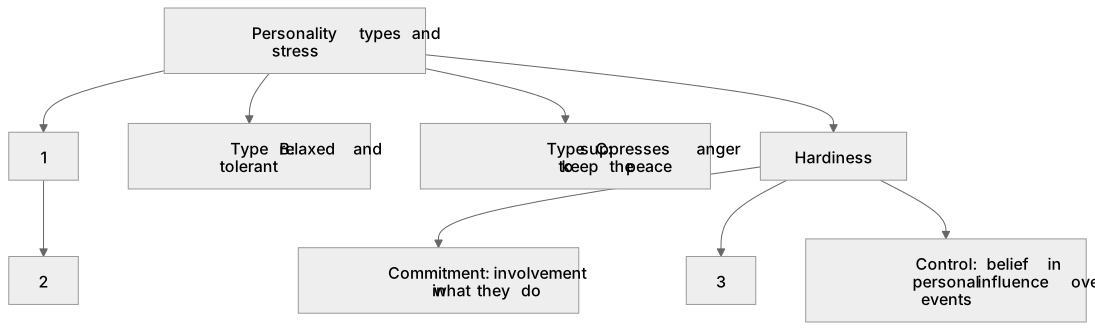
Some boxes have lost their names. Pick the right name for each number.
1Box 1
2Box 2
3Box 3
There is more to this lesson
The full lesson goes on to check your understanding and help you earn the marks. Create a free account to carry on, with your progress saved.
A week of Premium from your first lesson · Then the free plan continues · No card, no charge
Test your understanding of Stress: Individual differences in stress: personality types A, B and C and associated behaviours; hardiness, including commitment, challenge and control.
Active recall beats re-reading. Take an instant quiz now to test what you’ve learned and lock it into long-term memory.
A week of Premium from your first lesson · Then the free plan continues · No card, no charge