AQA · A-Level · Psychology
Course version: 7182-2025 · Exams from 2027
Sources of stress: life changes and daily hassles. Workplace stress,…
Full specification wording
Stress: Sources of stress: life changes and daily hassles. Workplace stress, including the effects of workload and control.
Two rival accounts of what wears people down.
Checked against the AQA 7182-2025 specification (opens in a new tab) on .
- Point 3 of 6
- 2 key terms
Study notes
From the checked teaching notes for this specification point.
The idea
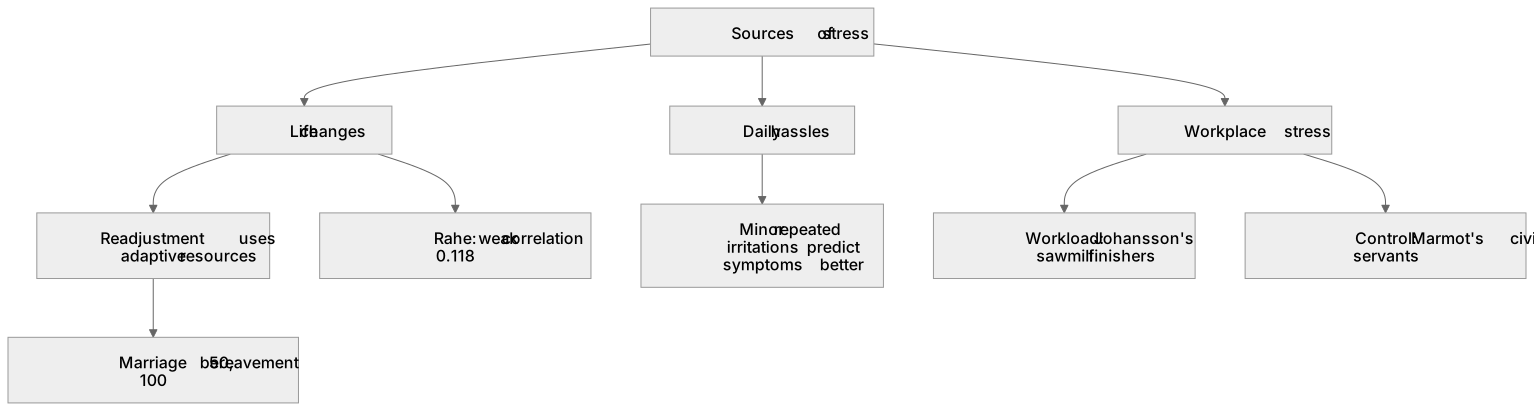
Two rival accounts of what wears people down. Holmes and Rahe argued it is major change, desirable or not: they scaled forty-three life events in life change units, anchoring marriage at fifty, so bereavement of a spouse scores a hundred and divorce seventy-three. Rahe then found only a weak correlation, around 0.118, between units accumulated and later illness in US sailors. Kanner countered that the daily grind matters more, and his hassles measure outpredicted life events for psychological symptoms. At work two things bite. Johansson's Swedish sawmill finishers, machine-paced and isolated, showed adrenaline far above baseline and more absence than cleaners; Marmot's Whitehall civil servants showed low job control, rather than sheer workload, tracking heart disease.
What earns the marks
- Life changes explained as readjustment: any change, positive or negative, uses up adaptive resources, which is why marriage sits on the scale alongside bereavement.
- Named values from the scale to anchor the answer, and the weak size of Rahe's naval correlation.
- Daily hassles as the rival account: minor, repeated irritations accumulate and predict symptoms better than discrete life events.
- Workload evidence: Johansson's sawmill finishers, whose repetitive machine-paced work produced raised adrenaline, more illness and more absenteeism than cleaners.
- Control evidence: Marmot's civil servants, where the lowest grades with least job control had the highest cardiovascular risk.
- AO3: the data are correlational and often retrospective, so recall of life events may itself be coloured by current ill health.
- AO3: individual differences in appraisal mean the same event carries a different weight for different people, which a fixed score cannot capture.
Common mistakes and how to put them right
Saying the life events scale measures bad events only.
Put it right: Marriage, holidays and promotion are on it because the theory is about change, not misery.
Reporting the Whitehall finding backwards as senior managers being the most stressed.
Put it right: Control protects, so risk was highest at the bottom.
Quoting a correlation of around 0.118 as though it were strong evidence.
Blurring hassles into life events.
Put it right: Hassles are ongoing daily irritations; life events are discrete changes in circumstance.
Discussing workplace stress only as too much work, and never mentioning control.
Exam tips
- Application items describe a job, so decide whether the stressor is workload, control, or both, and say which before evaluating.
- Discuss questions reward setting life events against daily hassles as competing explanations rather than describing each in turn.
- Attach at least one figure or named sample to each study you use; it is what separates a top band answer from a vague one.
Try the lesson
The start of the Stress: Sources of stress: life changes and daily hassles. Workplace stress, including the effects of workload and control. lesson, made from checked teaching notes for this specification point.
Have a go first
Which of the following is best described as a 'daily hassle' rather than a 'life change' source of stress?
Listen
Two rival accounts of what wears people down. Holmes and Rahe argued it is major change, desirable or not: they scaled forty-three life events in life change units, anchoring marriage at fifty, so bereavement of a spouse scores a hundred and divorce seventy-three. Rahe then found only a weak correlation, around 0.118, between units accumulated and later illness in US sailors. Kanner countered that the daily grind matters more, and his hassles measure outpredicted life events for psychological symptoms. At work two things bite. Johansson's Swedish sawmill finishers, machine-paced and isolated, showed adrenaline far above baseline and more absence than cleaners; Marmot's Whitehall civil servants showed low job control, rather than sheer workload, tracking heart disease. A strong answer earns marks for these points. Life changes explained as readjustment: any change, positive or negative, uses up adaptive resources, which is why marriage sits on the scale alongside bereavement. Named values from the scale to anchor the answer, and the weak size of Rahe's naval correlation. Daily hassles as the rival account: minor, repeated irritations accumulate and predict symptoms better than discrete life events. Workload evidence: Johansson's sawmill finishers, whose repetitive machine-paced work produced raised adrenaline, more illness and more absenteeism than cleaners. Exam tip: Application items describe a job, so decide whether the stressor is workload, control, or both, and say which before evaluating.
See it
Key words
Say what each word means before you turn the card.
Life changes
Try answering aloud or in your head before turning the card.
Daily hassles
Try answering aloud or in your head before turning the card.
See every definition
- Life changes
- Any change, positive or negative, uses up adaptive resources, which is why marriage sits on the scale alongside bereavement.
- Daily hassles
- Minor, repeated irritations accumulate and predict symptoms better than discrete life events.
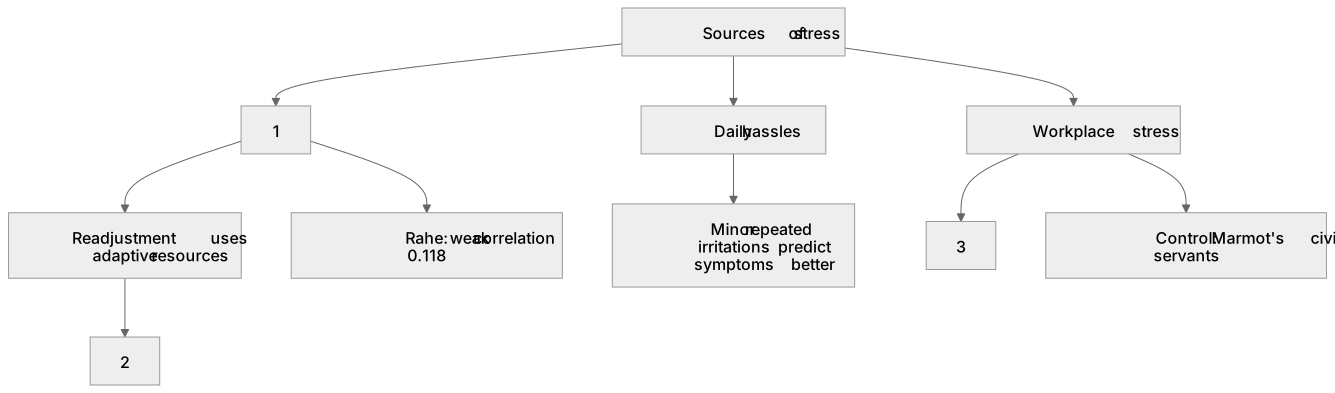
Label the diagram
Some boxes have lost their names. Pick the right name for each number.
1Box 1
2Box 2
3Box 3
There is more to this lesson
The full lesson goes on to check your understanding and help you earn the marks. Create a free account to carry on, with your progress saved.
A week of Premium from your first lesson · Then the free plan continues · No card, no charge
Test your understanding of Stress: Sources of stress: life changes and daily hassles. Workplace stress, including the effects of workload and control.
Active recall beats re-reading. Take an instant quiz now to test what you’ve learned and lock it into long-term memory.
A week of Premium from your first lesson · Then the free plan continues · No card, no charge