AQA · A-Level · Psychology
Course version: 7182-2025 · Exams from 2027
The role of stress in illness, including reference to immunosuppression…
Full specification wording
Stress: The role of stress in illness, including reference to immunosuppression and cardiovascular disorders.
The link is not magic; it is cortisol.
Checked against the AQA 7182-2025 specification (opens in a new tab) on .
- Point 2 of 6
- 4 key terms
Study notes
From the checked teaching notes for this specification point.
The idea
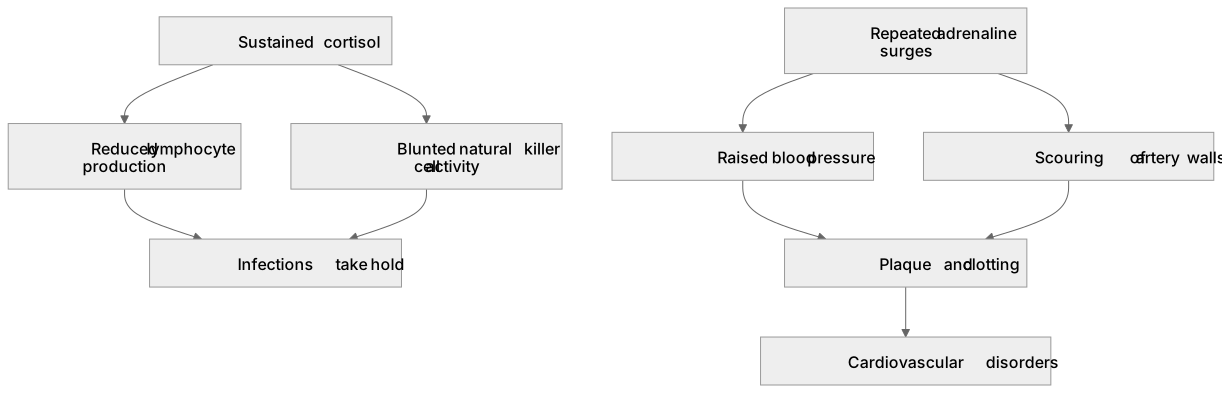
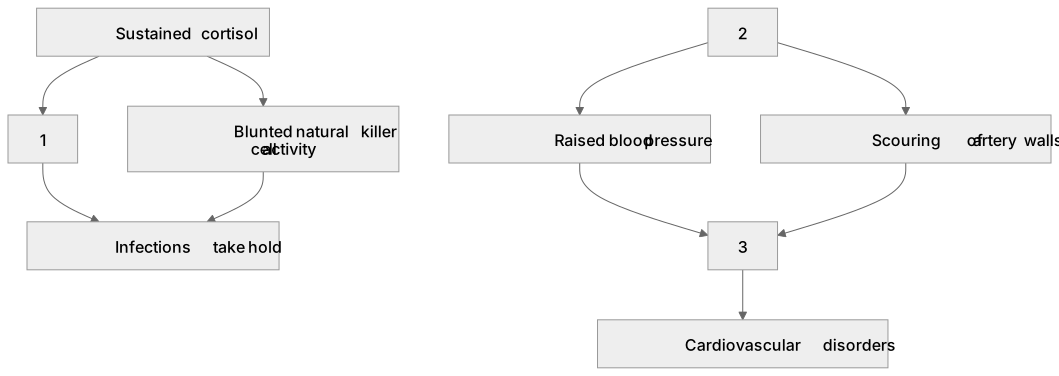
The link is not magic; it is cortisol. Sustained cortisol reduces lymphocyte production and blunts natural killer cell activity, so infections take hold. Kiecolt-Glaser took blood from seventy-five medical students a month before exams and again during them: natural killer activity fell in the exam sample, furthest in students also reporting loneliness. Her wound-healing work found biopsy wounds in carers of relatives with Alzheimer's took roughly nine days longer to close than in matched controls. On the heart, repeated adrenaline surges raise blood pressure and scour artery walls, encouraging plaque and clotting; Williams found the angriest of thirteen thousand adults were about two and a half times likelier to have a heart attack. All of it is correlational, and stressed people also smoke and sleep badly.
What earns the marks
- The mechanism first: chronic cortisol suppresses immune function, reducing lymphocyte numbers and natural killer cell activity.
- Kiecolt-Glaser's medical students, with the direction of the finding stated: natural killer cell activity was lower during exams than a month before.
- The wound-healing study on carers, where healing took around a quarter longer than in controls.
- The cardiovascular mechanism: raised blood pressure and heart rate, damage to artery linings, plaque formation and increased clotting.
- Cohen's common cold study, where a higher proportion of the high-stress group developed colds after controlled exposure to the virus.
- AO3: the evidence is correlational, so illness could precede or cause the stress rather than follow it.
- AO3: the indirect behavioural route, since stressed people smoke, drink, sleep less and eat worse, which confounds the direct immune explanation.
Common mistakes and how to put them right
Writing that stress causes illness when the studies are correlational or quasi-experimental and cannot show causation.
Claiming stress always weakens immunity.
Put it right: Brief acute stressors can temporarily boost immune activity, so the relationship is not a straight line.
Naming Kiecolt-Glaser without saying which way the result went, which earns no credit for the finding.
Treating immunosuppression as just meaning catching colds, instead of a measurable change in immune cells.
Explaining cardiovascular damage as stress hormones being toxic, rather than through blood pressure, vessel damage and clotting.
Exam tips
- Use the figures. A stated percentage or a stated number of days is credited where a vague claim that more people got ill is not.
- Application items put a character under a deadline or in a caring role, so name the measure and the study that fits that scenario.
- For evaluation, the third-variable lifestyle confound and the difficulty of measuring immune function are the two strongest lines available.
Try the lesson
The start of the Stress: The role of stress in illness, including reference to immunosuppression and cardiovascular disorders. lesson, made from checked teaching notes for this specification point.
Have a go first
How does chronic stress primarily contribute to immunosuppression in the human body?
Listen
The link is not magic; it is cortisol. Sustained cortisol reduces lymphocyte production and blunts natural killer cell activity, so infections take hold. Kiecolt-Glaser took blood from seventy-five medical students a month before exams and again during them: natural killer activity fell in the exam sample, furthest in students also reporting loneliness. Her wound-healing work found biopsy wounds in carers of relatives with Alzheimer's took roughly nine days longer to close than in matched controls. On the heart, repeated adrenaline surges raise blood pressure and scour artery walls, encouraging plaque and clotting; Williams found the angriest of thirteen thousand adults were about two and a half times likelier to have a heart attack. All of it is correlational, and stressed people also smoke and sleep badly. A strong answer earns marks for these points. The mechanism first: chronic cortisol suppresses immune function, reducing lymphocyte numbers and natural killer cell activity. Kiecolt-Glaser's medical students, with the direction of the finding stated: natural killer cell activity was lower during exams than a month before. The wound-healing study on carers, where healing took around a quarter longer than in controls. The cardiovascular mechanism: raised blood pressure and heart rate, damage to artery linings, plaque formation and increased clotting. Exam tip: Use the figures. A stated percentage or a stated number of days is credited where a vague claim that more people got ill is not.
See it
Key words
Say what each word means before you turn the card.
Cortisol
Try answering aloud or in your head before turning the card.
Correlation against causation
Try answering aloud or in your head before turning the card.
Indirect behavioural route
Try answering aloud or in your head before turning the card.
Cardiovascular mechanisms
Try answering aloud or in your head before turning the card.
See every definition
- Cortisol
- Sustained levels reduce lymphocyte production and blunt natural killer cell activity, so infections take hold.
- Correlation against causation
- All of the evidence is correlational, so illness could precede or cause the stress rather than follow it.
- Indirect behavioural route
- Stressed people also smoke, drink, sleep less and eat worse, which confounds the direct immune explanation.
- Cardiovascular mechanisms
- Repeated adrenaline surges raise blood pressure and scour artery walls, encouraging plaque and clotting.
Label the diagram
Some boxes have lost their names. Pick the right name for each number.
1Box 1
2Box 2
3Box 3
There is more to this lesson
The full lesson goes on to check your understanding and help you earn the marks. Create a free account to carry on, with your progress saved.
A week of Premium from your first lesson · Then the free plan continues · No card, no charge
Test your understanding of Stress: The role of stress in illness, including reference to immunosuppression and cardiovascular disorders.
Active recall beats re-reading. Take an instant quiz now to test what you’ve learned and lock it into long-term memory.
A week of Premium from your first lesson · Then the free plan continues · No card, no charge