Pearson Edexcel · GCSE · Psychology
Course version: 1PS0 · Version from Sept 2017
Questionnaire, including a. closed-ended questions to elicit quantitative…
Full specification wording
Designing psychological research: 11.1.13 questionnaire, including a. closed-ended questions to elicit quantitative data b. open-ended questions to elicit qualitative data
A questionnaire is a self-report method where participants respond to written questions.
Checked against the Pearson Edexcel 1PS0 specification (opens in a new tab) on .
- Point 14 of 17
- 2 key terms
Study notes
From the checked teaching notes for this specification point.
The idea
A questionnaire is a self-report method where participants respond to written questions. It includes closed-ended questions, which restrict the respondent to fixed answers like 'yes/no'. These elicit quantitative data, which is numerical and easy to analyse statistically, for example, calculating the percentage of people who sleep eight hours a night. Questionnaires also include open-ended questions, allowing participants to answer in their own words without restricted options. These elicit qualitative data, providing rich, non-numerical insights, such as asking participants to describe how they feel after a poor night's sleep. Researchers often use a combination of both question types to gather comprehensive data.
What earns the marks
- Define a questionnaire as a self-report technique using written questions.
- Identify closed-ended questions as those with fixed response options.
- Explain that closed-ended questions produce quantitative (numerical) data.
- Identify open-ended questions as those allowing free-text responses.
- Explain that open-ended questions produce qualitative (descriptive) data.
Common mistakes and how to put them right
Confusing qualitative and quantitative data.
Put it right by remembering that quantitative is numerical (quantities) and qualitative is descriptive (qualities).
Assuming questionnaires only use one type of question.
Put it right by recognising that many questionnaires use a mix of open and closed questions.
Stating that closed questions provide detailed insights.
Put it right by noting that closed questions lack detail, whereas open questions provide rich detail.
Exam tips
- When designing a questionnaire for an exam answer, clearly state whether your proposed question is open or closed.
- Link the type of question directly to the type of data it produces, such as closed questions for quantitative data.
- Use clear, unambiguous language when writing example questions to ensure they measure what is intended.
Try the lesson
The start of the Designing psychological research: 11.1.13 questionnaire, including a. closed-ended questions to elicit quantitative data b. open-ended questions to elicit qualitative data lesson, made from checked teaching notes for this specification point.
Have a go first
Which type of question in a questionnaire is specifically designed to produce quantitative data?
Listen
A questionnaire is a self-report method where participants respond to written questions. It includes closed-ended questions, which restrict the respondent to fixed answers like 'yes/no'. These elicit quantitative data, which is numerical and easy to analyse statistically, for example, calculating the percentage of people who sleep eight hours a night. Questionnaires also include open-ended questions, allowing participants to answer in their own words without restricted options. These elicit qualitative data, providing rich, non-numerical insights, such as asking participants to describe how they feel after a poor night's sleep. Researchers often use a combination of both question types to gather comprehensive data. A strong answer earns marks for these points. Define a questionnaire as a self-report technique using written questions. Identify closed-ended questions as those with fixed response options. Explain that closed-ended questions produce quantitative (numerical) data. Identify open-ended questions as those allowing free-text responses. A common slip: Confusing qualitative and quantitative data. Instead, remembering that quantitative is numerical (quantities) and qualitative is descriptive (qualities). Exam tip: When designing a questionnaire for an exam answer, clearly state whether your proposed question is open or closed.
See it
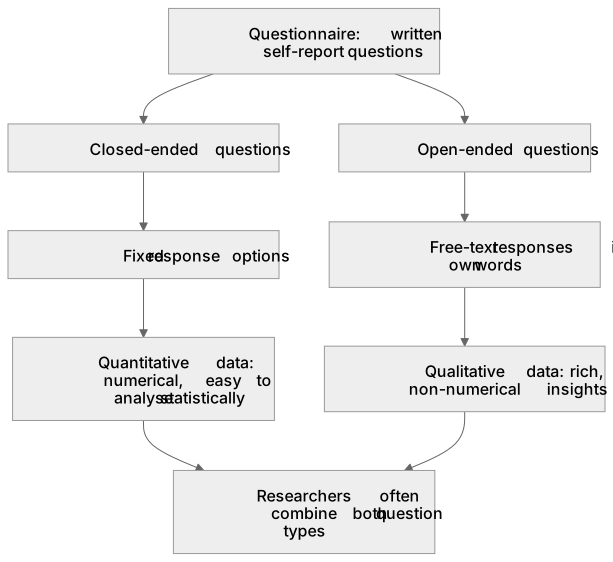
Key words
Say what each word means before you turn the card.
Quantitative data
Try answering aloud or in your head before turning the card.
Qualitative data
Try answering aloud or in your head before turning the card.
See every definition
- Quantitative data
- Numerical data that is easy to analyse statistically, elicited by closed-ended questions with fixed answers.
- Qualitative data
- Rich, non-numerical insights elicited by open-ended questions that allow participants to answer in their own words.
Label the diagram
Some boxes have lost their names. Pick the right name for each number.
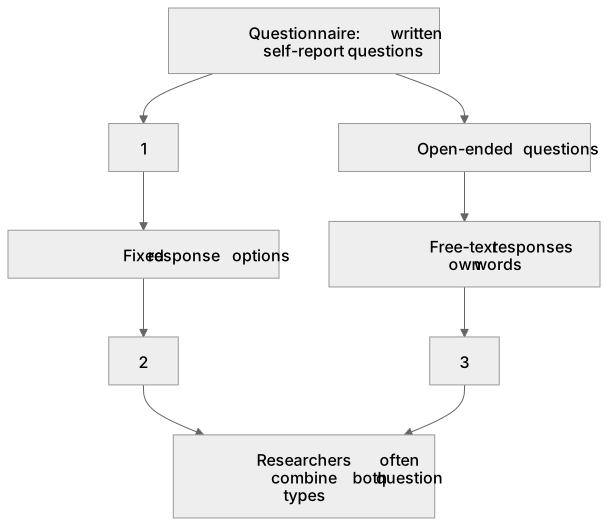
1Box 1
2Box 2
3Box 3
There is more to this lesson
The full lesson goes on to check your understanding and help you earn the marks. Create a free account to carry on, with your progress saved.
A week of Premium from your first lesson · Then the free plan continues · No card, no charge
Test your understanding of Designing psychological research: 11.1.13 questionnaire, including a. closed-ended questions to elicit quantitative data b. open-ended questions to elicit qualitative data
Active recall beats re-reading. Take an instant quiz now to test what you’ve learned and lock it into long-term memory.
A week of Premium from your first lesson · Then the free plan continues · No card, no charge