Pearson Edexcel · GCSE · Psychology
Course version: 1PS0 · Version from Sept 2017
Designing psychological research: 11.1.15 case study
A case study is an in-depth investigation of a single individual, small group, or specific event.
Checked against the Pearson Edexcel 1PS0 specification (opens in a new tab) on .
- Point 16 of 17
Study notes
From the checked teaching notes for this specification point.
The idea
A case study is an in-depth investigation of a single individual, small group, or specific event. It uses a variety of research methods, such as interviews, observations, and psychological tests, to gather rich qualitative and quantitative data. Case studies are useful for investigating rare phenomena that cannot be studied experimentally due to ethical constraints, such as severe brain damage. While they provide deep insights and high ecological validity, their findings are difficult to generalise to the wider population because the sample is unique. Furthermore, researchers may become subjective, leading to researcher bias, and replicating a case study is usually impossible, which significantly reduces the reliability of the findings.
What earns the marks
- Identify a case study as a detailed, in-depth investigation of a single individual, small group, or event.
- Recognise that case studies employ multiple research methods, such as interviews and observations, to gather comprehensive data.
- Evaluate the strengths of case studies, including the ability to study rare behaviours and gather rich, qualitative data.
- Evaluate the weaknesses of case studies, such as the lack of generalisability and the potential for researcher bias.
Common mistakes and how to put them right
Believing case studies only collect qualitative data.
Put it right: Case studies can collect both qualitative data, such as interview transcripts, and quantitative data, such as psychometric test scores.
Confusing case studies with experimental methods.
Put it right: Case studies do not manipulate an independent variable to measure a dependent variable; they observe and describe existing phenomena.
Assuming findings from a case study apply to the general population.
Put it right: Because the sample is usually one unique individual or a small group, findings cannot be easily generalised to the wider population.
Exam tips
- When evaluating a case study, explicitly link the unique nature of the sample to the issue of low generalisability.
- Use specific examples of rare conditions to illustrate why case studies are sometimes the only ethical way to conduct research.
- Remember to mention that case studies are often longitudinal, meaning the researcher tracks the individual over an extended period of time.
Try the lesson
The start of the Designing psychological research: 11.1.15 case study lesson, made from checked teaching notes for this specification point.
Have a go first
A psychologist conducts an in-depth investigation into the life and behaviour of a single patient who has a rare brain injury. Which research method is the psychologist using?
Listen
A case study is an in-depth investigation of a single individual, small group, or specific event. It uses a variety of research methods, such as interviews, observations, and psychological tests, to gather rich qualitative and quantitative data. Case studies are useful for investigating rare phenomena that cannot be studied experimentally due to ethical constraints, such as severe brain damage. While they provide deep insights and high ecological validity, their findings are difficult to generalise to the wider population because the sample is unique. Furthermore, researchers may become subjective, leading to researcher bias, and replicating a case study is usually impossible, which significantly reduces the reliability of the findings. A strong answer earns marks for these points. Identify a case study as a detailed, in-depth investigation of a single individual, small group, or event. Recognise that case studies employ multiple research methods, such as interviews and observations, to gather comprehensive data. Evaluate the strengths of case studies, including the ability to study rare behaviours and gather rich, qualitative data. Evaluate the weaknesses of case studies, such as the lack of generalisability and the potential for researcher bias. A common slip: Believing case studies only collect qualitative data. Instead, Case studies can collect both qualitative data, such as interview transcripts, and quantitative data, such as psychometric test scores. Exam tip: When evaluating a case study, explicitly link the unique nature of the sample to the issue of low generalisability.
See it

Label the diagram
Some boxes have lost their names. Pick the right name for each number.
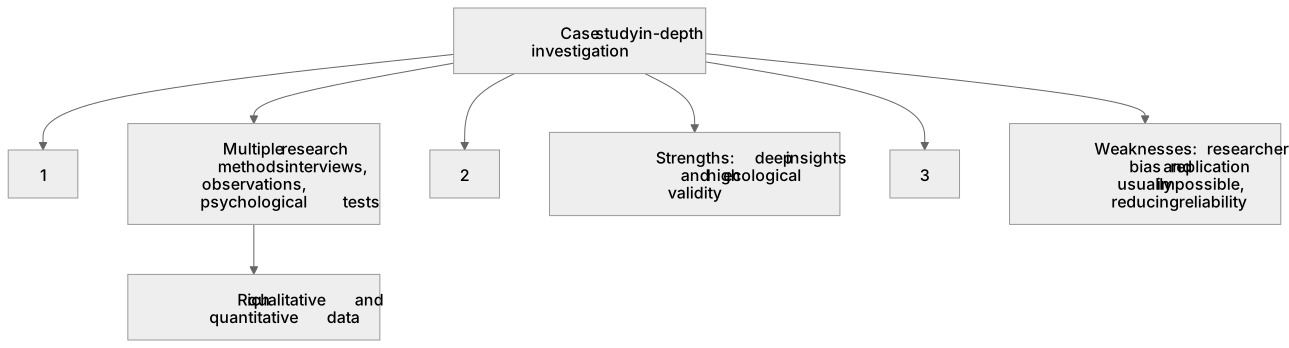
1Box 1
2Box 2
3Box 3
There is more to this lesson
The full lesson goes on to check your understanding and help you earn the marks. Create a free account to carry on, with your progress saved.
A week of Premium from your first lesson · Then the free plan continues · No card, no charge
Test your understanding of Designing psychological research: 11.1.15 case study
Active recall beats re-reading. Take an instant quiz now to test what you’ve learned and lock it into long-term memory.
A week of Premium from your first lesson · Then the free plan continues · No card, no charge