Pearson Edexcel · GCSE · Psychology
Course version: 1PS0 · Version from Sept 2017
Understand the role of education and intelligence, including Piaget’s…
Full specification wording
Development: 1.1.2 Understand the role of education and intelligence, including Piaget’s Theory of Cognitive Development, and the four stages of cognitive development, including strengths and weaknesses of the theory: a. sensorimotor b. pre-operational c. concrete operational d. formal operational e. schemata/schemas f. assimilation g. accommodation h. equilibrium
Piaget’s Theory explains how intelligence evolves through active learning.
Checked against the Pearson Edexcel 1PS0 specification (opens in a new tab) on .
- Point 2 of 4
- 4 key terms
Study notes
From the checked teaching notes for this specification point.
The idea
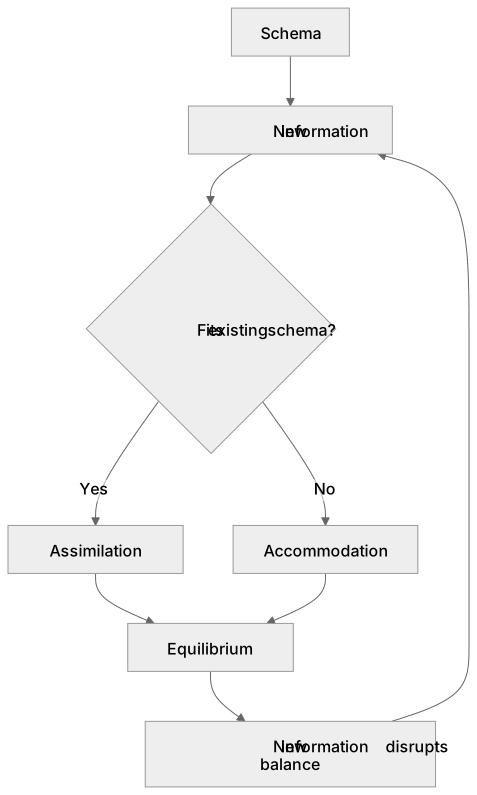
Piaget’s Theory explains how intelligence evolves through active learning. Children build mental frameworks called schemas. When new information fits an existing schema, assimilation occurs, maintaining equilibrium. If it does not fit, accommodation alters the schema to restore balance. Piaget proposed four stages: sensorimotor (learning through senses), pre-operational (symbolic but egocentric thought), concrete operational (logical thought about physical objects), and formal operational (abstract reasoning). While influential in education by promoting discovery learning, weaknesses include underestimating children's abilities at earlier ages and ignoring the role of social influences on cognitive development.
What earns the marks
- Schemas are mental structures that organise past experiences and provide a framework for understanding future experiences.
- Assimilation involves incorporating new information into an existing schema without changing it.
- Accommodation requires modifying an existing schema or creating a new one when new information cannot be assimilated.
- The sensorimotor stage is characterised by learning through sensory input and motor actions, culminating in object permanence.
- A key weakness of Piaget's theory is that subsequent research has shown children often achieve cognitive milestones earlier than he proposed.
Common mistakes and how to put them right
Confusing assimilation and accommodation.
Put it right: Assimilation adds to an existing schema without changing its core, whereas accommodation fundamentally alters the schema or creates a new one.
Assuming the stages can occur in any order.
Put it right: Piaget argued that the four stages of cognitive development are invariant and must occur in a strict sequence.
Believing equilibrium is a permanent state.
Put it right: Equilibrium is a temporary state of cognitive balance that is disrupted by new, conflicting information, prompting further learning.
Exam tips
- Provide a concrete example, such as a child calling a horse a 'dog' (assimilation) before learning the new word (accommodation), to clearly distinguish the two processes.
- Memorise the exact names and chronological order of the four stages: sensorimotor, pre-operational, concrete operational, and formal operational.
- When evaluating Piaget's theory, contrast his idea of independent discovery learning with Vygotsky's emphasis on social interaction to highlight a theoretical weakness.
Try the lesson
The start of the Development: 1.1.2 Understand the role of education and intelligence, including Piaget’s Theory of Cognitive Development, and the four stages of cognitive development, including strengths and weaknesses of the theory: a. sensorimotor b. pre-operational c. concrete operational d. formal operational e. schemata/schemas f. assimilation g. accommodation h. equilibrium lesson, made from checked teaching notes for this specification point.
Have a go first
According to Piaget’s Theory of Cognitive Development, what term is used to describe a mental structure that contains knowledge about an object, person, or situation?
Listen
Piaget’s Theory explains how intelligence evolves through active learning. Children build mental frameworks called schemas. When new information fits an existing schema, assimilation occurs, maintaining equilibrium. If it does not fit, accommodation alters the schema to restore balance. Piaget proposed four stages: sensorimotor (learning through senses), pre-operational (symbolic but egocentric thought), concrete operational (logical thought about physical objects), and formal operational (abstract reasoning). While influential in education by promoting discovery learning, weaknesses include underestimating children's abilities at earlier ages and ignoring the role of social influences on cognitive development. A strong answer earns marks for these points. Schemas are mental structures that organise past experiences and provide a framework for understanding future experiences. Assimilation involves incorporating new information into an existing schema without changing it. Accommodation requires modifying an existing schema or creating a new one when new information cannot be assimilated. The sensorimotor stage is characterised by learning through sensory input and motor actions, culminating in object permanence. Exam tip: Provide a concrete example, such as a child calling a horse a 'dog' (assimilation) before learning the new word (accommodation), to clearly distinguish the two processes.
See it
Key words
Say what each word means before you turn the card.
Schemas
Try answering aloud or in your head before turning the card.
Assimilation
Try answering aloud or in your head before turning the card.
Accommodation
Try answering aloud or in your head before turning the card.
Equilibrium
Try answering aloud or in your head before turning the card.
See every definition
- Schemas
- Mental structures that organise past experiences and provide a framework for understanding future experiences.
- Assimilation
- Incorporating new information into an existing schema without changing it.
- Accommodation
- Modifying an existing schema or creating a new one when new information cannot be assimilated.
- Equilibrium
- A temporary state of cognitive balance that is disrupted by new, conflicting information, prompting further learning.
Label the diagram
Some boxes have lost their names. Pick the right name for each number.
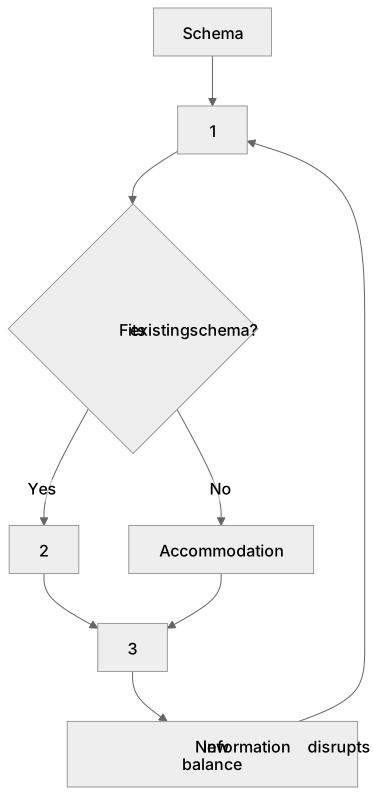
1Box 1
2Box 2
3Box 3
There is more to this lesson
The full lesson goes on to check your understanding and help you earn the marks. Create a free account to carry on, with your progress saved.
A week of Premium from your first lesson · Then the free plan continues · No card, no charge
Test your understanding of Development: 1.1.2 Understand the role of education and intelligence, including Piaget’s Theory of Cognitive Development, and the four stages of cognitive development, including strengths and weaknesses of the theory: a. sensorimotor b. pre-operational c. concrete operational d. formal operational e. schemata/schemas f. assimilation g. accommodation h. equilibrium
Active recall beats re-reading. Take an instant quiz now to test what you’ve learned and lock it into long-term memory.
A week of Premium from your first lesson · Then the free plan continues · No card, no charge