Pearson Edexcel · GCSE · Psychology
Course version: 1PS0 · Version from Sept 2017
Understand morality issues in psychology and the individual, including: a.…
Full specification wording
Issues and debates: 1.3.1 Understand morality issues in psychology and the individual, including: a. the terms ‘morality’ and ‘moral(s)’ b. pre-conventional, conventional and post-conventional stages of morality c. the use of content, theories and research drawn from cognitive development to explain development of morality
Morality refers to principles concerning the distinction between right and wrong, while morals are specific beliefs about acceptable behaviour.
Checked against the Pearson Edexcel 1PS0 specification (opens in a new tab) on .
- Point 1 of 5
- 4 key terms
Study notes
From the checked teaching notes for this specification point.
The idea
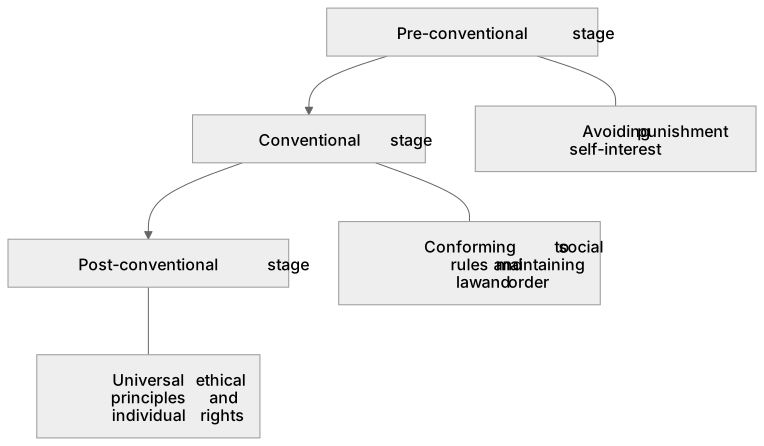
Morality refers to principles concerning the distinction between right and wrong, while morals are specific beliefs about acceptable behaviour. Cognitive development theories, notably Kohlberg's, explain how morality evolves. In the pre-conventional stage, morality is driven by avoiding punishment and self-interest. The conventional stage focuses on conforming to social rules and maintaining law and order to gain approval. Finally, the post-conventional stage involves abstract reasoning based on universal ethical principles and individual rights, which may transcend societal laws. Understanding these stages allows psychologists to use cognitive development research to explain how an individual's moral reasoning matures over time.
What earns the marks
- Define 'morality' as the general principles of right and wrong, and 'morals' as specific personal or societal rules of behaviour.
- Describe the pre-conventional stage as moral reasoning based on consequences, such as avoiding punishment or gaining rewards.
- Describe the conventional stage as moral reasoning based on social conformity, maintaining order, and obeying authority.
- Describe the post-conventional stage as moral reasoning based on abstract, universal ethical principles and human rights.
- Explain how cognitive development theories and research are used to understand the progression of moral reasoning.
Common mistakes and how to put them right
Confusing the pre-conventional and conventional stages.
Put it right: Pre-conventional focuses on direct personal consequences, whereas conventional focuses on societal rules and expectations.
Assuming everyone reaches the post-conventional stage.
Put it right: Cognitive development research suggests that many individuals remain at the conventional stage of moral reasoning.
Using 'morality' and 'morals' interchangeably without distinction.
Put it right: Morality refers to the broader concept of right and wrong, while morals are the specific rules or habits of conduct.
Exam tips
- Use clear examples to illustrate each stage of moral development, such as Heinz's dilemma, to demonstrate your understanding of cognitive reasoning.
- Clearly distinguish between the terms 'morality' and 'morals' when defining key concepts in issues and debates.
- Link the stages of morality directly to cognitive development, showing how advanced moral reasoning requires advanced cognitive abilities.
Try the lesson
The start of the Issues and debates: 1.3.1 Understand morality issues in psychology and the individual, including: a. the terms ‘morality’ and ‘moral(s)’ b. pre-conventional, conventional and post-conventional stages of morality c. the use of content, theories and research drawn from cognitive development to explain development of morality lesson, made from checked teaching notes for this specification point.
Have a go first
Which of the following correctly identifies the three stages of moral development proposed by Kohlberg?
Listen
Morality refers to principles concerning the distinction between right and wrong, while morals are specific beliefs about acceptable behaviour. Cognitive development theories, notably Kohlberg's, explain how morality evolves. In the pre-conventional stage, morality is driven by avoiding punishment and self-interest. The conventional stage focuses on conforming to social rules and maintaining law and order to gain approval. Finally, the post-conventional stage involves abstract reasoning based on universal ethical principles and individual rights, which may transcend societal laws. Understanding these stages allows psychologists to use cognitive development research to explain how an individual's moral reasoning matures over time. A strong answer earns marks for these points. Define 'morality' as the general principles of right and wrong, and 'morals' as specific personal or societal rules of behaviour. Describe the pre-conventional stage as moral reasoning based on consequences, such as avoiding punishment or gaining rewards. Describe the conventional stage as moral reasoning based on social conformity, maintaining order, and obeying authority. Describe the post-conventional stage as moral reasoning based on abstract, universal ethical principles and human rights. A common slip: Confusing the pre-conventional and conventional stages. Instead, pre-conventional focuses on direct personal consequences, whereas conventional focuses on societal rules and expectations. Exam tip: Use clear examples to illustrate each stage of moral development, such as Heinz's dilemma, to demonstrate your understanding of cognitive reasoning.
See it
Key words
Say what each word means before you turn the card.
Morality
Try answering aloud or in your head before turning the card.
Morals
Try answering aloud or in your head before turning the card.
Pre-conventional stage
Try answering aloud or in your head before turning the card.
Conventional stage
Try answering aloud or in your head before turning the card.
See every definition
- Morality
- The general principles concerning the distinction between right and wrong.
- Morals
- Specific beliefs or rules about acceptable behaviour.
- Pre-conventional stage
- Moral reasoning driven by avoiding punishment and self-interest.
- Conventional stage
- Moral reasoning focused on conforming to social rules and maintaining law and order to gain approval.
Label the diagram
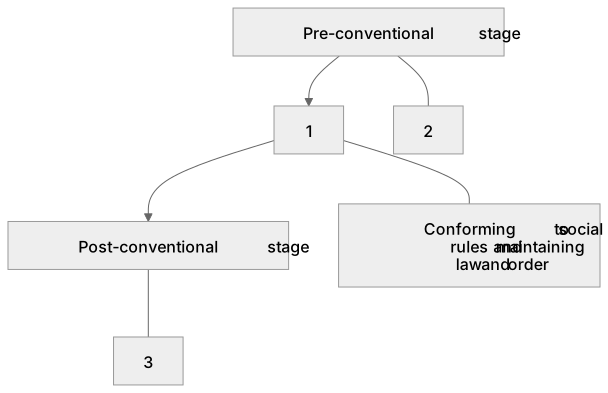
Some boxes have lost their names. Pick the right name for each number.
1Box 1
2Box 2
3Box 3
There is more to this lesson
The full lesson goes on to check your understanding and help you earn the marks. Create a free account to carry on, with your progress saved.
A week of Premium from your first lesson · Then the free plan continues · No card, no charge
Test your understanding of Issues and debates: 1.3.1 Understand morality issues in psychology and the individual, including: a. the terms ‘morality’ and ‘moral(s)’ b. pre-conventional, conventional and post-conventional stages of morality c. the use of content, theories and research drawn from cognitive development to explain development of morality
Active recall beats re-reading. Take an instant quiz now to test what you’ve learned and lock it into long-term memory.
A week of Premium from your first lesson · Then the free plan continues · No card, no charge