Pearson Edexcel · GCSE · Psychology
Course version: 1PS0 · Version from Sept 2017
Understand the reductionism and holism debate, including: a. the terms…
Full specification wording
Issues and debates: 2.3.1 Understand the reductionism and holism debate, including: a. the terms ‘reductionism’ and ‘reductionist’ b. the terms ‘holism’ and ‘holistic’ c. the use of content, theories and research drawn from human memory to explain the reductionism and holism debate
Reductionism breaks complex behaviour into simpler, isolated components.
Checked against the Pearson Edexcel 1PS0 specification (opens in a new tab) on .
- Point 2 of 5
- 2 key terms
Study notes
From the checked teaching notes for this specification point.
The idea
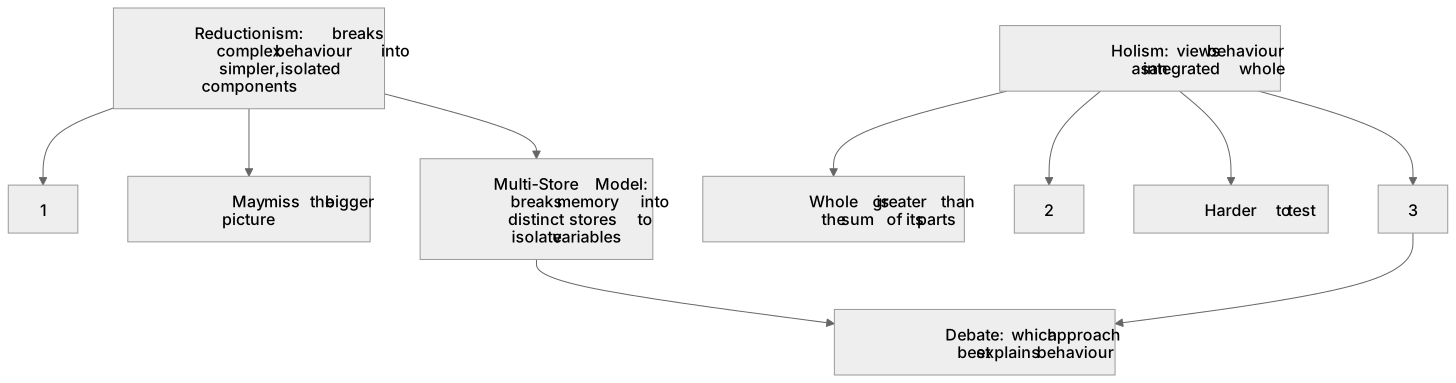
Reductionism breaks complex behaviour into simpler, isolated components. A reductionist approach aids scientific testing but may miss the bigger picture. Holism views behaviour as an integrated whole, arguing the whole is greater than the sum of its parts. A holistic approach provides richer understanding but is harder to test. The debate centres on which approach best explains behaviour. This is illustrated using human memory: the Multi-Store Model is reductionist, breaking memory into distinct stores to isolate variables. Conversely, Bartlett's reconstructive memory theory is holistic, considering how schemas, past experiences, and cultural contexts interact to shape how we remember, rather than isolating single cognitive mechanisms.
What earns the marks
- Identify the definition of reductionism as breaking down behaviour into simpler, constituent parts.
- Identify the definition of holism as viewing behaviour as an integrated, whole system.
- Recognise the Multi-Store Model of memory as an example of a reductionist theory.
- Recognise reconstructive memory as an example of a holistic theory.
- Evaluate the strengths and weaknesses of reductionist and holistic approaches to explaining human memory.
Common mistakes and how to put them right
Confusing reductionism with ignoring factors.
Put it right: Reductionism isolates specific factors to study them in detail, rather than simply ignoring them.
Assuming holistic theories are always superior.
Put it right: Holistic theories are often harder to test scientifically and may lack predictive power compared to reductionist theories.
Misidentifying memory models; correction: remember that the Multi-Store Model is reductionist because it separates memory into distinct stores, while reconstructive memory is holistic.
Exam tips
- Use the Multi-Store Model and reconstructive memory as contrasting examples when evaluating the debate.
- When defining holism, use the phrase 'the whole is greater than the sum of its parts' to demonstrate clear understanding.
- Be prepared to apply the concepts of reductionism and holism to novel scenarios or brief stimulus material.
Try the lesson
The start of the Issues and debates: 2.3.1 Understand the reductionism and holism debate, including: a. the terms ‘reductionism’ and ‘reductionist’ b. the terms ‘holism’ and ‘holistic’ c. the use of content, theories and research drawn from human memory to explain the reductionism and holism debate lesson, made from checked teaching notes for this specification point.
Have a go first
Which of the following best describes a 'reductionist' approach in psychology?
Listen
Reductionism breaks complex behaviour into simpler, isolated components. A reductionist approach aids scientific testing but may miss the bigger picture. Holism views behaviour as an integrated whole, arguing the whole is greater than the sum of its parts. A holistic approach provides richer understanding but is harder to test. The debate centres on which approach best explains behaviour. This is illustrated using human memory: the Multi-Store Model is reductionist, breaking memory into distinct stores to isolate variables. Conversely, Bartlett's reconstructive memory theory is holistic, considering how schemas, past experiences, and cultural contexts interact to shape how we remember, rather than isolating single cognitive mechanisms. A strong answer earns marks for these points. Identify the definition of reductionism as breaking down behaviour into simpler, constituent parts. Identify the definition of holism as viewing behaviour as an integrated, whole system. Recognise the Multi-Store Model of memory as an example of a reductionist theory. Recognise reconstructive memory as an example of a holistic theory. A common slip: Confusing reductionism with ignoring factors. Instead, reductionism isolates specific factors to study them in detail, rather than simply ignoring them. Exam tip: Use the Multi-Store Model and reconstructive memory as contrasting examples when evaluating the debate.
See it

Key words
Say what each word means before you turn the card.
Reductionism
Try answering aloud or in your head before turning the card.
Holism
Try answering aloud or in your head before turning the card.
See every definition
- Reductionism
- Breaking complex behaviour into simpler, isolated components, which aids scientific testing but may miss the bigger picture.
- Holism
- Viewing behaviour as an integrated whole, arguing the whole is greater than the sum of its parts, which provides richer understanding but is harder to test.
Label the diagram
Some boxes have lost their names. Pick the right name for each number.
1Box 1
2Box 2
3Box 3
There is more to this lesson
The full lesson goes on to check your understanding and help you earn the marks. Create a free account to carry on, with your progress saved.
A week of Premium from your first lesson · Then the free plan continues · No card, no charge
Test your understanding of Issues and debates: 2.3.1 Understand the reductionism and holism debate, including: a. the terms ‘reductionism’ and ‘reductionist’ b. the terms ‘holism’ and ‘holistic’ c. the use of content, theories and research drawn from human memory to explain the reductionism and holism debate
Active recall beats re-reading. Take an instant quiz now to test what you’ve learned and lock it into long-term memory.
A week of Premium from your first lesson · Then the free plan continues · No card, no charge