Pearson Edexcel · GCSE · Psychology
Course version: 1PS0 · Version from Sept 2017
Understand ethical issues in psychological research, including: a. know…
Full specification wording
Issues and debates: 11.3.1 Understand ethical issues in psychological research, including: a. know the term ‘ethical issue(s)’ b. use content, theories, and research drawn from the compulsory topics (Topics 1, 2, 3, 4, 5) to explain ethical issues in psychological research
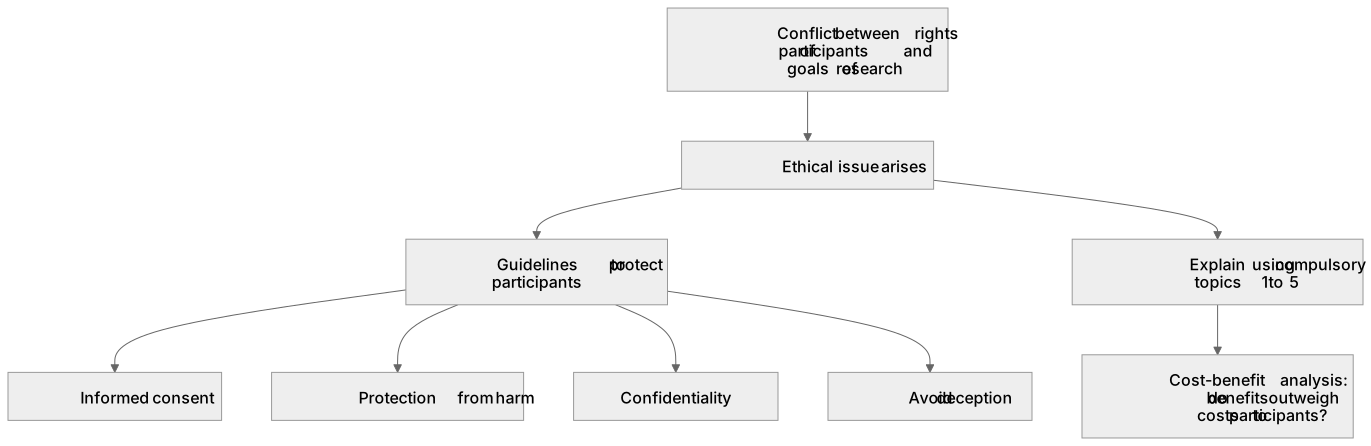
An ethical issue arises when there is a conflict between the rights of participants and the goals of research to produce authentic, useful data.
Checked against the Pearson Edexcel 1PS0 specification (opens in a new tab) on .
- Point 5 of 5
- 2 key terms
Study notes
From the checked teaching notes for this specification point.
The idea
An ethical issue arises when there is a conflict between the rights of participants and the goals of research to produce authentic, useful data. Researchers must follow guidelines to protect participants from harm, ensure informed consent, maintain confidentiality, and avoid deception. You must be able to explain these issues using examples from compulsory topics (Development, Memory, Psychological Problems, The Brain and Neuropsychology, and Social Influence). For instance, in Social Influence, studies on obedience often involve deception and risk of psychological harm, raising significant ethical issues. Understanding these conflicts helps evaluate whether the benefits of a study outweigh the costs to the participants involved.
What earns the marks
- Define an ethical issue as a conflict between participant rights and research goals.
- Identify specific ethical guidelines such as informed consent, protection from harm, confidentiality, and deception.
- Apply knowledge of ethical issues to specific core studies from Topics 1 to 5.
- Explain how a specific study from the compulsory topics breached or upheld ethical guidelines.
Common mistakes and how to put them right
Confusing ethical guidelines with ethical issues.
Put it right: Guidelines are the rules, while an issue is the dilemma or conflict that arises when rules are hard to follow.
Stating that a study was 'unethical' without specifying why.
Put it right: Name the specific ethical issue, such as lack of informed consent or failure to protect from psychological harm.
Forgetting to link ethical issues to the compulsory topics.
Put it right: Practice evaluating the ethics of specific named studies from Development, Memory, Psychological Problems, The Brain, and Social Influence.
Exam tips
- When evaluating a study, explicitly name the ethical issue and describe exactly how the researchers' actions caused that issue.
- Use the cost-benefit analysis concept to explain why some studies with ethical issues were still permitted to take place.
- Memorise one major ethical strength and one ethical weakness for key studies in Topics 1 to 5 to use as concrete examples.
Try the lesson
The start of the Issues and debates: 11.3.1 Understand ethical issues in psychological research, including: a. know the term ‘ethical issue(s)’ b. use content, theories, and research drawn from the compulsory topics (Topics 1, 2, 3, 4, 5) to explain ethical issues in psychological research lesson, made from checked teaching notes for this specification point.
Have a go first
What is the most accurate definition of an 'ethical issue' in psychological research?
Listen
An ethical issue arises when there is a conflict between the rights of participants and the goals of research to produce authentic, useful data. Researchers must follow guidelines to protect participants from harm, ensure informed consent, maintain confidentiality, and avoid deception. You must be able to explain these issues using examples from compulsory topics (Development, Memory, Psychological Problems, The Brain and Neuropsychology, and Social Influence). For instance, in Social Influence, studies on obedience often involve deception and risk of psychological harm, raising significant ethical issues. Understanding these conflicts helps evaluate whether the benefits of a study outweigh the costs to the participants involved. A strong answer earns marks for these points. Define an ethical issue as a conflict between participant rights and research goals. Identify specific ethical guidelines such as informed consent, protection from harm, confidentiality, and deception. Apply knowledge of ethical issues to specific core studies from Topics 1 to 5. Explain how a specific study from the compulsory topics breached or upheld ethical guidelines. A common slip: Confusing ethical guidelines with ethical issues. Instead, guidelines are the rules, while an issue is the dilemma or conflict that arises when rules are hard to follow. Exam tip: When evaluating a study, explicitly name the ethical issue and describe exactly how the researchers' actions caused that issue.
See it
Key words
Say what each word means before you turn the card.
Ethical issue
Try answering aloud or in your head before turning the card.
Cost-benefit analysis
Try answering aloud or in your head before turning the card.
See every definition
- Ethical issue
- A conflict between the rights of participants and the goals of research to produce authentic, useful data.
- Cost-benefit analysis
- A concept used to explain why some studies with ethical issues were still permitted to take place, by weighing the benefits of a study against the costs to the participants involved.
Label the diagram
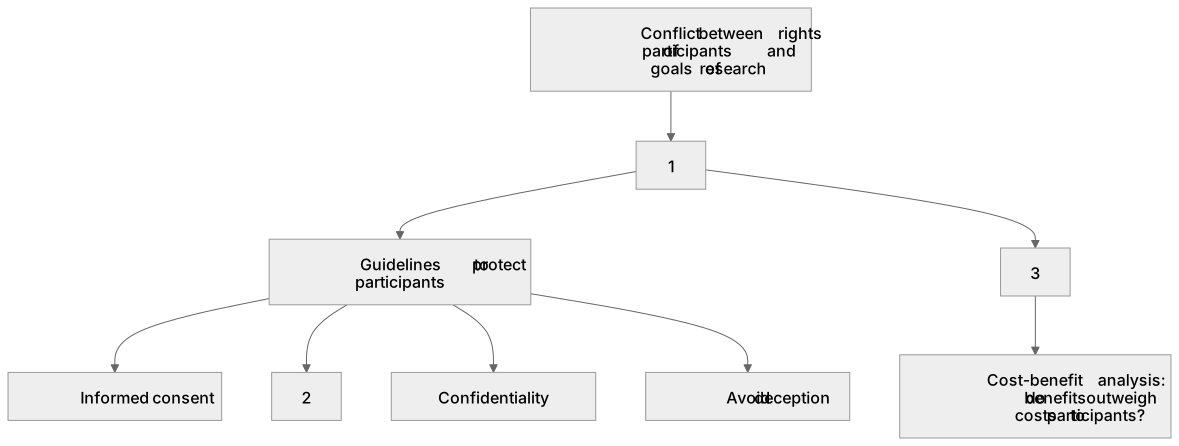
Some boxes have lost their names. Pick the right name for each number.
1Box 1
2Box 2
3Box 3
There is more to this lesson
The full lesson goes on to check your understanding and help you earn the marks. Create a free account to carry on, with your progress saved.
A week of Premium from your first lesson · Then the free plan continues · No card, no charge
Test your understanding of Issues and debates: 11.3.1 Understand ethical issues in psychological research, including: a. know the term ‘ethical issue(s)’ b. use content, theories, and research drawn from the compulsory topics (Topics 1, 2, 3, 4, 5) to explain ethical issues in psychological research
Active recall beats re-reading. Take an instant quiz now to test what you’ve learned and lock it into long-term memory.
A week of Premium from your first lesson · Then the free plan continues · No card, no charge