Pearson Edexcel · GCSE · Psychology
Course version: 1PS0 · Version from Sept 2017
Understand social and cultural issues in psychology, including: a. know…
Full specification wording
Issues and debates: 5.3.1 Understand social and cultural issues in psychology, including: a. know the terms ‘society’ and ‘social issues’ b. know the term ‘culture’ c. the use of content, theories, and research drawn from social influence to explain social and cultural issues in psychology
Understanding social and cultural issues is vital in psychology.
Checked against the Pearson Edexcel 1PS0 specification (opens in a new tab) on .
- Point 4 of 5
- 3 key terms
Study notes
From the checked teaching notes for this specification point.
The idea
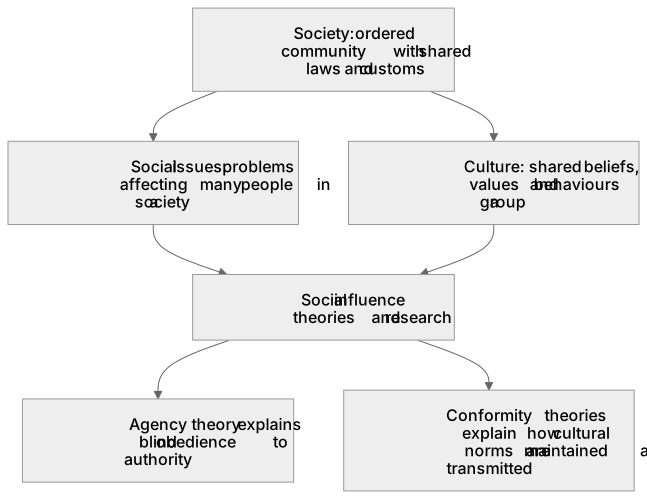
Understanding social and cultural issues is vital in psychology. 'Society' refers to a group of people living together in an ordered community, sharing laws and customs. 'Social issues' are problems affecting many people within a society, such as discrimination or crime. 'Culture' encompasses the shared beliefs, values, and behaviours of a specific group. Psychologists use theories and research from social influence to explain these issues. For example, Milgram's agency theory explains how ordinary people might commit atrocities under the orders of an authority figure, addressing the social issue of blind obedience. Similarly, theories of conformity help explain how cultural norms are maintained and transmitted across different generations.
What earns the marks
- Define 'society' as a group of people living together in an ordered community with shared laws and customs.
- Define 'social issues' as problems that affect a significant number of individuals within a society.
- Define 'culture' as the shared beliefs, values, customs, and behaviours of a particular group.
- Apply social influence theories, such as agency theory or social impact theory, to explain real-world social issues like obedience to destructive authority.
- Use research studies, such as Milgram or Zimbardo, to illustrate how cultural and social contexts shape human behaviour.
Common mistakes and how to put them right
Confusing the terms 'society' and 'culture'.
Put it right: Society refers to the structured community of people, while culture refers to their shared beliefs and practices.
Failing to link psychological theories to specific social issues.
Put it right: Provide a concrete example, such as using conformity research to explain bystander behaviour or peer pressure.
Treating culture as a fixed, biological trait.
Put it right: Explain culture as a learned set of behaviours and values that are transmitted socially.
Exam tips
- When asked to explain a social issue, explicitly name the psychological theory or study you are using as evidence.
- Practice defining 'society', 'social issues', and 'culture' clearly, as these definitions can form the basis of short-answer questions.
- Consider how cultural differences might affect the results of social influence studies, such as variations in conformity rates across different countries.
Try the lesson
The start of the Issues and debates: 5.3.1 Understand social and cultural issues in psychology, including: a. know the terms ‘society’ and ‘social issues’ b. know the term ‘culture’ c. the use of content, theories, and research drawn from social influence to explain social and cultural issues in psychology lesson, made from checked teaching notes for this specification point.
Have a go first
In the context of social and cultural issues in psychology, which of the following provides the most accurate definition of the term 'culture'?
Listen
Understanding social and cultural issues is vital in psychology. Society' refers to a group of people living together in an ordered community, sharing laws and customs. Social issues' are problems affecting many people within a society, such as discrimination or crime. Culture' encompasses the shared beliefs, values, and behaviours of a specific group. Psychologists use theories and research from social influence to explain these issues. For example, Milgram's agency theory explains how ordinary people might commit atrocities under the orders of an authority figure, addressing the social issue of blind obedience. Similarly, theories of conformity help explain how cultural norms are maintained and transmitted across different generations. A strong answer earns marks for these points. Define 'society' as a group of people living together in an ordered community with shared laws and customs. Define 'social issues' as problems that affect a significant number of individuals within a society. Define 'culture' as the shared beliefs, values, customs, and behaviours of a particular group. Apply social influence theories, such as agency theory or social impact theory, to explain real-world social issues like obedience to destructive authority. A common slip: Confusing the terms 'society' and 'culture'. Instead, society refers to the structured community of people, while culture refers to their shared beliefs and practices. Exam tip: When asked to explain a social issue, explicitly name the psychological theory or study you are using as evidence.
See it
Key words
Say what each word means before you turn the card.
Society
Try answering aloud or in your head before turning the card.
Social issues
Try answering aloud or in your head before turning the card.
Culture
Try answering aloud or in your head before turning the card.
See every definition
- Society
- A group of people living together in an ordered community, sharing laws and customs.
- Social issues
- Problems affecting many people within a society, such as discrimination or crime.
- Culture
- The shared beliefs, values, and behaviours of a specific group.
Label the diagram
Some boxes have lost their names. Pick the right name for each number.
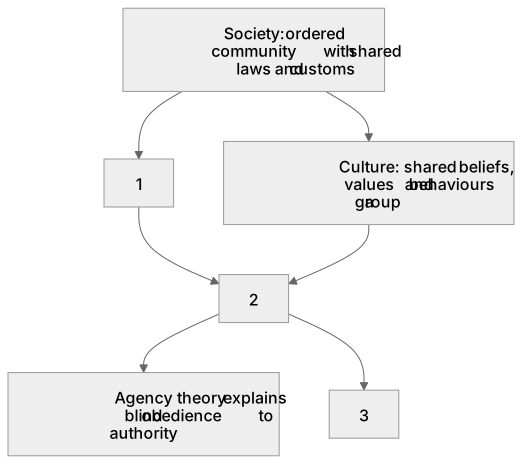
1Box 1
2Box 2
3Box 3
There is more to this lesson
The full lesson goes on to check your understanding and help you earn the marks. Create a free account to carry on, with your progress saved.
A week of Premium from your first lesson · Then the free plan continues · No card, no charge
Test your understanding of Issues and debates: 5.3.1 Understand social and cultural issues in psychology, including: a. know the terms ‘society’ and ‘social issues’ b. know the term ‘culture’ c. the use of content, theories, and research drawn from social influence to explain social and cultural issues in psychology
Active recall beats re-reading. Take an instant quiz now to test what you’ve learned and lock it into long-term memory.
A week of Premium from your first lesson · Then the free plan continues · No card, no charge