Pearson Edexcel · GCSE · Psychology
Course version: 1PS0 · Version from Sept 2017
Understand how thought and language structures affect views of the world,…
Full specification wording
Language, thought and communication: 10.1.2 Understand how thought and language structures affect views of the world, including strengths and weaknesses of each theory: a. linguistic relativism b. linguistic determinism
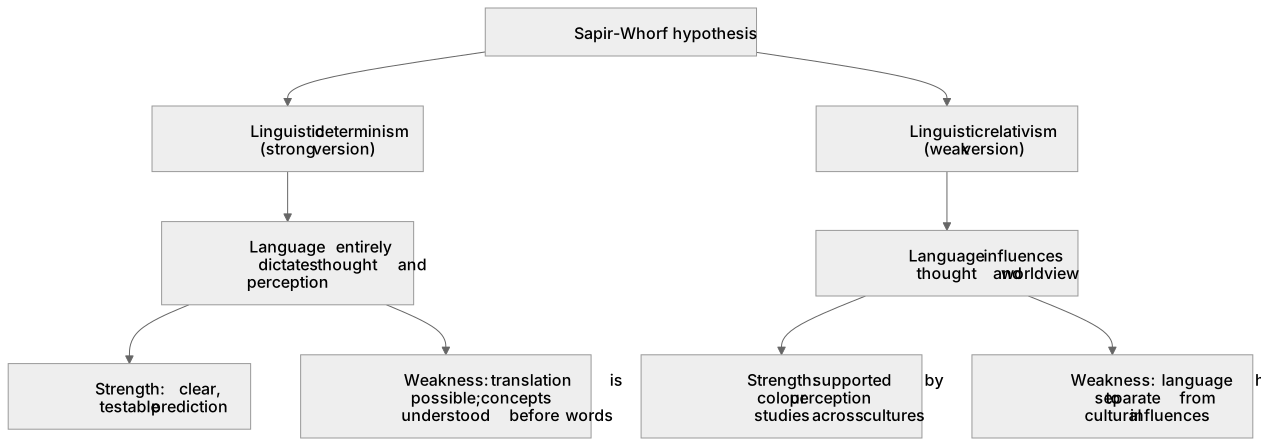
Linguistic determinism (the strong version of the Sapir-Whorf hypothesis) argues that language entirely dictates how we think and perceive the world; if a language lacks a word for a concept, its…
Checked against the Pearson Edexcel 1PS0 specification (opens in a new tab) on .
- Point 2 of 5
- 2 key terms
Study notes
From the checked teaching notes for this specification point.
The idea
Linguistic determinism (the strong version of the Sapir-Whorf hypothesis) argues that language entirely dictates how we think and perceive the world; if a language lacks a word for a concept, its speakers cannot think about it. A strength is its clear, testable prediction, but a major weakness is that translation between languages is possible, and people can understand concepts before learning the words for them. Linguistic relativism (the weak version) suggests language merely influences thought and worldview, making certain ways of thinking easier. This is supported by studies on colour perception across cultures, showing language affects recall speed. However, a weakness is the difficulty in separating language from cultural influences, making cause and effect hard to establish.
What earns the marks
- Define linguistic determinism as the theory that language strictly controls and limits human thought.
- Define linguistic relativism as the theory that language influences, but does not entirely dictate, human thought and perception.
- Identify a strength of linguistic relativism, such as supporting evidence from cross-cultural studies on colour categorisation or spatial reasoning.
- Identify a weakness of linguistic determinism, such as the human ability to invent new words for novel concepts or understand ideas without specific vocabulary.
Common mistakes and how to put them right
Confusing determinism and relativism.
Put it right: Determinism means language dictates thought (the strong view), while relativism means language only influences thought (the weak view).
Assuming linguistic determinism is widely accepted by modern psychologists.
Put it right: Recognise that linguistic relativism is the more widely accepted theory, as determinism is considered too rigid and easily disproved.
Failing to evaluate the theories.
Put it right: Ensure you can provide at least one specific strength and one specific weakness for both linguistic determinism and linguistic relativism.
Exam tips
- Use the terms 'strong version' for determinism and 'weak version' for relativism to help distinguish between the two concepts in your answers.
- When evaluating, use concrete examples like the Inuit words for snow or the Hopi concept of time to illustrate how language might affect a person's worldview.
- Be prepared to apply these theories to novel scenarios provided in the exam, identifying whether a given scenario supports determinism or relativism.
Try the lesson
The start of the Language, thought and communication: 10.1.2 Understand how thought and language structures affect views of the world, including strengths and weaknesses of each theory: a. linguistic relativism b. linguistic determinism lesson, made from checked teaching notes for this specification point.
Have a go first
Which of the following best describes the theory of linguistic determinism?
Listen
Linguistic determinism (the strong version of the Sapir-Whorf hypothesis) argues that language entirely dictates how we think and perceive the world; if a language lacks a word for a concept, its speakers cannot think about it. A strength is its clear, testable prediction, but a major weakness is that translation between languages is possible, and people can understand concepts before learning the words for them. Linguistic relativism (the weak version) suggests language merely influences thought and worldview, making certain ways of thinking easier. This is supported by studies on colour perception across cultures, showing language affects recall speed. However, a weakness is the difficulty in separating language from cultural influences, making cause and effect hard to establish. A strong answer earns marks for these points. Define linguistic determinism as the theory that language strictly controls and limits human thought. Define linguistic relativism as the theory that language influences, but does not entirely dictate, human thought and perception. Identify a strength of linguistic relativism, such as supporting evidence from cross-cultural studies on colour categorisation or spatial reasoning. Identify a weakness of linguistic determinism, such as the human ability to invent new words for novel concepts or understand ideas without specific vocabulary. A common slip: Confusing determinism and relativism. Instead, determinism means language dictates thought (the strong view), while relativism means language only influences thought (the weak view). Exam tip: Use the terms 'strong version' for determinism and 'weak version' for relativism to help distinguish between the two concepts in your answers.
See it
Key words
Say what each word means before you turn the card.
Linguistic determinism
Try answering aloud or in your head before turning the card.
Linguistic relativism
Try answering aloud or in your head before turning the card.
See every definition
- Linguistic determinism
- The strong version of the Sapir-Whorf hypothesis, arguing that language entirely dictates how we think and perceive the world.
- Linguistic relativism
- The weak version, suggesting language merely influences thought and worldview, making certain ways of thinking easier.
Label the diagram
Some boxes have lost their names. Pick the right name for each number.
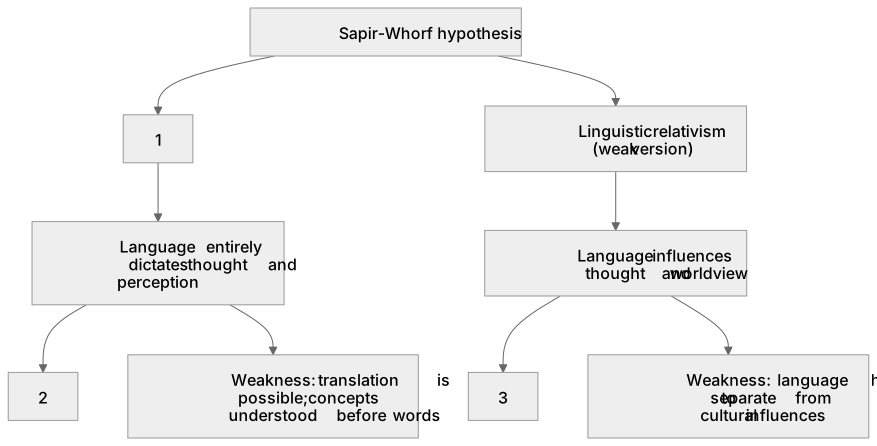
1Box 1
2Box 2
3Box 3
There is more to this lesson
The full lesson goes on to check your understanding and help you earn the marks. Create a free account to carry on, with your progress saved.
A week of Premium from your first lesson · Then the free plan continues · No card, no charge
Test your understanding of Language, thought and communication: 10.1.2 Understand how thought and language structures affect views of the world, including strengths and weaknesses of each theory: a. linguistic relativism b. linguistic determinism
Active recall beats re-reading. Take an instant quiz now to test what you’ve learned and lock it into long-term memory.
A week of Premium from your first lesson · Then the free plan continues · No card, no charge