Pearson Edexcel · GCSE · Psychology
Course version: 1PS0 · Version from Sept 2017
Understand how communication is different in humans to animals, including:…
Full specification wording
Language, thought and communication: 10.1.3 Understand how communication is different in humans to animals, including: a. Aitchison (1983) criteria of language features b. similarities and differences between humans and animal communication
Human and animal communication share similarities, such as using signals for survival, mating, and territory.
Checked against the Pearson Edexcel 1PS0 specification (opens in a new tab) on .
- Point 3 of 5
- 4 key terms
Study notes
From the checked teaching notes for this specification point.
The idea
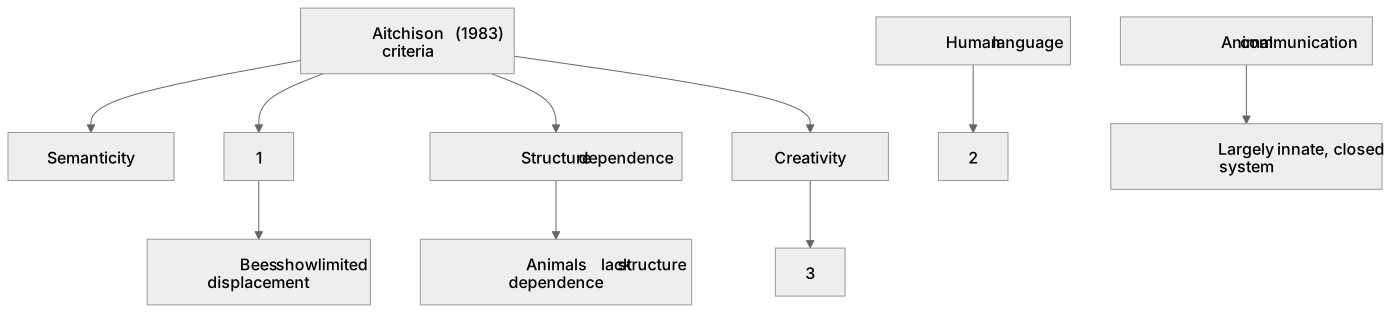
Human and animal communication share similarities, such as using signals for survival, mating, and territory. However, human language is vastly more complex. Aitchison (1983) identified key criteria distinguishing human language: semanticity (using symbols to mean specific things), displacement (communicating about things not physically present, like the past or future), structure dependence (using grammar), and creativity (producing infinite novel sentences). While animals like bees show limited displacement when communicating food location, they lack creativity and structure dependence. A key difference is that animal communication is largely innate and closed, whereas human language is learned, open-ended, and highly flexible.
What earns the marks
- Identify Aitchison's criteria for language, including semanticity, displacement, structure dependence, and creativity.
- Explain displacement as the ability to discuss events, concepts, or objects that are not currently present in time or space.
- Compare human and animal communication by identifying a similarity, such as the use of vocal or visual signals to convey basic needs or warnings.
- Contrast human and animal communication by explaining that human language is open and creative, while animal communication is typically a closed system with a fixed number of signals.
Common mistakes and how to put them right
Believing animals possess true language.
Put it right: Understand that while animals communicate effectively, their systems do not meet all of Aitchison's criteria for true language, particularly creativity and structure dependence.
Confusing displacement with semanticity.
Put it right: Displacement refers to time and space (things not physically present), while semanticity refers to specific sounds or signs having specific, agreed-upon meanings.
Assuming animal communication is entirely learned.
Put it right: Recognise that most animal communication is innate and instinctive, whereas human language requires significant learning and social interaction.
Exam tips
- Memorise Aitchison's four main criteria (semanticity, displacement, structure dependence, creativity) and be able to define each clearly with an example.
- Use specific examples of animal communication, such as the waggle dance of honey bees, to illustrate concepts like limited displacement.
- When asked for differences, explicitly state the human feature and the contrasting animal feature to ensure a complete and balanced comparison.
Try the lesson
The start of the Language, thought and communication: 10.1.3 Understand how communication is different in humans to animals, including: a. Aitchison (1983) criteria of language features b. similarities and differences between humans and animal communication lesson, made from checked teaching notes for this specification point.
Have a go first
According to Aitchison (1983), which feature of language refers to the ability to communicate about things that are not present in the current environment?
Listen
Human and animal communication share similarities, such as using signals for survival, mating, and territory. However, human language is vastly more complex. Aitchison (1983) identified key criteria distinguishing human language: semanticity (using symbols to mean specific things), displacement (communicating about things not physically present, like the past or future), structure dependence (using grammar), and creativity (producing infinite novel sentences). While animals like bees show limited displacement when communicating food location, they lack creativity and structure dependence. A key difference is that animal communication is largely innate and closed, whereas human language is learned, open-ended, and highly flexible. A strong answer earns marks for these points. Identify Aitchison's criteria for language, including semanticity, displacement, structure dependence, and creativity. Explain displacement as the ability to discuss events, concepts, or objects that are not currently present in time or space. Compare human and animal communication by identifying a similarity, such as the use of vocal or visual signals to convey basic needs or warnings. Contrast human and animal communication by explaining that human language is open and creative, while animal communication is typically a closed system with a fixed number of signals. A common slip: Believing animals possess true language. Instead, Understand that while animals communicate effectively, their systems do not meet all of Aitchison's criteria for true language, particularly creativity and structure dependence. Exam tip: Memorise Aitchison's four main criteria (semanticity, displacement, structure dependence, creativity) and be able to define each clearly with an example.
See it

Key words
Say what each word means before you turn the card.
Semanticity
Try answering aloud or in your head before turning the card.
Displacement
Try answering aloud or in your head before turning the card.
Structure dependence
Try answering aloud or in your head before turning the card.
Creativity
Try answering aloud or in your head before turning the card.
See every definition
- Semanticity
- Using symbols to mean specific things, with specific sounds or signs having specific, agreed-upon meanings.
- Displacement
- Communicating about things not physically present, such as the past or future, or events, concepts or objects not currently present in time or space.
- Structure dependence
- Using grammar, one of Aitchison's criteria distinguishing human language.
- Creativity
- Producing infinite novel sentences, a feature of human language that animal communication lacks.
Label the diagram
Some boxes have lost their names. Pick the right name for each number.
1Box 1
2Box 2
3Box 3
There is more to this lesson
The full lesson goes on to check your understanding and help you earn the marks. Create a free account to carry on, with your progress saved.
A week of Premium from your first lesson · Then the free plan continues · No card, no charge
Test your understanding of Language, thought and communication: 10.1.3 Understand how communication is different in humans to animals, including: a. Aitchison (1983) criteria of language features b. similarities and differences between humans and animal communication
Active recall beats re-reading. Take an instant quiz now to test what you’ve learned and lock it into long-term memory.
A week of Premium from your first lesson · Then the free plan continues · No card, no charge