Pearson Edexcel · GCSE · Psychology
Course version: 1PS0 · Version from Sept 2017
Understand explanations of non-verbal communication, including Darwin’s…
Full specification wording
Language, thought and communication: 10.1.5 Understand explanations of non-verbal communication, including Darwin’s (1872) theory of evolution
Charles Darwin’s (1872) theory explains non-verbal communication as an adaptive trait promoting survival.
Checked against the Pearson Edexcel 1PS0 specification (opens in a new tab) on .
- Point 5 of 5
Study notes
From the checked teaching notes for this specification point.
The idea
Charles Darwin’s (1872) theory explains non-verbal communication as an adaptive trait promoting survival. Darwin proposed that facial expressions and body language are innate and universal, rather than learned. He introduced serviceable associated habits, suggesting behaviours that originally served a practical physical function, like baring teeth to prepare for a bite or widening eyes in fear, became communicative signals over generations. Because these non-verbal signals helped ancestors survive by warning of danger or signalling submission, they were passed down genetically. This biological explanation contrasts with theories suggesting non-verbal communication is culturally learned.
What earns the marks
- State that Darwin's theory proposes non-verbal communication is innate and biologically determined.
- Explain that non-verbal behaviours evolved because they provided a survival or reproductive advantage.
- Describe the concept of serviceable associated habits, where a functional action becomes a communicative signal.
- Provide an example of an evolutionary non-verbal signal, such as baring teeth to show aggression.
- Contrast Darwin's evolutionary explanation with the idea that non-verbal communication is culturally learned.
Common mistakes and how to put them right
Stating that Darwin believed non-verbal communication is learned.
Put it right: Darwin argued that these behaviours are innate and genetically inherited.
Misunderstanding serviceable associated habits.
Put it right: This principle means that a behaviour originally had a physical purpose before it became a way to communicate an emotion.
Failing to link non-verbal communication to survival.
Put it right: Explain how a specific expression or posture helped ancestors survive, such as widening eyes to spot threats.
Exam tips
- Clearly define the term innate when explaining Darwin's theory of non-verbal communication.
- Use the example of an animal baring its teeth to illustrate a serviceable associated habit that humans also display.
- Link the universality of certain facial expressions across different cultures as evidence supporting Darwin's evolutionary theory.
Try the lesson
The start of the Language, thought and communication: 10.1.5 Understand explanations of non-verbal communication, including Darwin’s (1872) theory of evolution lesson, made from checked teaching notes for this specification point.
Have a go first
According to Darwin’s (1872) theory of evolution, how do humans acquire their basic facial expressions?
Listen
Charles Darwin’s (1872) theory explains non-verbal communication as an adaptive trait promoting survival. Darwin proposed that facial expressions and body language are innate and universal, rather than learned. He introduced serviceable associated habits, suggesting behaviours that originally served a practical physical function, like baring teeth to prepare for a bite or widening eyes in fear, became communicative signals over generations. Because these non-verbal signals helped ancestors survive by warning of danger or signalling submission, they were passed down genetically. This biological explanation contrasts with theories suggesting non-verbal communication is culturally learned. A strong answer earns marks for these points. State that Darwin's theory proposes non-verbal communication is innate and biologically determined. Explain that non-verbal behaviours evolved because they provided a survival or reproductive advantage. Describe the concept of serviceable associated habits, where a functional action becomes a communicative signal. Provide an example of an evolutionary non-verbal signal, such as baring teeth to show aggression. A common slip: Stating that Darwin believed non-verbal communication is learned. Instead, Darwin argued that these behaviours are innate and genetically inherited. Exam tip: Clearly define the term innate when explaining Darwin's theory of non-verbal communication.
See it
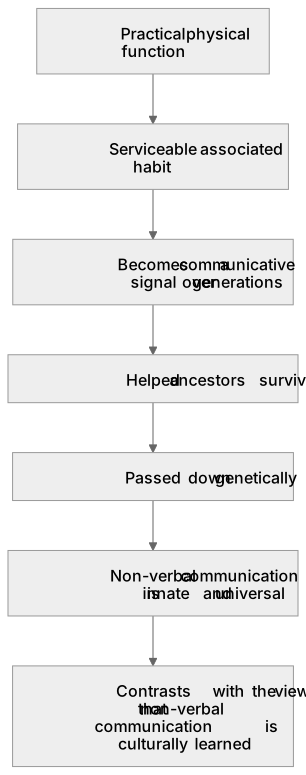
Put it in order
Put these steps in the order they happen.
- 1. Contrasts with the view that non-verbal communication is culturally learned
- 2. Non-verbal communication is innate and universal
- 3. Becomes a communicative signal over generations
- 4. Passed down genetically
- 5. Practical physical function
- 6. Serviceable associated habit
- 7. Helped ancestors survive
Label the diagram
Some boxes have lost their names. Pick the right name for each number.
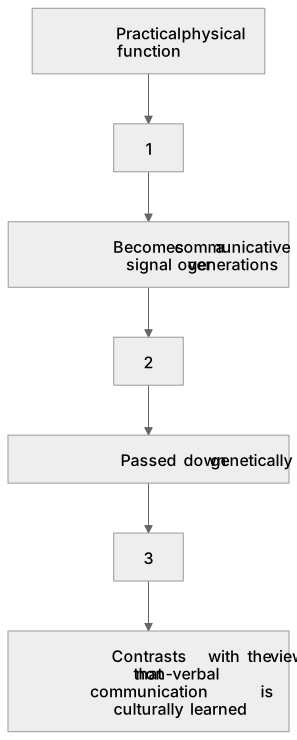
1Box 1
2Box 2
3Box 3
There is more to this lesson
The full lesson goes on to check your understanding and help you earn the marks. Create a free account to carry on, with your progress saved.
A week of Premium from your first lesson · Then the free plan continues · No card, no charge
Test your understanding of Language, thought and communication: 10.1.5 Understand explanations of non-verbal communication, including Darwin’s (1872) theory of evolution
Active recall beats re-reading. Take an instant quiz now to test what you’ve learned and lock it into long-term memory.
A week of Premium from your first lesson · Then the free plan continues · No card, no charge