Pearson Edexcel · GCSE · Psychology
Course version: 1PS0 · Version from Sept 2017
Know the structure and process of memory and information processing: a.…
Full specification wording
Memory: 2.1.1 Know the structure and process of memory and information processing: a. input b. processing c. output d. encoding e. storage f. retrieval
Memory functions like a computer through information processing.
Checked against the Pearson Edexcel 1PS0 specification (opens in a new tab) on .
- Point 1 of 5
- 4 key terms
Study notes
From the checked teaching notes for this specification point.
The idea
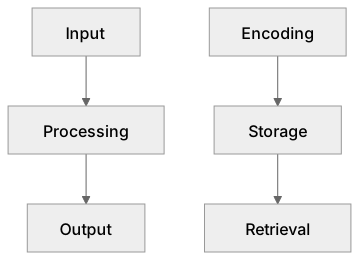
Memory functions like a computer through information processing. It begins with 'input', where sensory information from the environment enters the system (e.g., hearing a voice). Next is 'processing', where the brain interprets this information. Finally, 'output' occurs, which is the resulting behaviour, such as writing a note. To retain information, three stages occur. 'Encoding' transforms sensory input into a usable format, like acoustic or semantic codes. 'Storage' involves holding this encoded information over time. 'Retrieval' is the process of accessing and bringing stored information back into conscious awareness when needed, like recalling a fact during an exam.
What earns the marks
- Identify input as the raw sensory information received from the environment.
- Describe processing as the brain's active manipulation and interpretation of data.
- Define output as the behavioural response or action resulting from processed information.
- Explain encoding as the transformation of sensory data into a storable format, such as visual or acoustic codes.
- Define storage as the retention and maintenance of encoded information over time.
- Describe retrieval as the process of locating and accessing stored information for conscious use.
Common mistakes and how to put them right
Confusing encoding with storage.
Put it right: Encoding is the transformation of data into a usable format, whereas storage is the maintenance of that data over time.
Using input and encoding interchangeably.
Put it right: Input is the raw sensory data entering the system, while encoding is the active process of converting that data into a memory trace.
Misunderstanding output as only verbal communication.
Put it right: Output includes any behavioural response or action resulting from processed information, not just spoken words.
Exam tips
- Use the computer analogy (input, process, output) to structure your answers about information processing.
- When defining retrieval, always mention that it involves bringing information back into conscious awareness.
- Be prepared to apply the stages of memory to a novel scenario, such as learning a new skill or studying for a test.
Try the lesson
The start of the Memory: 2.1.1 Know the structure and process of memory and information processing: a. input b. processing c. output d. encoding e. storage f. retrieval lesson, made from checked teaching notes for this specification point.
Have a go first
In the information processing model of memory, what term is used to describe the process of changing sensory information into a form that can be stored in the brain?
Listen
Memory functions like a computer through information processing. It begins with 'input', where sensory information from the environment enters the system (e.g., hearing a voice). Next is 'processing', where the brain interprets this information. Finally, 'output' occurs, which is the resulting behaviour, such as writing a note. To retain information, three stages occur. Encoding' transforms sensory input into a usable format, like acoustic or semantic codes. Storage' involves holding this encoded information over time. Retrieval' is the process of accessing and bringing stored information back into conscious awareness when needed, like recalling a fact during an exam. A strong answer earns marks for these points. Identify input as the raw sensory information received from the environment. Describe processing as the brain's active manipulation and interpretation of data. Define output as the behavioural response or action resulting from processed information. Explain encoding as the transformation of sensory data into a storable format, such as visual or acoustic codes. A common slip: Confusing encoding with storage. Instead, Encoding is the transformation of data into a usable format, whereas storage is the maintenance of that data over time. Exam tip: Use the computer analogy (input, process, output) to structure your answers about information processing.
See it
Key words
Say what each word means before you turn the card.
Information processing
Try answering aloud or in your head before turning the card.
Encoding
Try answering aloud or in your head before turning the card.
Storage
Try answering aloud or in your head before turning the card.
Retrieval
Try answering aloud or in your head before turning the card.
See every definition
- Information processing
- Memory functions like a computer, beginning with input, then processing, and finally output.
- Encoding
- Transforms sensory input into a usable format, such as acoustic or semantic codes.
- Storage
- Involves holding encoded information over time.
- Retrieval
- The process of accessing and bringing stored information back into conscious awareness when needed.
Label the diagram
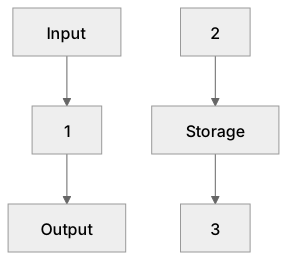
Some boxes have lost their names. Pick the right name for each number.
1Box 1
2Box 2
3Box 3
There is more to this lesson
The full lesson goes on to check your understanding and help you earn the marks. Create a free account to carry on, with your progress saved.
A week of Premium from your first lesson · Then the free plan continues · No card, no charge
Test your understanding of Memory: 2.1.1 Know the structure and process of memory and information processing: a. input b. processing c. output d. encoding e. storage f. retrieval
Active recall beats re-reading. Take an instant quiz now to test what you’ve learned and lock it into long-term memory.
A week of Premium from your first lesson · Then the free plan continues · No card, no charge