Pearson Edexcel · GCSE · Psychology
Course version: 1PS0 · Version from Sept 2017
Understand the features of short-term and long-term memory, including: a.…
Full specification wording
Memory: 2.1.2 Understand the features of short-term and long-term memory, including: a. duration b. capacity
Short-term memory (STM) and long-term memory (LTM) differ significantly.
Checked against the Pearson Edexcel 1PS0 specification (opens in a new tab) on .
- Point 2 of 5
- 4 key terms
Study notes
From the checked teaching notes for this specification point.
The idea
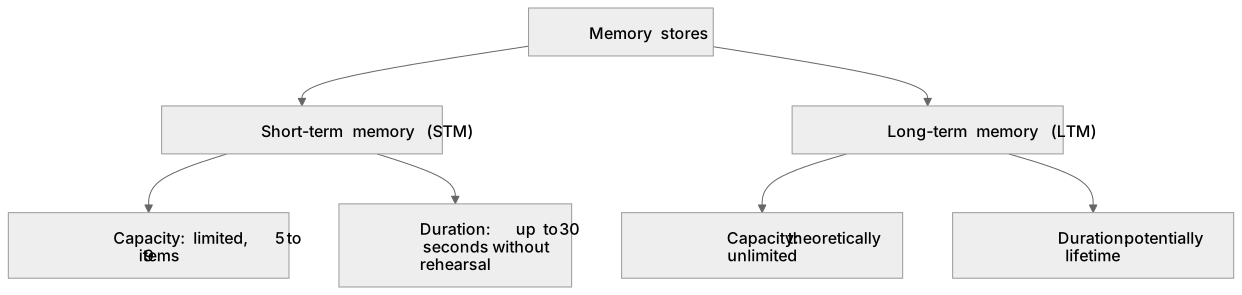
Short-term memory (STM) and long-term memory (LTM) differ significantly. 'Capacity' refers to how much information a memory store can hold. STM has a limited capacity, typically holding 5 to 9 items (often called the magic number 7 plus or minus 2), like remembering a phone number just long enough to dial it. In contrast, LTM has a theoretically unlimited capacity. 'Duration' refers to how long information remains in the store. STM has a brief duration, lasting up to 30 seconds without rehearsal. LTM can store information for a lifetime, from a few minutes to many decades, such as remembering a childhood home. Understanding these distinctions is crucial for evaluating memory models.
What earns the marks
- State the capacity of short-term memory as approximately 5 to 9 items.
- State the duration of short-term memory as up to 30 seconds without active rehearsal.
- Describe the capacity of long-term memory as theoretically unlimited.
- Describe the duration of long-term memory as potentially lasting a lifetime.
Common mistakes and how to put them right
Stating STM duration is a few minutes.
Put it right: STM duration is strictly up to 30 seconds unless the information is actively rehearsed.
Confusing capacity and duration.
Put it right: Capacity is the amount of information held (e.g., 7 items), while duration is the length of time it is held (e.g., 30 seconds).
Assuming LTM capacity has a measurable limit.
Put it right: LTM capacity is considered theoretically unlimited, as no maximum limit has been identified.
Exam tips
- Memorise the specific numbers for STM: 5 to 9 items for capacity and up to 30 seconds for duration.
- Use the phrase 'theoretically unlimited' when describing the capacity of LTM to show precise understanding.
- When comparing STM and LTM, explicitly use the terms 'capacity' and 'duration' to ensure you address the specific features required.
Try the lesson
The start of the Memory: 2.1.2 Understand the features of short-term and long-term memory, including: a. duration b. capacity lesson, made from checked teaching notes for this specification point.
Have a go first
What is the generally accepted capacity of short-term memory?
Listen
Short-term memory (STM) and long-term memory (LTM) differ significantly. Capacity' refers to how much information a memory store can hold. STM has a limited capacity, typically holding 5 to 9 items (often called the magic number 7 plus or minus 2), like remembering a phone number just long enough to dial it. In contrast, LTM has a theoretically unlimited capacity. Duration' refers to how long information remains in the store. STM has a brief duration, lasting up to 30 seconds without rehearsal. LTM can store information for a lifetime, from a few minutes to many decades, such as remembering a childhood home. Understanding these distinctions is crucial for evaluating memory models. A strong answer earns marks for these points. State the capacity of short-term memory as approximately 5 to 9 items. State the duration of short-term memory as up to 30 seconds without active rehearsal. Describe the capacity of long-term memory as theoretically unlimited. Describe the duration of long-term memory as potentially lasting a lifetime. A common slip: Stating STM duration is a few minutes. Instead, STM duration is strictly up to 30 seconds unless the information is actively rehearsed. Exam tip: Memorise the specific numbers for STM: 5 to 9 items for capacity and up to 30 seconds for duration.
See it
Key words
Say what each word means before you turn the card.
Capacity
Try answering aloud or in your head before turning the card.
Duration
Try answering aloud or in your head before turning the card.
Short-term memory
Try answering aloud or in your head before turning the card.
Long-term memory
Try answering aloud or in your head before turning the card.
See every definition
- Capacity
- Refers to how much information a memory store can hold, such as 5 to 9 items in short-term memory.
- Duration
- Refers to how long information remains in the store, such as up to 30 seconds in short-term memory without rehearsal.
- Short-term memory
- A memory store with a limited capacity of 5 to 9 items and a brief duration of up to 30 seconds without rehearsal.
- Long-term memory
- A memory store with a theoretically unlimited capacity and a duration that can last a lifetime.
Label the diagram
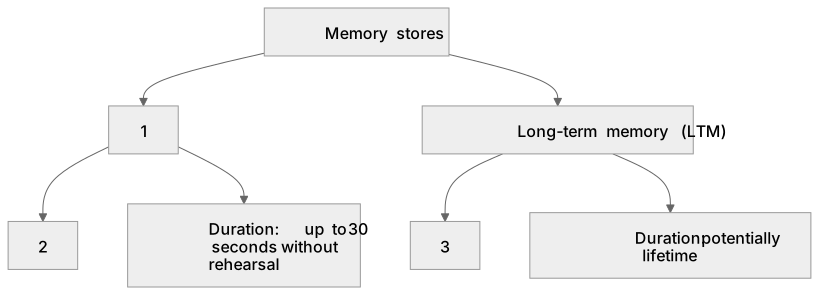
Some boxes have lost their names. Pick the right name for each number.
1Box 1
2Box 2
3Box 3
There is more to this lesson
The full lesson goes on to check your understanding and help you earn the marks. Create a free account to carry on, with your progress saved.
A week of Premium from your first lesson · Then the free plan continues · No card, no charge
Test your understanding of Memory: 2.1.2 Understand the features of short-term and long-term memory, including: a. duration b. capacity
Active recall beats re-reading. Take an instant quiz now to test what you’ve learned and lock it into long-term memory.
A week of Premium from your first lesson · Then the free plan continues · No card, no charge