Pearson Edexcel · GCSE · Psychology
Course version: 1PS0 · Version from Sept 2017
Understand the active process of memory through the Theory of…
Full specification wording
Memory: 2.1.4 Understand the active process of memory through the Theory of Reconstructive Memory (Bartlett, 1932), including strengths and weaknesses of the theory: a. how schemas are formed b. how schemas influence memory
Bartlett's (1932) Theory of Reconstructive Memory states memory is an active process.
Checked against the Pearson Edexcel 1PS0 specification (opens in a new tab) on .
- Point 4 of 5
- 2 key terms
Study notes
From the checked teaching notes for this specification point.
The idea
Bartlett's (1932) Theory of Reconstructive Memory states memory is an active process. We store fragments of information and reconstruct them during recall, altering details to fit expectations. This is driven by schemas: mental frameworks formed through personal experiences and culture. Schemas influence memory by causing us to omit unfamiliar details or change elements to make sense of them. For example, recalling a story about a canoe might be changed to a boat to fit a cultural schema. A strength is its real-world application to eyewitness testimony, highlighting memory unreliability. A weakness is that Bartlett's original research lacked strict experimental controls, making his findings less scientifically rigorous.
What earns the marks
- Define reconstructive memory as the active process of piecing together memory fragments during recall.
- Explain that schemas are mental frameworks formed through past experiences and cultural expectations.
- Describe how schemas influence memory by causing omissions, rationalisations, or transformations of unfamiliar details.
- Identify a strength of the theory, such as its application to understanding the unreliability of eyewitness testimony.
- Identify a weakness of the theory, such as the lack of standardised procedures in Bartlett's original research.
Common mistakes and how to put them right
Believing memory works like a video camera.
Put it right by explaining that memory is an active reconstruction of events, not an exact replay.
Confusing schemas with memories themselves.
Put it right by defining schemas as the underlying frameworks that shape how memories are encoded and retrieved.
Stating that Bartlett's theory proves memory is always completely false.
Put it right by noting that while details may change, the core meaning is often retained.
Exam tips
- Use the term rationalisation when explaining how people change unfamiliar details to make sense of them based on their schemas.
- When evaluating the theory, link its strengths directly to real-world applications, such as police interviews and eyewitness testimony.
- Be prepared to apply the concept of schemas to novel scenarios provided in the exam, identifying how a person's background might alter their recall.
Try the lesson
The start of the Memory: 2.1.4 Understand the active process of memory through the Theory of Reconstructive Memory (Bartlett, 1932), including strengths and weaknesses of the theory: a. how schemas are formed b. how schemas influence memory lesson, made from checked teaching notes for this specification point.
Have a go first
According to Bartlett's Theory of Reconstructive Memory, what is the definition of a schema?
Listen
Bartlett's (1932) Theory of Reconstructive Memory states memory is an active process. We store fragments of information and reconstruct them during recall, altering details to fit expectations. This is driven by schemas: mental frameworks formed through personal experiences and culture. Schemas influence memory by causing us to omit unfamiliar details or change elements to make sense of them. For example, recalling a story about a canoe might be changed to a boat to fit a cultural schema. A strength is its real-world application to eyewitness testimony, highlighting memory unreliability. A weakness is that Bartlett's original research lacked strict experimental controls, making his findings less scientifically rigorous. A strong answer earns marks for these points. Define reconstructive memory as the active process of piecing together memory fragments during recall. Explain that schemas are mental frameworks formed through past experiences and cultural expectations. Describe how schemas influence memory by causing omissions, rationalisations, or transformations of unfamiliar details. Identify a strength of the theory, such as its application to understanding the unreliability of eyewitness testimony. A common slip: Believing memory works like a video camera. Instead, explaining that memory is an active reconstruction of events, not an exact replay. Exam tip: Use the term rationalisation when explaining how people change unfamiliar details to make sense of them based on their schemas.
See it
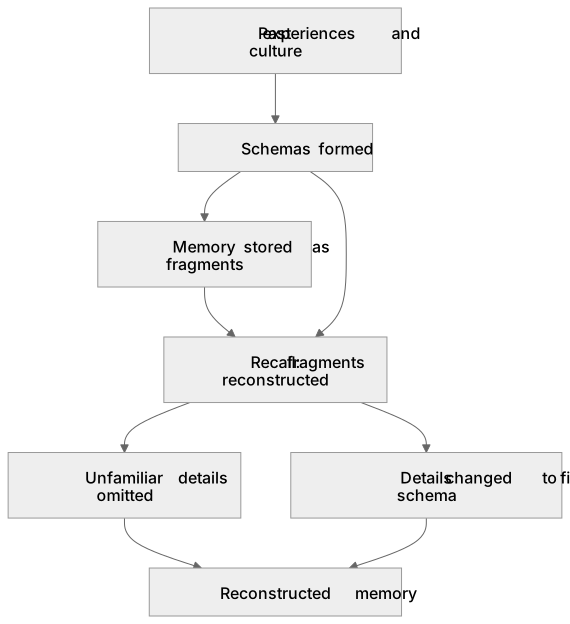
Key words
Say what each word means before you turn the card.
Reconstructive memory
Try answering aloud or in your head before turning the card.
Schemas
Try answering aloud or in your head before turning the card.
See every definition
- Reconstructive memory
- The active process in which fragments of information are stored and reconstructed during recall, altering details to fit expectations.
- Schemas
- Mental frameworks formed through personal experiences and culture.
Label the diagram
Some boxes have lost their names. Pick the right name for each number.
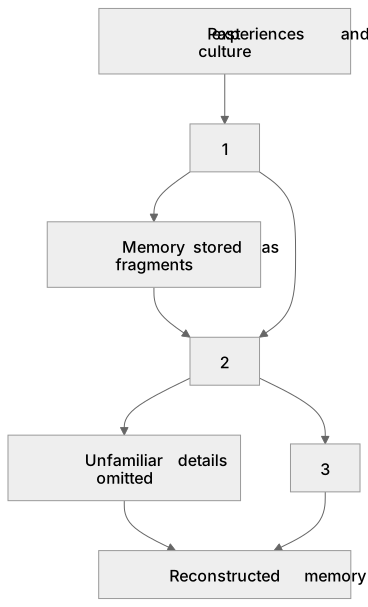
1Box 1
2Box 2
3Box 3
There is more to this lesson
The full lesson goes on to check your understanding and help you earn the marks. Create a free account to carry on, with your progress saved.
A week of Premium from your first lesson · Then the free plan continues · No card, no charge
Test your understanding of Memory: 2.1.4 Understand the active process of memory through the Theory of Reconstructive Memory (Bartlett, 1932), including strengths and weaknesses of the theory: a. how schemas are formed b. how schemas influence memory
Active recall beats re-reading. Take an instant quiz now to test what you’ve learned and lock it into long-term memory.
A week of Premium from your first lesson · Then the free plan continues · No card, no charge