Pearson Edexcel · GCSE · Psychology
Course version: 1PS0 · Version from Sept 2017
Understand examples of, and the reasons for, monocular and binocular depth…
Full specification wording
Perception: 8.1.1 Understand examples of, and the reasons for, monocular and binocular depth cues: visual cues, to include: a. superimposition b. relative size c. linear perspective d. stereopsis e. texture gradient f. height in the plane visual illusions, to include: g. fictions h. ambiguous figures i. distortions visual constancies, to include: j. shape k. colour l. size
Depth cues allow 3D perception.
Checked against the Pearson Edexcel 1PS0 specification (opens in a new tab) on .
- Point 1 of 4
- 4 key terms
Study notes
From the checked teaching notes for this specification point.
The idea
Depth cues allow 3D perception. Monocular cues need one eye: superimposition (blocking objects seem closer), relative size (smaller objects appear further), linear perspective (parallel lines converge), texture gradient (distant details blur), and height in the plane (higher objects seem further). Stereopsis is a binocular cue using retinal disparity to judge depth. Illusions trick perception: fictions create non-existent shapes, ambiguous figures offer multiple interpretations, and distortions misrepresent size or shape. Visual constancies maintain stable perception despite sensory changes: shape (an opening door stays rectangular), colour (apples stay red in shadow), and size (people walking away do not shrink).
What earns the marks
- Identify stereopsis as the only binocular depth cue in the specification, requiring two eyes.
- Define fictions as illusions where a figure is perceived even though it is not present in the stimulus.
- Explain that visual constancies allow objects to be perceived as stable despite changes in the retinal image.
- Differentiate between linear perspective (converging lines) and texture gradient (loss of detail).
Common mistakes and how to put them right
Mistaking stereopsis for a monocular cue.
Put it right: Stereopsis requires both eyes to compare slightly different images.
Confusing relative size with size constancy.
Put it right: Relative size is a depth cue judging distance based on size, whereas size constancy is perceiving an object's actual size as unchanging regardless of distance.
Believing ambiguous figures are distortions.
Put it right: Ambiguous figures have two distinct interpretations, while distortions misrepresent the physical properties of a single object.
Exam tips
- Use concrete examples, such as an opening door, to illustrate shape constancy in multiple-choice scenarios.
- Memorise the specific categories of illusions (fictions, ambiguous figures, distortions) to quickly eliminate incorrect options.
- Pay attention to whether a question asks for a monocular or binocular cue, as stereopsis is the only binocular option.
Try the lesson
The start of the Perception: 8.1.1 Understand examples of, and the reasons for, monocular and binocular depth cues: visual cues, to include: a. superimposition b. relative size c. linear perspective d. stereopsis e. texture gradient f. height in the plane visual illusions, to include: g. fictions h. ambiguous figures i. distortions visual constancies, to include: j. shape k. colour l. size lesson, made from checked teaching notes for this specification point.
Have a go first
Which visual cue is being used when one object partially blocks another, making the blocked object appear further away?
Listen
Depth cues allow 3D perception. Monocular cues need one eye: superimposition (blocking objects seem closer), relative size (smaller objects appear further), linear perspective (parallel lines converge), texture gradient (distant details blur), and height in the plane (higher objects seem further). Stereopsis is a binocular cue using retinal disparity to judge depth. Illusions trick perception: fictions create non-existent shapes, ambiguous figures offer multiple interpretations, and distortions misrepresent size or shape. Visual constancies maintain stable perception despite sensory changes: shape (an opening door stays rectangular), colour (apples stay red in shadow), and size (people walking away do not shrink). A strong answer earns marks for these points. Identify stereopsis as the only binocular depth cue in the specification, requiring two eyes. Define fictions as illusions where a figure is perceived even though it is not present in the stimulus. Explain that visual constancies allow objects to be perceived as stable despite changes in the retinal image. Differentiate between linear perspective (converging lines) and texture gradient (loss of detail). A common slip: Mistaking stereopsis for a monocular cue. Instead, stereopsis requires both eyes to compare slightly different images. Exam tip: Use concrete examples, such as an opening door, to illustrate shape constancy in multiple-choice scenarios.
See it

Key words
Say what each word means before you turn the card.
Stereopsis
Try answering aloud or in your head before turning the card.
Fictions
Try answering aloud or in your head before turning the card.
Ambiguous figures
Try answering aloud or in your head before turning the card.
Visual constancies
Try answering aloud or in your head before turning the card.
See every definition
- Stereopsis
- A binocular depth cue that uses retinal disparity, requiring both eyes to compare slightly different images to judge depth.
- Fictions
- Illusions where a figure is perceived even though it is not present in the stimulus.
- Ambiguous figures
- Illusions that offer multiple interpretations, having two distinct interpretations.
- Visual constancies
- These allow objects to be perceived as stable despite changes in the retinal image.
Label the diagram
Some boxes have lost their names. Pick the right name for each number.
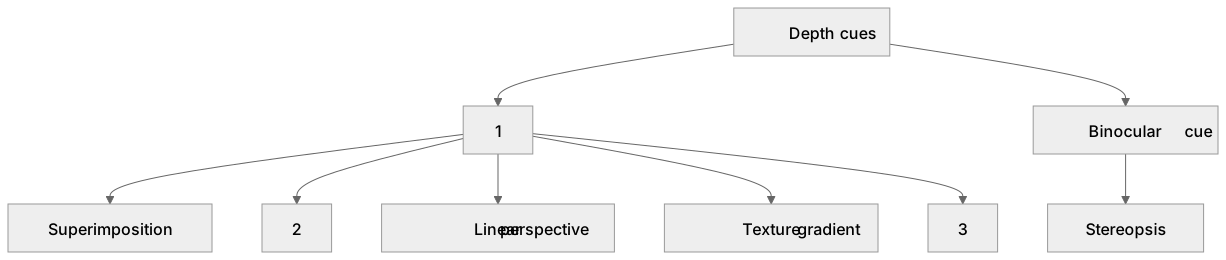
1Box 1
2Box 2
3Box 3
There is more to this lesson
The full lesson goes on to check your understanding and help you earn the marks. Create a free account to carry on, with your progress saved.
A week of Premium from your first lesson · Then the free plan continues · No card, no charge
Test your understanding of Perception: 8.1.1 Understand examples of, and the reasons for, monocular and binocular depth cues: visual cues, to include: a. superimposition b. relative size c. linear perspective d. stereopsis e. texture gradient f. height in the plane visual illusions, to include: g. fictions h. ambiguous figures i. distortions visual constancies, to include: j. shape k. colour l. size
Active recall beats re-reading. Take an instant quiz now to test what you’ve learned and lock it into long-term memory.
A week of Premium from your first lesson · Then the free plan continues · No card, no charge