Pearson Edexcel · GCSE · Psychology
Course version: 1PS0 · Version from Sept 2017
Understand the Direct Theory of Perception (Gibson, 1996) as an…
Full specification wording
Perception: 8.1.2 Understand the Direct Theory of Perception (Gibson, 1996) as an explanation of sensation and perception, including strengths and weaknesses of the theory: a. sensory input b. optic flow c. invariants d. affordances
Optic flow is the changing pattern of light as we move, helping us judge speed and direction.
Checked against the Pearson Edexcel 1PS0 specification (opens in a new tab) on .
- Point 2 of 4
- 4 key terms
Study notes
From the checked teaching notes for this specification point.
The idea
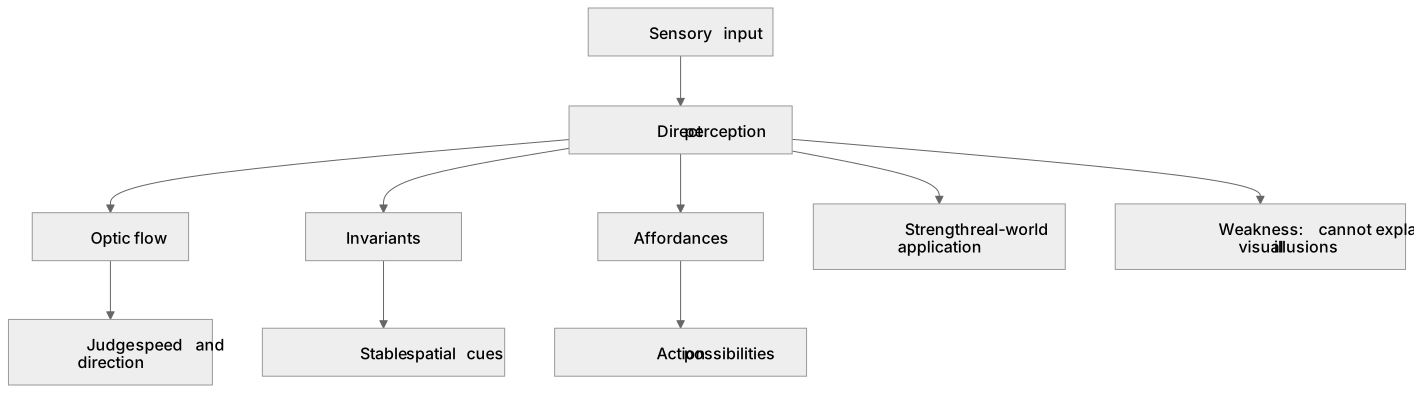
Optic flow is the changing pattern of light as we move, helping us judge speed and direction. Invariants are environmental aspects that remain constant during movement, providing stable spatial cues. Affordances are the action possibilities of an object, such as a chair 'affording' sitting. A strength is its real-world application, like designing pilot runways using optic flow. However, a major weakness is its inability to explain visual illusions, where our perception clearly differs from the direct sensory input received.
What earns the marks
- State that Gibson's Direct Theory views sensation and perception as the same process, relying entirely on sensory input.
- Describe optic flow as the visual information created by movement, which helps determine speed and direction.
- Identify invariants as aspects of the environment that remain constant as the observer moves.
- Identify affordances as the perceived uses or action possibilities of an object in the environment.
- Evaluate the theory by noting it struggles to explain why visual illusions occur.
Common mistakes and how to put them right
Confusing invariants with affordances.
Put it right: Invariants are unchanging environmental cues during movement, whereas affordances are the action possibilities an object offers.
Believing Gibson's theory relies on past experience.
Put it right: Gibson argued perception is direct and innate, requiring no prior knowledge or cognitive processing.
Stating that the theory successfully explains illusions.
Put it right: The theory's main weakness is its inability to explain visual illusions, as it claims perception is always accurate.
Exam tips
- Link optic flow directly to movement in your answers, as it only occurs when the observer is in motion.
- Use the concept of affordances to explain how animals and humans instantly know how to interact with novel environments.
- Contrast Gibson's direct theory with constructivist theories when evaluating its weaknesses regarding visual illusions.
Try the lesson
The start of the Perception: 8.1.2 Understand the Direct Theory of Perception (Gibson, 1996) as an explanation of sensation and perception, including strengths and weaknesses of the theory: a. sensory input b. optic flow c. invariants d. affordances lesson, made from checked teaching notes for this specification point.
Have a go first
According to Gibson's Direct Theory of Perception, what is meant by the term 'affordances'?
Listen
Optic flow is the changing pattern of light as we move, helping us judge speed and direction. Invariants are environmental aspects that remain constant during movement, providing stable spatial cues. Affordances are the action possibilities of an object, such as a chair 'affording' sitting. A strength is its real-world application, like designing pilot runways using optic flow. However, a major weakness is its inability to explain visual illusions, where our perception clearly differs from the direct sensory input received. A strong answer earns marks for these points. State that Gibson's Direct Theory views sensation and perception as the same process, relying entirely on sensory input. Describe optic flow as the visual information created by movement, which helps determine speed and direction. Identify invariants as aspects of the environment that remain constant as the observer moves. Identify affordances as the perceived uses or action possibilities of an object in the environment. A common slip: Confusing invariants with affordances. Instead, invariants are unchanging environmental cues during movement, whereas affordances are the action possibilities an object offers. Exam tip: Link optic flow directly to movement in your answers, as it only occurs when the observer is in motion.
See it
Key words
Say what each word means before you turn the card.
Optic flow
Try answering aloud or in your head before turning the card.
Invariants
Try answering aloud or in your head before turning the card.
Affordances
Try answering aloud or in your head before turning the card.
Sensory input
Try answering aloud or in your head before turning the card.
See every definition
- Optic flow
- The changing pattern of light as we move, helping us judge speed and direction.
- Invariants
- Environmental aspects that remain constant during movement, providing stable spatial cues.
- Affordances
- The action possibilities of an object, such as a chair 'affording' sitting.
- Sensory input
- The information from the senses on which Gibson's Direct Theory relies entirely, with sensation and perception seen as identical.
Label the diagram
Some boxes have lost their names. Pick the right name for each number.
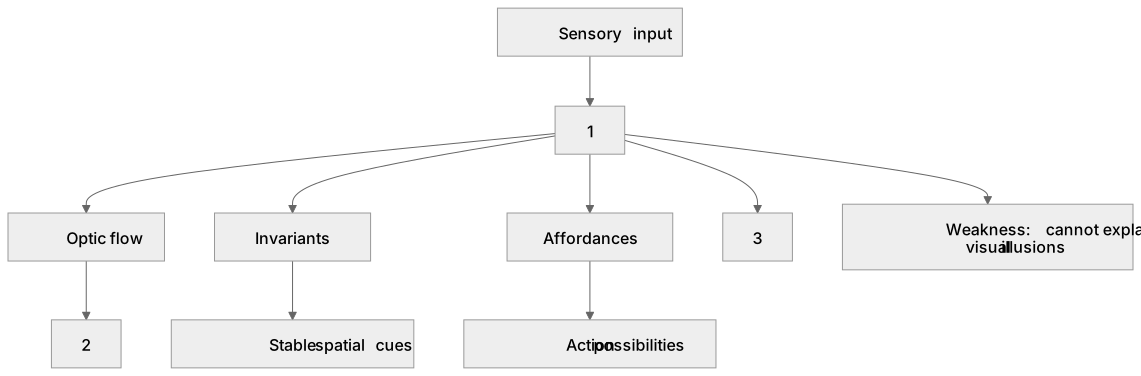
1Box 1
2Box 2
3Box 3
There is more to this lesson
The full lesson goes on to check your understanding and help you earn the marks. Create a free account to carry on, with your progress saved.
A week of Premium from your first lesson · Then the free plan continues · No card, no charge
Test your understanding of Perception: 8.1.2 Understand the Direct Theory of Perception (Gibson, 1996) as an explanation of sensation and perception, including strengths and weaknesses of the theory: a. sensory input b. optic flow c. invariants d. affordances
Active recall beats re-reading. Take an instant quiz now to test what you’ve learned and lock it into long-term memory.
A week of Premium from your first lesson · Then the free plan continues · No card, no charge