Pearson Edexcel · GCSE · Psychology
Course version: 1PS0 · Version from Sept 2017
Understand the Constructivist Theory of Perception (Gregory, 1970) as an…
Full specification wording
Perception: 8.1.3 Understand the Constructivist Theory of Perception (Gregory, 1970) as an explanation of sensation and perception, including strengths and weaknesses of the theory: a. sensory input b. perceptual hypothesis c. inferences d. prior knowledge
Gregory (1970) proposed that perception is an active, constructive process.
Checked against the Pearson Edexcel 1PS0 specification (opens in a new tab) on .
- Point 3 of 4
- 4 key terms
Study notes
From the checked teaching notes for this specification point.
The idea
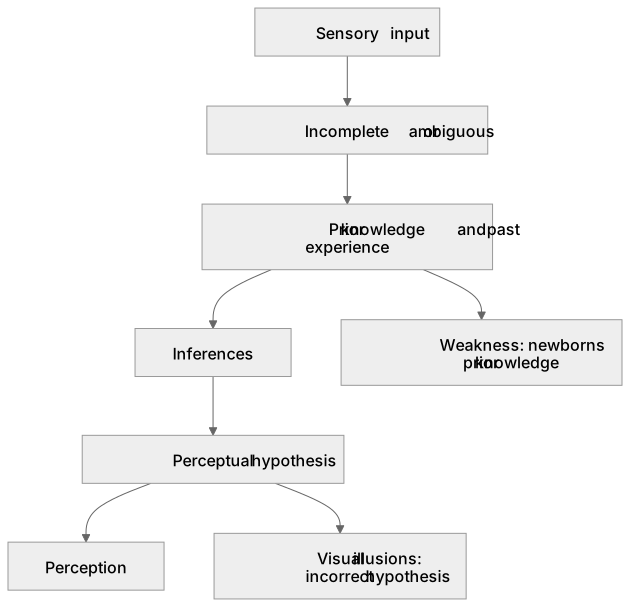
Gregory (1970) proposed that perception is an active, constructive process. Sensory input from the environment is often incomplete or ambiguous. To make sense of this, the brain uses prior knowledge and past experiences to make inferences about what is being perceived. This results in a perceptual hypothesis—a best guess about the sensory information. For example, seeing a partially obscured shape in the dark, your brain infers it is a chair based on prior knowledge. Strengths include its ability to explain visual illusions where our hypotheses are incorrect. However, a weakness is that it struggles to explain how perception occurs in newborns who lack prior knowledge, suggesting some aspects of perception must be innate rather than learned.
What earns the marks
- Identifies that sensory input is often incomplete and requires interpretation.
- Explains that the brain makes inferences based on prior knowledge and past experience.
- Defines a perceptual hypothesis as the brain's best guess about ambiguous sensory information.
- Evaluates the theory by citing its success in explaining visual illusions as incorrect hypotheses.
- Evaluates the theory by noting its failure to explain innate perceptual abilities in infants.
Common mistakes and how to put them right
Confusing sensation with perception.
Put it right: Sensation is the physical detection of stimuli, whereas perception is the brain's interpretation of it.
Assuming perceptual hypotheses are always correct.
Put it right: Visual illusions demonstrate that our brain's inferences can sometimes lead to incorrect perceptions.
Believing Gregory's theory supports innate perception.
Put it right: Gregory's constructivist theory relies on learned prior knowledge, contrasting with theories of innate perception.
Exam tips
- Use the term 'perceptual hypothesis' when describing how the brain makes a 'best guess' about ambiguous stimuli.
- Link the concept of 'inferences' directly to the use of 'prior knowledge' and past experiences.
- When evaluating, contrast Gregory's reliance on learning with evidence of innate perception in infants to provide a clear weakness.
Try the lesson
The start of the Perception: 8.1.3 Understand the Constructivist Theory of Perception (Gregory, 1970) as an explanation of sensation and perception, including strengths and weaknesses of the theory: a. sensory input b. perceptual hypothesis c. inferences d. prior knowledge lesson, made from checked teaching notes for this specification point.
Have a go first
According to Gregory's constructivist theory of perception, what is meant by a 'perceptual hypothesis'?
Listen
Gregory (1970) proposed that perception is an active, constructive process. Sensory input from the environment is often incomplete or ambiguous. To make sense of this, the brain uses prior knowledge and past experiences to make inferences about what is being perceived. This results in a perceptual hypothesis—a best guess about the sensory information. For example, seeing a partially obscured shape in the dark, your brain infers it is a chair based on prior knowledge. Strengths include its ability to explain visual illusions where our hypotheses are incorrect. However, a weakness is that it struggles to explain how perception occurs in newborns who lack prior knowledge, suggesting some aspects of perception must be innate rather than learned. A strong answer earns marks for these points. Identifies that sensory input is often incomplete and requires interpretation. Explains that the brain makes inferences based on prior knowledge and past experience. Defines a perceptual hypothesis as the brain's best guess about ambiguous sensory information. Evaluates the theory by citing its success in explaining visual illusions as incorrect hypotheses. A common slip: Confusing sensation with perception. Instead, sensation is the physical detection of stimuli, whereas perception is the brain's interpretation of it. Exam tip: Use the term 'perceptual hypothesis' when describing how the brain makes a 'best guess' about ambiguous stimuli.
See it
Key words
Say what each word means before you turn the card.
Sensation and perception
Try answering aloud or in your head before turning the card.
Perceptual hypothesis
Try answering aloud or in your head before turning the card.
Inferences
Try answering aloud or in your head before turning the card.
Prior knowledge
Try answering aloud or in your head before turning the card.
See every definition
- Sensation and perception
- Sensation is the physical detection of stimuli, whereas perception is the brain's interpretation of it.
- Perceptual hypothesis
- The brain's best guess about ambiguous sensory information.
- Inferences
- Conclusions the brain makes about what is being perceived, based on prior knowledge and past experiences.
- Prior knowledge
- Past experiences that the brain uses to make inferences about incomplete or ambiguous sensory input.
Label the diagram
Some boxes have lost their names. Pick the right name for each number.
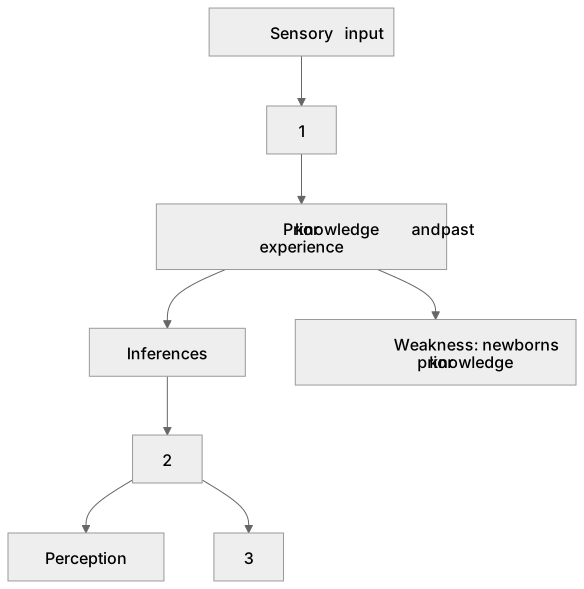
1Box 1
2Box 2
3Box 3
There is more to this lesson
The full lesson goes on to check your understanding and help you earn the marks. Create a free account to carry on, with your progress saved.
A week of Premium from your first lesson · Then the free plan continues · No card, no charge
Test your understanding of Perception: 8.1.3 Understand the Constructivist Theory of Perception (Gregory, 1970) as an explanation of sensation and perception, including strengths and weaknesses of the theory: a. sensory input b. perceptual hypothesis c. inferences d. prior knowledge
Active recall beats re-reading. Take an instant quiz now to test what you’ve learned and lock it into long-term memory.
A week of Premium from your first lesson · Then the free plan continues · No card, no charge